Arizona Flood Rescue: Two Rescued from Waist-Deep Water
WATCH: On-scene video documentation is embedded below →
LISTEN TO THIS ARTICLE
Audio Narration • English (US)
A quiet Sunday in Cornville, Arizona, turned into a race against rising water when a sudden deluge left a man and woman stranded inside their home. With muddy floodwater swallowing the porch and creeping toward the windows, the only way out was straight through the current – and the only help was already wading toward them.
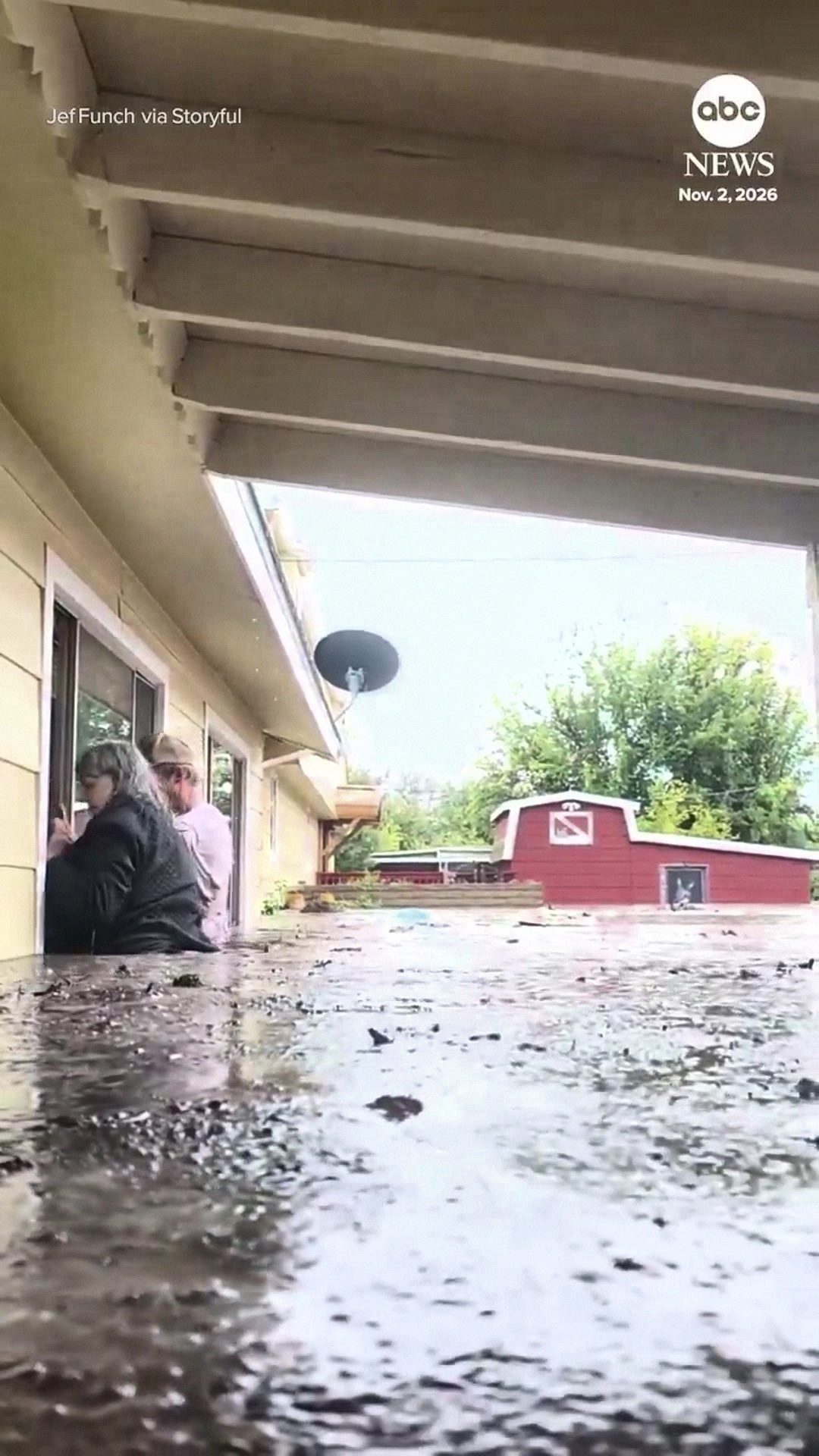
- Roughly five inches of rain fell across the area, sending sheets of runoff into low-lying neighborhoods and turning yards into slow-moving ponds.
- A man and a woman inside a single-story home found themselves surrounded by waist-deep water, their exit blocked by the rising flood.
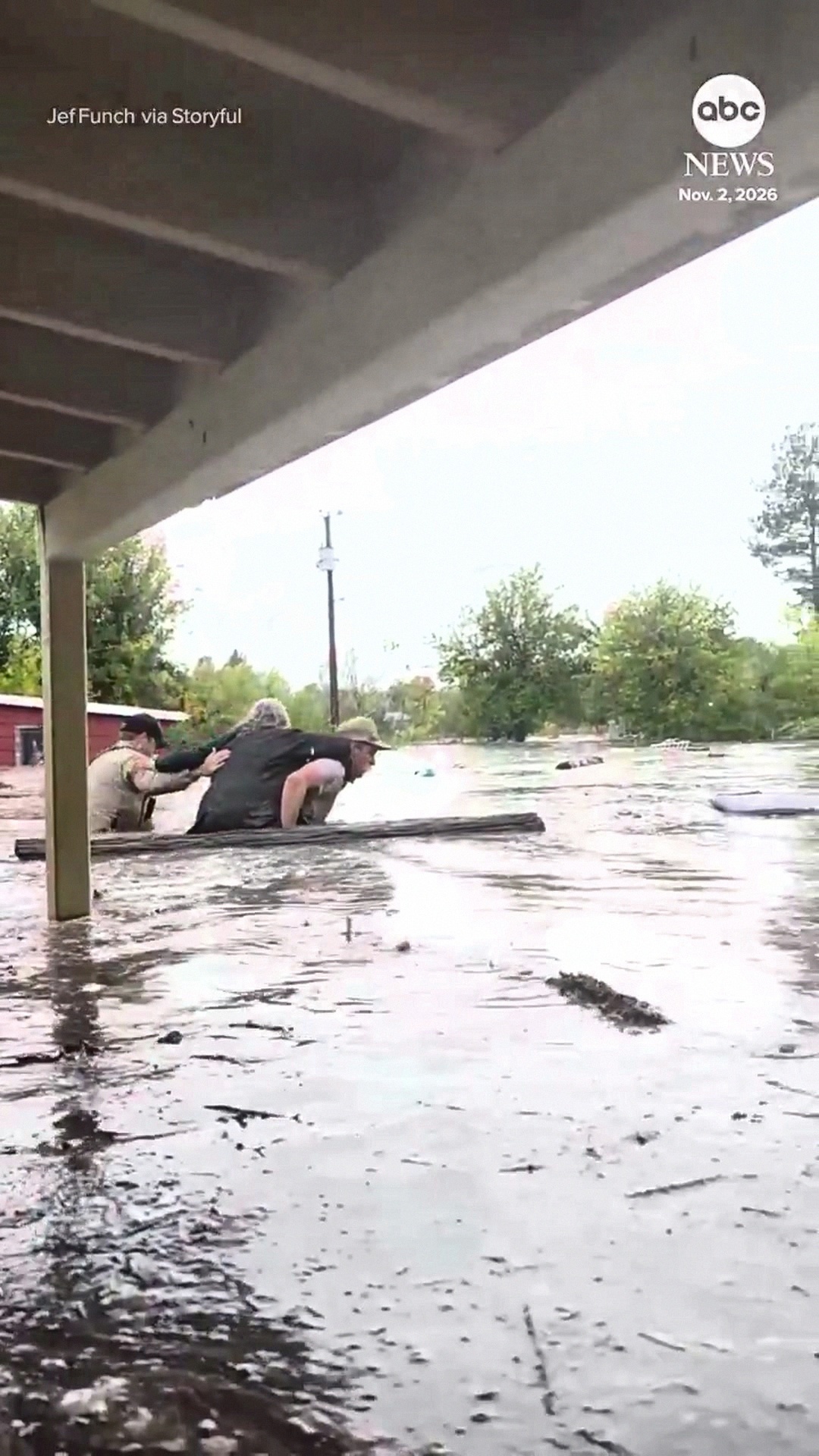
- Neighbors and rescuers waded across the submerged porch, using calm, steady direction to coax the pair out of the structure.
- The pair were brought to safety through the water, with the entire extraction captured on camera by a bystander near the roofline.
What the Recorded Footage Captures: Chronological Breakdown
The video opens at a low, almost water-level vantage point beneath a broad porch overhang, where the camera sits just inches above the murky surface. Rainwater has already claimed the entire walkway, and the reflection of the red barn across the yard shimmers in the ripples. A woman stands pressed against the siding near a window, her shoulders hunched, while a man beside her gestures toward the flooded yard. The sky above the roofline is a flat, washed-out gray, and the only sounds are the soft slap of water against the house and the murmur of voices off-screen.
Within moments, a rescuer in a soaked t-shirt appears at the edge of the frame, wading chest-first through the current. The audio captures the first exchange: "Oh my god. You need help? Yes!" The urgency in that answer is immediate – no debate, no hesitation. The rescuer moves closer, and another voice cuts in, warning that the water could be deeper and colder than it looks. The man in the doorway waves them forward anyway, and the camera tilts slightly as the operator adjusts to keep both figures in view.
Then comes the moment that shifts the tone from panic to cooperation. A rescuer offers a simple, almost gentle question – whether the woman is stuck – and she answers quietly that she is fine. A voice on the porch suggests a piggyback ride, and the man in the water turns to check the window. The camera records a brief, human pause: "Shut the window," someone says, and a hand reaches up to pull the glass closed before the evacuation begins. The water continues to lap at the porch posts as the group forms a careful line, moving with the slow, deliberate caution of people who understand the ground beneath them is no longer solid.
The footage then cuts to a wider angle where the two residents are guided away from the home, the rescuer's arms braced to keep them steady. The last audible exchange is practical and calm: "We thought you were in the other house. Let's do it this way. There's less time in the water." The camera lingers on the empty porch, the water still rising, before the scene fades.
Critical Blind Spots: What the Lens Leaves Unresolved
What the camera cannot show is the hour before the rescue – the moment the water first breached the threshold, the sound of it moving through the house, and the decision-making that led the pair to stay put rather than attempt an early exit. There is no footage of the property's storm drains, the slope of the surrounding terrain, or the drainage channels that may have funneled runoff directly toward the home.
The lens also leaves the neighbors' side of the story unresolved. Who called for help, and how long did the group wait before entering the water? The rescuers appear already soaked and prepared, suggesting they had been working the neighborhood for some time before this particular extraction. Off-camera, other homes may have been facing similar conditions, and the visible rescue could be one thread in a much larger local response.
Finally, the aftermath is almost entirely absent. The footage ends at the porch, but the questions of where the pair went next, whether the home sustained structural damage, and how long the water took to recede remain unanswered. The camera captures the rescue, but not the recovery.
Statutory Framework and Protocol Analysis
In swift-water situations, standard procedure emphasizes reaching the stranded party from an upstream or stable anchor point, maintaining verbal contact, and moving in a controlled formation. The rescuers in this footage follow that logic almost instinctively – one leads, another steadies, and the residents are kept between them as they cross. The calm, repetitive instructions heard on the audio reflect an informal but recognizable protocol: confirm the person is mobile, check for hazards, and move deliberately rather than quickly.
The event also highlights a broader community expectation. In rural and semi-rural areas like Cornville, where homes sit close to seasonal washes and drainage paths, neighbors are often the first responders on scene. The five inches of rain that fell in a short window exceeded what the local ground could absorb, and the resulting runoff turned a routine Sunday into an emergency. The visible cooperation between residents and rescuers speaks to a preparedness culture that relies on quick, local judgment.
| Incident Parameter | Observation at the Scene |
|---|---|
| Location type | Single-story residential home with covered porch |
| Water depth | Waist-deep across the porch and yard |
| Rainfall reported | Approximately five inches in the area |
| People assisted | One man and one woman inside the home |
| Extraction method | Guided wading with neighbor assistance |
| Notable instruction | Closing the window before departure |
| Recording source | Bystander footage from beneath the porch |
Read more:
Read more: Learjet 60 Crash: 78-Second Dive Through Florida Storms →
Core Questions and Institutional Review
- How quickly did water enter the home before the rescue began, and was there an earlier window for evacuation?
- What role did local drainage and runoff patterns play in directing floodwater toward this specific residence?
- Were other nearby homes facing similar conditions, and how were they prioritized during the response?
- What long-term assessments will determine whether the structure remains habitable after the flooding receded?
The footage ends on a quiet note – a porch swallowed by brown water, a closed window, and two people safely guided away. But the image raises a question that lingers longer than the rescue itself: when the water rises faster than anyone expects, how prepared are the neighborhoods that sit closest to the runoff? Share your perspective on what communities like this should do differently.
LATEST DEVELOPING INCIDENT
An even more shocking incident just erupted hours ago that has stunned onlookers nationwide. Full investigative breakdown and on-scene evidence documented below.
BREAKING: READ NEXT SHOCKING INCIDENT – LATEST CASE ↓
Learjet 60 Crash: 78-Second Dive Through Florida Storms
The altimeter read 35,000 feet and the jet still had time. Below it, a line of thunderstorms stacked across Palm Beach County like unbroken black weather, and inside the cockpit two pilots asked for a climb and a better ride. Less than a minute and a half later, the aircraft was in a spiral the transcripts describe as an overspeed condition, and a voice on the radio was calling mayday – the last normal word of a flight that had already begun to unravel.
- The flight: a Learjet 60 departed Austin, Texas, bound for the Bahamas with nine people aboard, cruising roughly seven miles above the Florida coastline two hours into the trip.
- The weather wall: flight-tracking and weather radar placed the jet directly against a string of thunderstorms; the crew reported ice and turbulence and requested a climb to 37,000 feet.
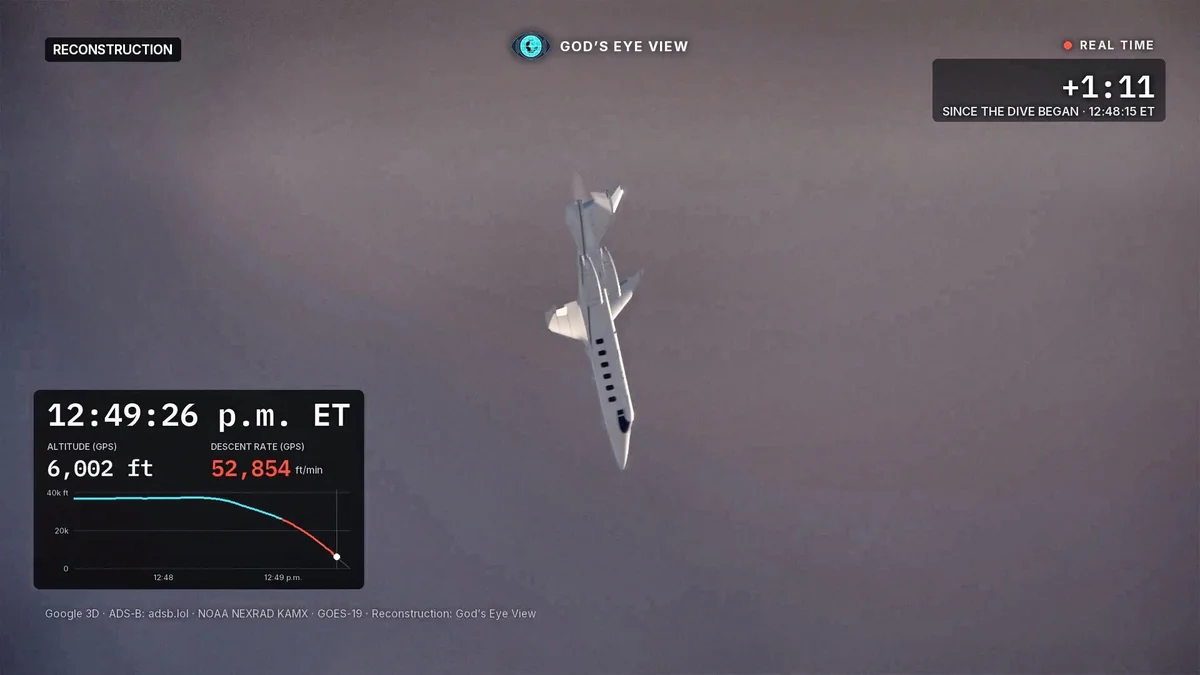
- The collapse: within a reconstructed 78 seconds the aircraft lost its stable flight path, declared an emergency, and descended at rates the cockpit itself reported as tens of thousands of feet per minute.
- The aftermath: all nine people on board died, one person on the ground was injured, and debris from the left elevator – the tail surface that controls pitch – was recovered in three pieces between 1.3 and 3.8 miles from the crash site.
What the Recorded Footage Captures: Chronological Breakdown
The reconstruction opens in an expanse of soft blue-gray, the jet rendered small and pale against a cloud deck that seems to rise out of the frame. A pale contrail trails behind it. On the left side of the screen, a dark instrument panel counts down: 33,090 feet, a descent rate of 17,341 feet per minute. The time stamp reads 12:48:40 p.m. ET. A caption across the top renders a cockpit line in clean white type: "Declare an emergency, 722 Bravo Delta. We are in an overspeed condition, descending 20,000 feet per minute." The voice behind those words carries no panic – only the flat, procedural steadiness of someone working through a checklist they never wanted to use.
Eighteen seconds later, the aircraft has sunk to 23,957 feet. The descent rate has nearly doubled to 31,139 feet per minute, and the jet's icon now sits against the bruising purple flank of a massive storm cell, its outline almost swallowed by the cloud canvas. The altitude curve on the display has bent into a steep, almost vertical line.
By 12:49:26, the numbers have collapsed to 6,002 feet and a descent rate of 52,854 feet per minute. The jet is drawn tilted on its axis, nose down, a thin white shell against a featureless void. The narration tracks a single turn – a bank of roughly 60 degrees – and a question from the ground that repeats before the answer comes. Then the reconstruction cuts away, and the viewer is left looking at something else entirely: a highway from above, a ripple of brake lights, and the words on screen confirming that all nine people aboard lost their lives.
Critical Blind Spots: What the Lens Leaves Unresolved
The reconstruction is honest about its own edges. It is a fusion of public flight tracking, radar, satellite imagery, and bystander footage – a composite stitched into a single timeline – which means every frame is an interpretation, not a witness. The instrument readouts are derived from broadcast data with its own sampling gaps, and the cloud field is a projection of radar returns rather than a photograph of the sky that day. What the jet actually saw through its windshield in those final seconds remains, necessarily, outside the frame.
The audio is the more complicated blind spot. The cockpit recordings capture a crew fighting for control, but they cannot capture the physical forces acting on the airframe – the ice accretion on wings and tail, the buffet, the control inputs that may or may not have been available. A widely shared comment on the footage noted that Learjet 60 documentation warns of extreme icing conditions, particularly around the tail section, and that a hard climb out of a storm and into precipitation was, in that commenter's words, "an overall bad situation." That is speculation from the public, not a finding.
The most striking gap is human. Within hours of the replay's release, viewers began arguing about the crew – one post lamented that a young pilot had drawn "a lot of hate" online, while another, from journalist Kim Zetter, described the cockpit voice as showing "remarkable presence of mind and training to convey the info she conveyed while knowing their fate." None of these observers were in the aircraft. The reconstruction invites exactly this kind of projection, and the lens offers no corrective.
Statutory Framework and Protocol Analysis
What the record does show is a crew operating inside a well-worn protocol. When the ride deteriorated, they asked for altitude. When the situation crossed a threshold, they declared an emergency and gave the ground their descent rate – a deliberate act of information-sharing that gives controllers the data they need to clear airspace and prepare for the worst. The controller's replies in the replay are equally procedural: roger, climb and maintain, let me know what you need. Even the phrase "I'm here with you" lands as a piece of standard radio comfort, not a flourish.
| Incident Parameter | Recorded On-Scene Evidence |
|---|---|
| Altitude at onset | Approximately 35,000 feet, roughly seven miles above Palm Beach County |
| Duration of the event | About 78 seconds from cruise altitude to impact |
| Reported descent rate | Cockpit radio call cited 20,000 feet per minute; reconstruction display reached 52,854 feet per minute |
| Reported attitude | A bank of approximately 60 degrees noted on the radio |
| Weather context | Flight path intersected a line of thunderstorms; crew reported ice and turbulence |
| Casualties | All nine aboard died; one person on the ground was injured |
| Debris field | Left elevator recovered in three pieces, 1.3 to 3.8 miles from the crash site |
The reconstruction's value is forensic rather than sensational. It converts a scatter of public data – ADS-B pings, radar sweeps, a bystander's phone footage, a drone rising over the highway – into a single legible sequence, and in doing so it lets ordinary viewers see how fast a stabilized flight can become an emergency. That is also its danger: a clean animation can feel like a verdict long before one exists.
Core Questions and Institutional Review
- What did the weather radar actually show at the aircraft's exact position in the ninety seconds before the mayday, and did the crew have that picture in the cockpit?
- Did the left elevator fail as a cause of the dive, or was it torn away by forces the aircraft could no longer withstand?
- Were icing conditions at altitude consistent with the airframe's certified limits, and was that certification adequate for the storm cell the jet entered?
- What does the full cockpit voice recording contain beyond the excerpts in the replay, and how will investigators weigh crew decision-making against mechanical failure?
Families of the nine people on board are left with a reconstruction that has been watched hundreds of thousands of times, and with a set of questions that only the final report can answer. The jet is rendered in pale gray against a purple sky, still descending, still transmitting. The voice on the radio keeps giving numbers. What remains is the gap between how calm a person can sound and how little time is actually left.
What would you want the record to show, if the last minute of your own flight were replayed frame by frame?