Learjet 60 Crash: 78-Second Dive Through Florida Storms
WATCH: On-scene video documentation is embedded below →
LISTEN TO THIS ARTICLE
Audio Narration • English (US)
The altimeter read 35,000 feet and the jet still had time. Below it, a line of thunderstorms stacked across Palm Beach County like unbroken black weather, and inside the cockpit two pilots asked for a climb and a better ride. Less than a minute and a half later, the aircraft was in a spiral the transcripts describe as an overspeed condition, and a voice on the radio was calling mayday – the last normal word of a flight that had already begun to unravel.
- The flight: a Learjet 60 departed Austin, Texas, bound for the Bahamas with nine people aboard, cruising roughly seven miles above the Florida coastline two hours into the trip.
- The weather wall: flight-tracking and weather radar placed the jet directly against a string of thunderstorms; the crew reported ice and turbulence and requested a climb to 37,000 feet.
- The collapse: within a reconstructed 78 seconds the aircraft lost its stable flight path, declared an emergency, and descended at rates the cockpit itself reported as tens of thousands of feet per minute.
- The aftermath: all nine people on board died, one person on the ground was injured, and debris from the left elevator – the tail surface that controls pitch – was recovered in three pieces between 1.3 and 3.8 miles from the crash site.
What the Recorded Footage Captures: Chronological Breakdown
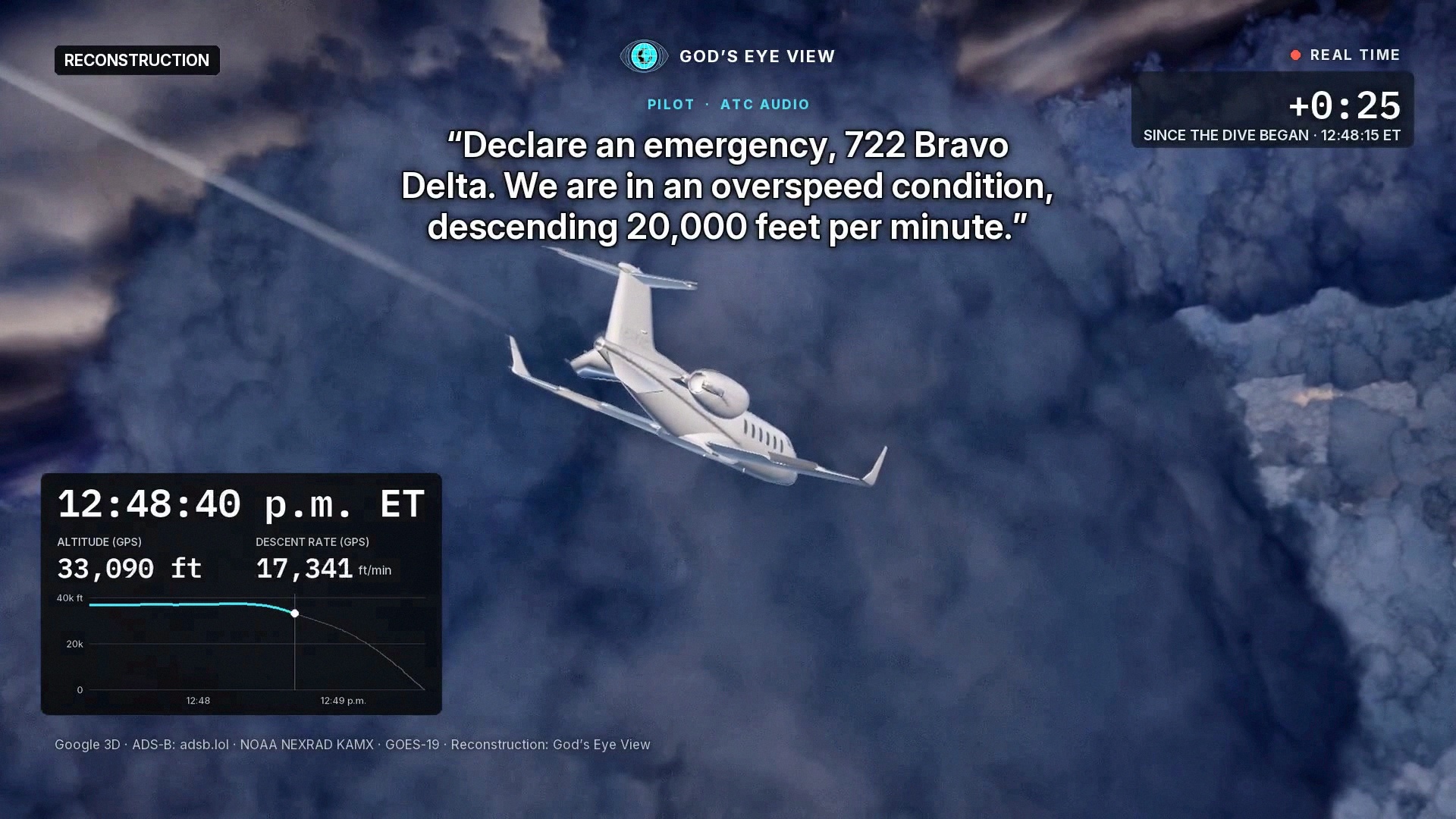
The reconstruction opens in an expanse of soft blue-gray, the jet rendered small and pale against a cloud deck that seems to rise out of the frame. A pale contrail trails behind it. On the left side of the screen, a dark instrument panel counts down: 33,090 feet, a descent rate of 17,341 feet per minute. The time stamp reads 12:48:40 p.m. ET. A caption across the top renders a cockpit line in clean white type: "Declare an emergency, 722 Bravo Delta. We are in an overspeed condition, descending 20,000 feet per minute." The voice behind those words carries no panic – only the flat, procedural steadiness of someone working through a checklist they never wanted to use.
Eighteen seconds later, the aircraft has sunk to 23,957 feet. The descent rate has nearly doubled to 31,139 feet per minute, and the jet's icon now sits against the bruising purple flank of a massive storm cell, its outline almost swallowed by the cloud canvas. The altitude curve on the display has bent into a steep, almost vertical line.
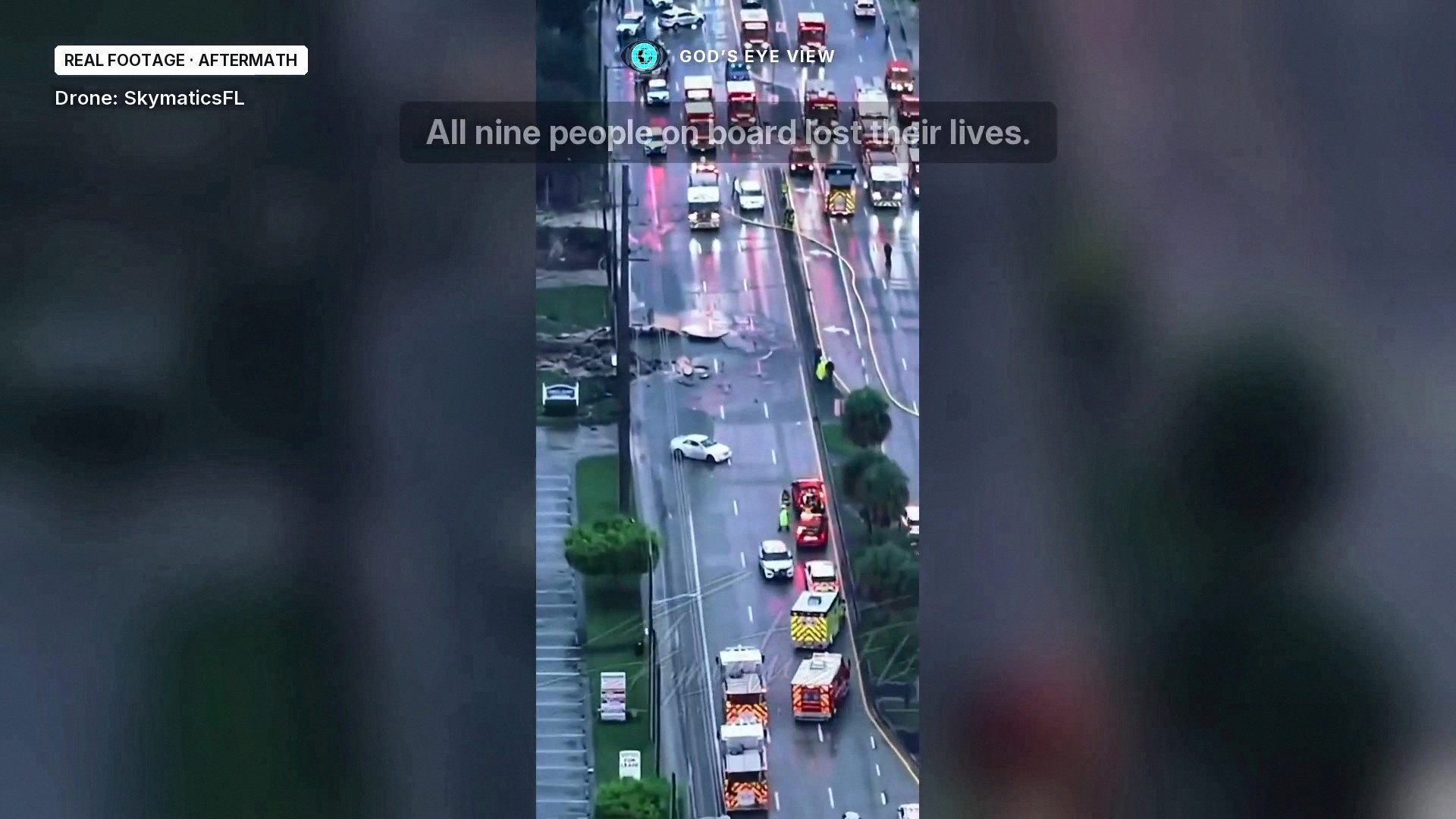
By 12:49:26, the numbers have collapsed to 6,002 feet and a descent rate of 52,854 feet per minute. The jet is drawn tilted on its axis, nose down, a thin white shell against a featureless void. The narration tracks a single turn – a bank of roughly 60 degrees – and a question from the ground that repeats before the answer comes. Then the reconstruction cuts away, and the viewer is left looking at something else entirely: a highway from above, a ripple of brake lights, and the words on screen confirming that all nine people aboard lost their lives.
Critical Blind Spots: What the Lens Leaves Unresolved
The reconstruction is honest about its own edges. It is a fusion of public flight tracking, radar, satellite imagery, and bystander footage – a composite stitched into a single timeline – which means every frame is an interpretation, not a witness. The instrument readouts are derived from broadcast data with its own sampling gaps, and the cloud field is a projection of radar returns rather than a photograph of the sky that day. What the jet actually saw through its windshield in those final seconds remains, necessarily, outside the frame.
The audio is the more complicated blind spot. The cockpit recordings capture a crew fighting for control, but they cannot capture the physical forces acting on the airframe – the ice accretion on wings and tail, the buffet, the control inputs that may or may not have been available. A widely shared comment on the footage noted that Learjet 60 documentation warns of extreme icing conditions, particularly around the tail section, and that a hard climb out of a storm and into precipitation was, in that commenter's words, "an overall bad situation." That is speculation from the public, not a finding.
The most striking gap is human. Within hours of the replay's release, viewers began arguing about the crew – one post lamented that a young pilot had drawn "a lot of hate" online, while another, from journalist Kim Zetter, described the cockpit voice as showing "remarkable presence of mind and training to convey the info she conveyed while knowing their fate." None of these observers were in the aircraft. The reconstruction invites exactly this kind of projection, and the lens offers no corrective.
Statutory Framework and Protocol Analysis
What the record does show is a crew operating inside a well-worn protocol. When the ride deteriorated, they asked for altitude. When the situation crossed a threshold, they declared an emergency and gave the ground their descent rate – a deliberate act of information-sharing that gives controllers the data they need to clear airspace and prepare for the worst. The controller's replies in the replay are equally procedural: roger, climb and maintain, let me know what you need. Even the phrase "I'm here with you" lands as a piece of standard radio comfort, not a flourish.
| Incident Parameter | Recorded On-Scene Evidence |
|---|---|
| Altitude at onset | Approximately 35,000 feet, roughly seven miles above Palm Beach County |
| Duration of the event | About 78 seconds from cruise altitude to impact |
| Reported descent rate | Cockpit radio call cited 20,000 feet per minute; reconstruction display reached 52,854 feet per minute |
| Reported attitude | A bank of approximately 60 degrees noted on the radio |
| Weather context | Flight path intersected a line of thunderstorms; crew reported ice and turbulence |
| Casualties | All nine aboard died; one person on the ground was injured |
| Debris field | Left elevator recovered in three pieces, 1.3 to 3.8 miles from the crash site |
Read more:
Read more: Halloween Porch Dispute Over 40 Juice Boxes Goes Viral →
The reconstruction's value is forensic rather than sensational. It converts a scatter of public data – ADS-B pings, radar sweeps, a bystander's phone footage, a drone rising over the highway – into a single legible sequence, and in doing so it lets ordinary viewers see how fast a stabilized flight can become an emergency. That is also its danger: a clean animation can feel like a verdict long before one exists.
Core Questions and Institutional Review
- What did the weather radar actually show at the aircraft's exact position in the ninety seconds before the mayday, and did the crew have that picture in the cockpit?
- Did the left elevator fail as a cause of the dive, or was it torn away by forces the aircraft could no longer withstand?
- Were icing conditions at altitude consistent with the airframe's certified limits, and was that certification adequate for the storm cell the jet entered?
- What does the full cockpit voice recording contain beyond the excerpts in the replay, and how will investigators weigh crew decision-making against mechanical failure?
Families of the nine people on board are left with a reconstruction that has been watched hundreds of thousands of times, and with a set of questions that only the final report can answer. The jet is rendered in pale gray against a purple sky, still descending, still transmitting. The voice on the radio keeps giving numbers. What remains is the gap between how calm a person can sound and how little time is actually left.
What would you want the record to show, if the last minute of your own flight were replayed frame by frame?
LATEST DEVELOPING INCIDENT
An even more shocking incident just erupted hours ago that has stunned onlookers nationwide. Full investigative breakdown and on-scene evidence documented below.
BREAKING: READ NEXT SHOCKING INCIDENT – LATEST CASE ↓
Stadium Ejection Escalates Into Chaotic Public Scuffle
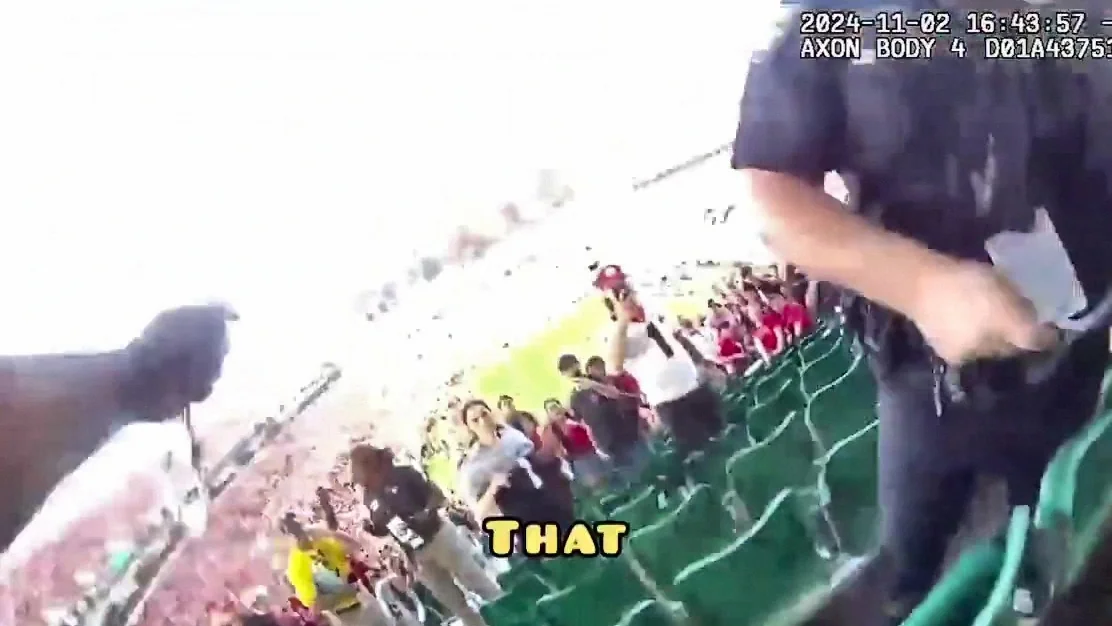
What began as a routine ejection inside a packed college football stadium turned into a tense, chaotic confrontation as a man refused to leave his seat, accused a woman of assault, and forced a swarm of security personnel to physically remove him. Captured on a body-worn camera, the encounter unfolds in a cramped section of green folding seats, where the man's defiance and the crowd's mounting anxiety collide.
- The setting: A crowded stadium section on the afternoon of November 2, 2024, where event staff and law enforcement converged to handle a disruption in the middle of a major rivalry game.
- The friction: A man already facing ejection refused to comply, insisting that a woman nearby had assaulted him and that he had video evidence to prove it.
- The intervention: Multiple officers and safety personnel surrounded the man, repeatedly ordering him to stand up and leave, while he argued and stalled.
- The aftermath: The encounter turned physical, with a visible scuffle as personnel worked to secure the man, sparking shouting among bystanders and warnings about jobs being lost.
What the Recorded Footage Captures: Chronological Breakdown
The body-camera clip opens with a shaky, sun-drenched view of stadium seating, the frame flooded with white light and green seats. A voice asks the central figure pointedly, "Hey sir, you been ejected or are we all going to leave?" The response is immediate and defiant: "No, I'm not." The man then pivots to his own grievance, insisting, "This lady here, assaulted me. I have it on camera." Nearby bystanders press the issue of whose property they are on and whether they should be leaving, and the tension thickens as the man repeats that he is not going anywhere.
As the exchange wears on, the conversation turns distinctly ominous. A voice in the recording declares, "I'm either going to fatally injures a cop or not leave." The words hang in the air, and the responding voices sharpen into command: "Get up. Get up. Get up." The camera swings wildly, catching flashes of green seats, an officer's uniform, and the blurred limbs of people standing and moving. Someone says, "Put trust on. Stand up. Stand up." The scuffle is not a clean, single motion; it is a messy, anxious push-and-pull captured from the chest-level vantage of the person holding the camera.
Near the climax, the audio becomes a tangle of overlapping voices. One person insists, "I'm not leaving you," while a countdown of sorts begins: "Five. Four." Then there is a jumble of exclamations and the urgent call, "Hey, we need war units." The camera jolts and the frame fills with a wash of pale light, the microphone picking up a frantic order to "get back" repeated again and again, punctuated by the warning, "Don't lose your job. You're going to lose your job." The footage settles into an uneasy lull, with a voice cheerily offering, "Throw them pizzas out the door. Hope y'all are having fun," before the clip drifts toward its calm, almost anticlimactic close.
Critical Blind Spots: What the Lens Leaves Unresolved
The body camera offers a narrow, personal perspective – the lens belongs to someone inside the action, meaning the full geometry of the scuffle is never clear. We see flashes of the man's body and the surrounding seats, but the precise moment the encounter became physical is obscured by the camera's wild motion and the wash of sunlight. The viewer is left to infer how the man was ultimately removed from his seat.
The most consequential blind spot concerns the allegation at the heart of the dispute. The man claims a woman assaulted him and insists he has it on camera. That claimed footage is never shown in this clip. The recording also leaves unclear who the woman is, what preceded the confrontation, and whether the ejection was initially requested over that dispute or a separate disturbance. The voices in the crowd off-camera – the warnings about jobs, the call for additional units – suggest a broader scene, but the identities and roles of those bystanders remain unresolved.
Statutory Framework and Protocol Analysis
In stadium settings, standard practice calls for a graduated response: a verbal request to leave, followed by a formal ejection, and finally law enforcement involvement if compliance is refused. The body-camera footage shows this protocol being fatally harmed in real time, with a verbal request giving way to repeated commands and eventually to physical direction. The escalation is visible in the body language – the leaning posture of personnel, the man's rigid refusal to rise, and the crowding of the aisle as onlookers shifted to watch.
The table below summarizes what the visible and audible evidence actually establishes.
| Incident Parameter | Observation at the Scene |
|---|---|
| Ejection request | A guest was asked to leave the seating section |
| Subject's response | The man refused to comply and remained seated |
| Claim of prior assault | The man accused a woman of assaulting him and cited video evidence |
| Verbal escalation | A voice made an extreme threat against law enforcement |
| Physical intervention | Personnel repeatedly ordered the man to stand and get up |
| Bystander reaction | Voices warned personnel about losing their jobs |
| Resolution | The camera becomes obscured amid a chaotic scuffle |
Community expectations around these events are shaped by the atmosphere of a large rivalry game: emotions run high, crowds are dense, and staff work to resolve disputes quickly to protect everyone nearby. The footage shows that the interplay between crowd pressure and official procedure can turn a simple ejection into a flashpoint within seconds, with the aisle itself becoming a stage for the confrontation.
Core Questions and Institutional Review
- What exactly triggered the initial ejection request, and did the alleged assault claim precede or follow it?
- Does the man's claimed video evidence exist, and what does it actually show?
- At what precise moment did the encounter become physical, and was the force used proportionate to the refusal to comply?
- What did the shouted warnings about losing a job refer to, and who was issuing them?
The scene closes with a strangely casual remark about pizzas and having fun, a jarring shift in tone after the chaos of the scuffle. That contrast – between the tense, shoving violence of the crowd and the lighthearted chatter moments later – underscores how quickly stadium events can swing from ordinary to volatile. What remains unclear is whether the man's account of being assaulted ever received a formal hearing, or whether the aisle scuffle simply became the final word.
Practical Takeaways
- Body-worn footage is powerful but narrow; the full context of a public dispute usually lies outside the frame.
- When a guest refuses an official ejection, minor friction can escalate into a physical confrontation in seconds.
- In crowded venues, bystander noise and pressure can complicate official procedures and prolong resolution.
- Claims of prior assault should be documented and reviewed separately from the compliance question.
What should a venue do when a guest accused of wrongdoing insists they are the victim and refuses to leave – and who should bear responsibility if the confrontation turns physical? Share your perspective below.