Shirtless Man Squares Up With Chicago Firefighter On Camera
WATCH: On-scene video documentation is embedded below →
LISTEN TO THIS ARTICLE
Audio Narration • English (US)
A shirtless man plants his feet on a rain-slicked Chicago street and gestures toward a firefighter twice his size, while a uniformed officer stands just yards away. What begins as a shouted challenge on open pavement collapses within seconds into a one-sided physical confrontation, leaving a crowd of bystanders frozen at the crosswalk. The question hanging over the scene is not who threw the first punch – it is why no one in uniform stepped in before the pavement did.
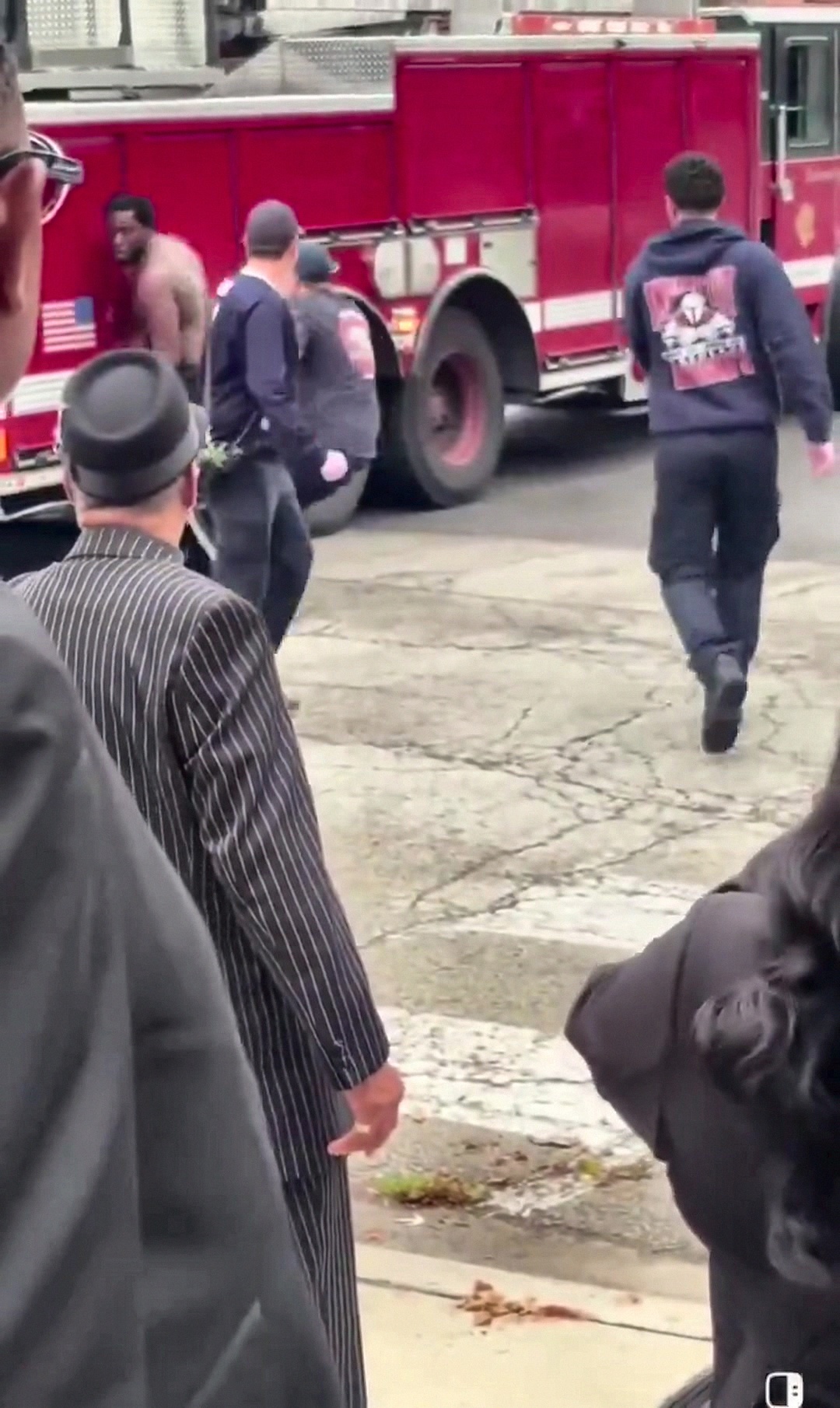
- A bare-chested man is captured on cellphone video challenging a Chicago firefighter near a red fire engine parked at the curb.
- A uniformed officer stands a short distance away during the verbal exchange, visible in the same frame but not immediately intervening.
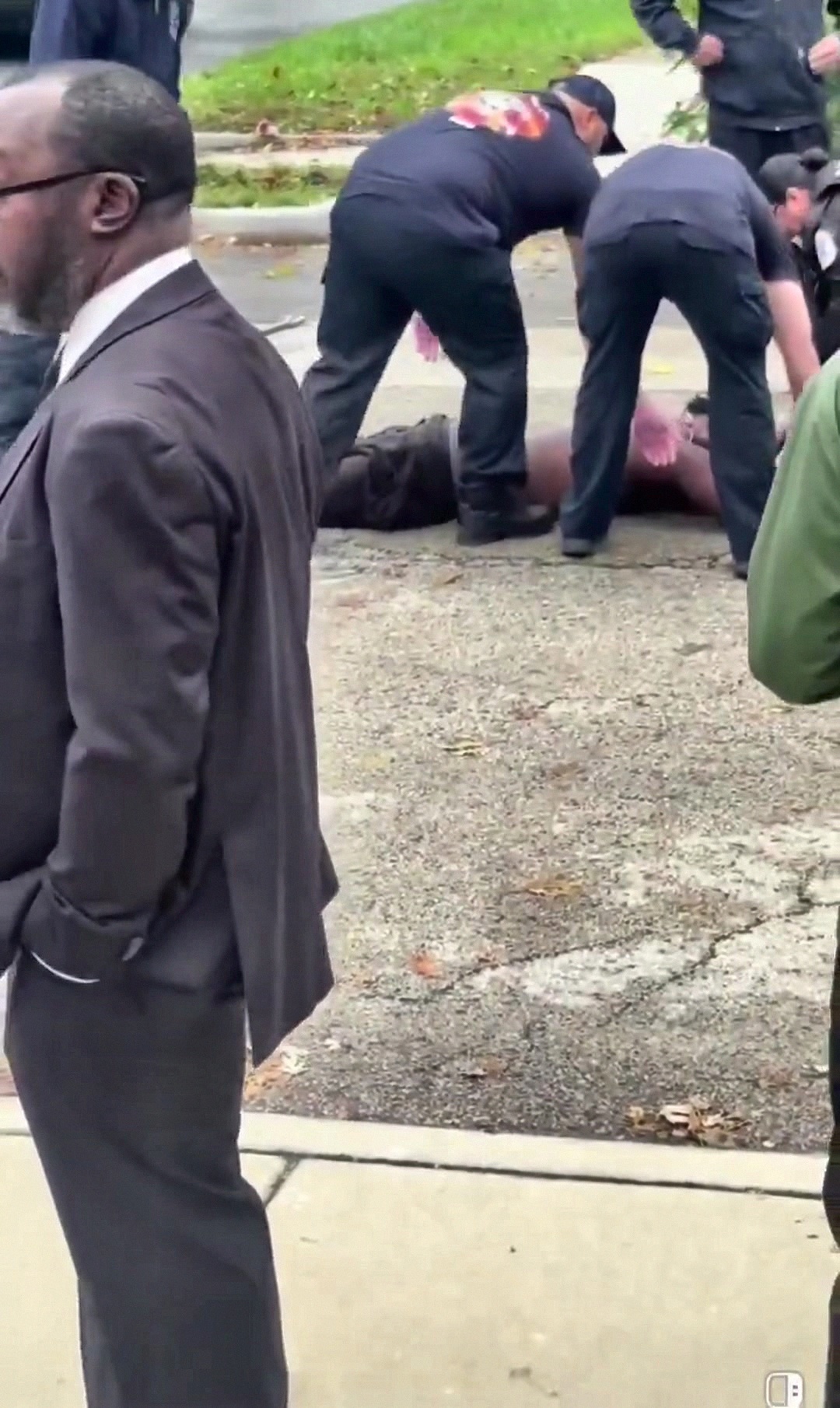
- The confrontation turns physical, and the challenger is dropped to the asphalt in a matter of moments.
- Multiple first responders converge to restrain and tend to the man on the ground while onlookers watch from the sidewalk.
What the Recorded Footage Captures: Chronological Breakdown
The clip opens wide, framing a stretch of cracked, wet pavement where a red fire engine sits angled against the curb and a white emergency vehicle idles across the street. Traffic lights hang green and red overhead, and a small cluster of pedestrians has gathered near the painted crosswalk. Into that open space walks the shirtless man, his pants dark and his posture loose, arms swinging as he paces a slow arc in front of the apparatus.
A firefighter in navy uniform steps forward to meet him. The distance between them closes quickly. The man gestures, shifts his weight, and lowers his shoulders in the unmistakable geometry of someone preparing to swing – a small performance of bravado staged for an audience he clearly knows is watching. Off to the left, an officer in a dark jacket marked with white lettering stands with hands near her waist, her body angled toward the pair but her feet unmoving.
"He's going to put on a show, baby," a voice calls from behind the camera.
Then it happens. The strike, the counter, the collapse – the footage does not linger on the mechanics. What it captures instead is the sudden horizontal fact of the man on the ground, limbs splayed across the pavement, while the camera jolts and voices spike in pitch. "Oh, damn," someone says. The crowd recoils in a single collective flinch, then surges forward.
Critical Blind Spots: What the Lens Leaves Unresolved
The frame is generous with aftermath and stingy with origin. Nothing in the recording explains what sparked the confrontation: whether words were exchanged in traffic, whether the man was in distress before he approached the engine, or whether the firefighter acted in defense or escalation. The camera owner's angle favors the spectacle over the sequence, and the crucial seconds before the first movement are simply absent.
The officer's positioning is the most scrutinized gap. She appears in frame early, then disappears from the action as the two men close the distance. What the lens cannot tell us is whether her view was blocked by the engine, whether she was calling for backup, or whether she judged the firefighter capable of resolving the matter himself. Bystanders in the background – a man in a pinstriped jacket, a woman in black – turn their heads to follow, their reactions offering no consensus on what they had just witnessed.
The audio is fragmentary at best. Voices overlap: someone shouts a name, someone else says "get back," and a voice mutters "I'm going to go" as the crowd begins to disperse. Who spoke those lines, and to whom, remains entirely unclear. The recording ends before any official narrative begins.
Statutory Framework and Protocol Analysis
Departments generally train crews to withdraw from a hostile scene and request a law-enforcement escort rather than trade words with a combative pedestrian. When a physical challenge is issued in the open, the safest documented response is distance – a retreat toward the apparatus, a call over the radio, a request that the officer take the lead. The footage shows a different choice: the firefighter held his ground and answered the challenge directly.
The public response has centered less on the firefighter and more on the officer's restraint. Bystanders and online viewers alike have framed her stillness as a failure of duty, though an officer's decision to let a capable adult defend himself – or to avoid escalating a scene already volatile – is a judgment call made in seconds, not minutes. The full picture requires whatever body-worn or dash footage exists, which the public has not seen.
| Incident Parameter | Recorded On-Scene Evidence |
|---|---|
| Location | Urban Chicago street beside a parked fire engine |
| Time of day | Daylight, overcast with wet pavement |
| Primary subjects | Shirtless adult male; uniformed firefighter |
| Officer presence | Uniformed female officer visible nearby, hands low |
| Physical outcome | Male knocked to the asphalt, restrained by responders |
| Bystander response | Visible at crosswalk, audible gasps and shouted warnings |
| Recording source | Handheld cellphone video from sidewalk vantage |
Read more:
Read more: Jailhouse Confrontation: Pop Music Meets Public Dispute →
Core Questions and Institutional Review
- What verbal exchange preceded the shirtless man's approach, and was it captured on any other recording?
- Why did the uniformed officer remain at a distance during the initial confrontation, and what radio traffic accompanied her positioning?
- Did the firefighter's response fall within departmental self-defense guidance, and will the department conduct a formal review?
- Was the man on the ground injured in the fall, and what medical care followed the restraint?
The pavement is dry in places and slick in others; by the time the clip closes, the man is surrounded by navy uniforms and gloved hands, and the crowd has thinned to a few lingering silhouettes. The camera keeps rolling until the story moves out of frame. What remains is a single unanswered question: when a public challenge is thrown down in front of an audience, does the duty to protect belong to the uniform – or to the person being challenged?
Key Takeaways
- Cellphone footage captures a shirtless man initiating a confrontation with a firefighter on a Chicago street.
- A uniformed officer is visible nearby but does not immediately intervene in the exchange.
- The challenger is knocked to the ground within seconds and attended to by multiple responders.
- The recording omits the origin of the dispute, the officer's radio traffic, and any official account.
LATEST DEVELOPING INCIDENT
An even more shocking incident just erupted hours ago that has stunned onlookers nationwide. Full investigative breakdown and on-scene evidence documented below.
BREAKING: READ NEXT SHOCKING INCIDENT – LATEST CASE ↓
Lake Forest Confrontation: Minor Wounded by Less-Lethal Rounds
The air in Lake Forest, California, was already thick with the afternoon heat and the sharp, metallic scents of a tense confrontation. When a voice pierced the noise with a frantic warning about a weapon, a ripple of pure panic washed through the crowd. But as the chaos settled, an even more unsettling truth emerged: two people, a mother and her juvenile son, were left bearing visible wounds from the encounter.
- A tense public confrontation unfolds in the streets of Lake Forest, California, captured on a shaky handheld camera on November 1, 2026.
- A sudden warning about a weapon causes a momentary panic among those observing the scene, shifting the crowd's focus from the primary dispute.
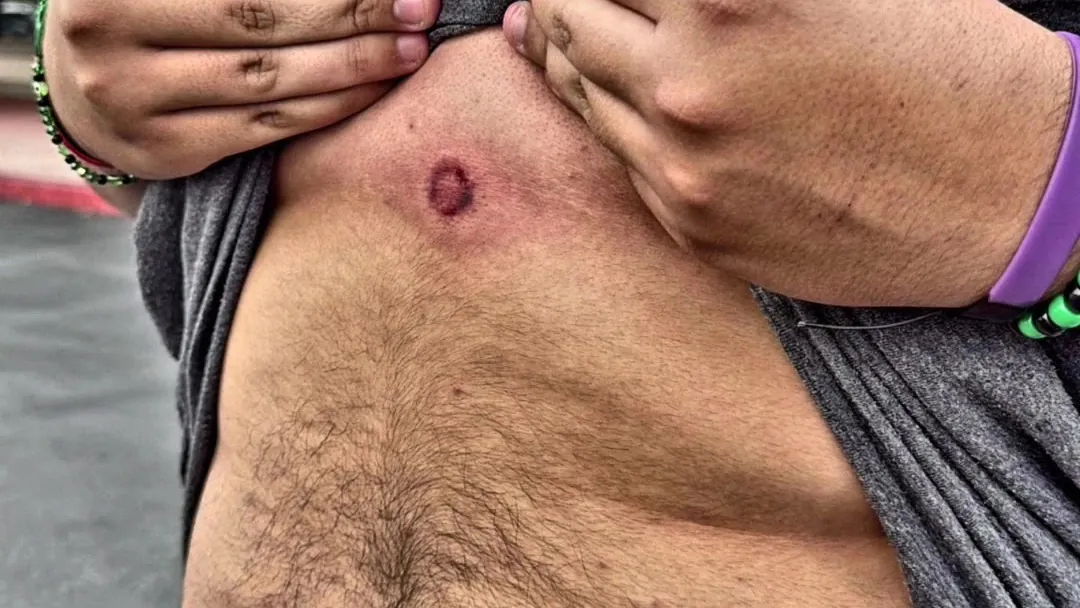
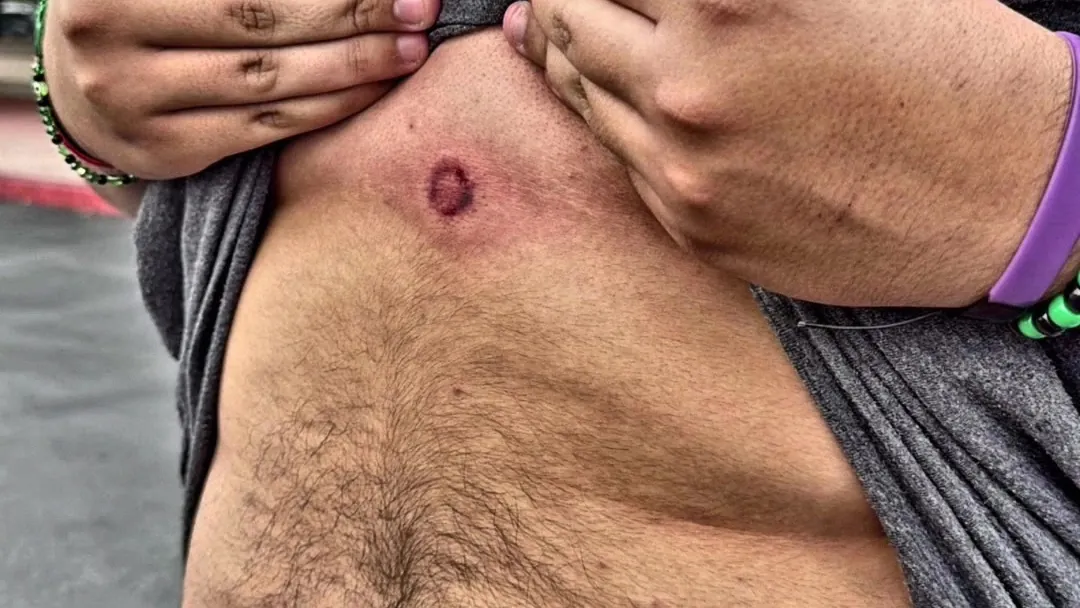
- The aftermath reveals a striking physical injury on a bystander, a circular contusion on his abdomen, which is displayed directly to the camera lens.
- A juvenile male confronts a figure clad in tactical gear, demanding answers and accountability for the injuries sustained by his mother and himself during the incident.
What the Recorded Footage Captures: Chronological Breakdown
The video opens with a close-up of a figure standing beside an open car door, clad in a beige tactical vest, a hood, and dark sunglasses. The atmosphere is tight, abrasive, and entirely chaotic. A bystander's voice cuts through the air, shouting, "Sons of individuals, he has got a weapon. Look out, he has got a weapon. Everyone get down on the floor right now." The lens shakes as people move, the immediate instinct of self-preservation overriding any curiosity to watch the confrontation.
Yet, the tension is swiftly interrupted by a clarification from the crowd. "Wait, wait, wait. Actually, look, it's just that the man hit, the man just hit the car window. He's just hitting the window, that's all." The panic fades, but the atmosphere remains volatile. The figure in the frame is seen holding a radio, his face obscured, maintaining a stoic, unreadable posture against the accusations being hurled at him by the gathering observers.
As the recording progresses, a young boy's voice becomes the focal point of the audio. He steps forward, addressing the figure directly with a series of raw, piercing questions. "How do you feel altercation a minor and my mom?" he asks, his voice carrying a mix of anger and disbelief. "How good do you feel bear-spraying my dad?" The lens then cuts to the physical evidence: a close-up of a man's torso, his hands pulling up his grey shirt to reveal a dark, ring-shaped bruise on his stomach. The skin is raised and raw, looking like a direct impact wound.
Critical Blind Spots: What the Lens Leaves Unresolved
What the camera does not show is the exact series of events that led to the injury on the man's abdomen. The footage begins in the middle of the confrontation. The viewer is told that a minor and his mother were hit, but the specific trajectory and the deployment mechanism of the less-lethal rounds remain outside the frame. The precision of the injury on the man's stomach – a distinct circular mark – suggests a direct hit from a kinetic projectile, but the distance and the intent are left to the imagination of the viewer.
Furthermore, the identity of the masked figure is never explicitly confirmed. He is dressed in tactical gear, and the word "POLICE" is visible on his vest, but the narrative around his role and the rules of engagement in this specific context are not provided. The boy's questions imply a family-wide impact, mentioning his mother and his father being bear-sprayed. Yet, the viewer is left to wonder how the family became the targets of these non-lethal measures and whether the boy's account is the full story.
The body of the video also reveals that bystanders initially believed a weapon was present. The rapid shift from a potential lethal threat to a claim of a mere car window hit paints a picture of confusion and miscommunication. The camera captures the panic but leaves the audience questioning whether the initial weapon claim was a misunderstanding or a genuine threat that forced the hands of the authorities.
Statutory Framework and Protocol Analysis
In the chaotic environment of a street protest or public confrontation, law enforcement officers are often placed in a precarious position. The use of less-lethal projectiles – often rubber or foam batons – is intended to disable a subject without causing permanent harm. However, when deployed into a group, the risk of collateral damage to bystanders, including minors, is a critical concern. The protocol demands that these tools be aimed at the lower body of a specific, identified threat, not into a crowd where a child or a non-participant could be struck.
The presence of a minor in the crossfire raises serious questions about the level of threat assessment and the duty of care. The boy’s testimony, hearing the sounds of the incident and witnessing the aftermath, underscores the psychological and physical trauma of such events. The community members were described as "just observing" before the altercation escalated, suggesting a breakdown in the separation between the public and those executing the enforcement action. The physical evidence of the bruise on the man's stomach is tangible proof that the kinetic munitions struck an individual at close range.
| Incident Parameter | Recorded On-Scene Evidence |
|---|---|
| Location | Lake Forest, California, on November 1, 2026 |
| Primary Action | Crowd dispersed after warnings of a weapon |
| Kinetic Injury | Visible circular contusion on an adult male's abdomen |
| Minor Involvement | Verbal testimony of a minor claiming he and his mother were shot |
| Chemical Agent | Mention of bear spray used against the boy's father |
| Key Equipment | Tactical vest, radio, and less-lethal rounds by the masked figure |
| Post-Event Behavior | The boy directly questions the figure's morality and accountability |
Core Questions and Institutional Review
- What was the exact sequence of events that led to the deployment of less-lethal rounds against civilians in the Lake Forest incident?
- How does the documented incident account reconcile the claim of a weapon threat with the subsequent observation that the man had only struck a car window?
- What specific threat assessment was conducted that resulted in a minor being struck by the less-lethal munitions during the encounter?
- Were the protocols for crowd control and the use of kinetic impact projectiles followed, and what is the status of the review regarding the injury to the young boy and his parents?
As the video fades, the viewer is left with the image of the bruise and the echo of a child's voice asking a simple, devastating question. The physical mark on the man's body will heal with time, but the community's demand for accountability remains a deep, unresolved scar on the pavement. Did the chaos of the moment justify the impact on an entire family, or was this a preventable escalation of force gone terribly wrong?
Practical Takeaways
- Know Your Rights: Understand that video evidence is crucial in documenting any public interaction, especially when physical force is used. Keep a camera rolling.
- De-escalation is Key: In high-tension public confrontations, the loudest voices often overshadow the truth. Pay close attention to the human details, like the status of bystanders and family members.
- Physical Evidence Matters: Contusions and injuries are key pieces of evidence. Documenting them immediately with clear, well-lit photographs helps establish the timeline and severity of the incident.
- Follow Protocol: The use of less-lethal force requires strict adherence to safety protocols, and any injury to a minor raises urgent questions that demand a formal, transparent investigation.