Sidewalk Confrontation Caught on Camera in Vancouver, WA
WATCH: On-scene video documentation is embedded below →
LISTEN TO THIS ARTICLE
Audio Narration • English (US)
The camera shakes slightly as the man in the red cap steps backward onto a rain-slicked curb, his free hand raised. A blue banner sags across the crosswalk behind him, its white letters catching the gray November light. What began as a lone flag-bearer’s afternoon has collapsed into a single, tight loop of confrontation – one man broadcasting, another man pressing close, and a backdrop of traffic that never stops moving.
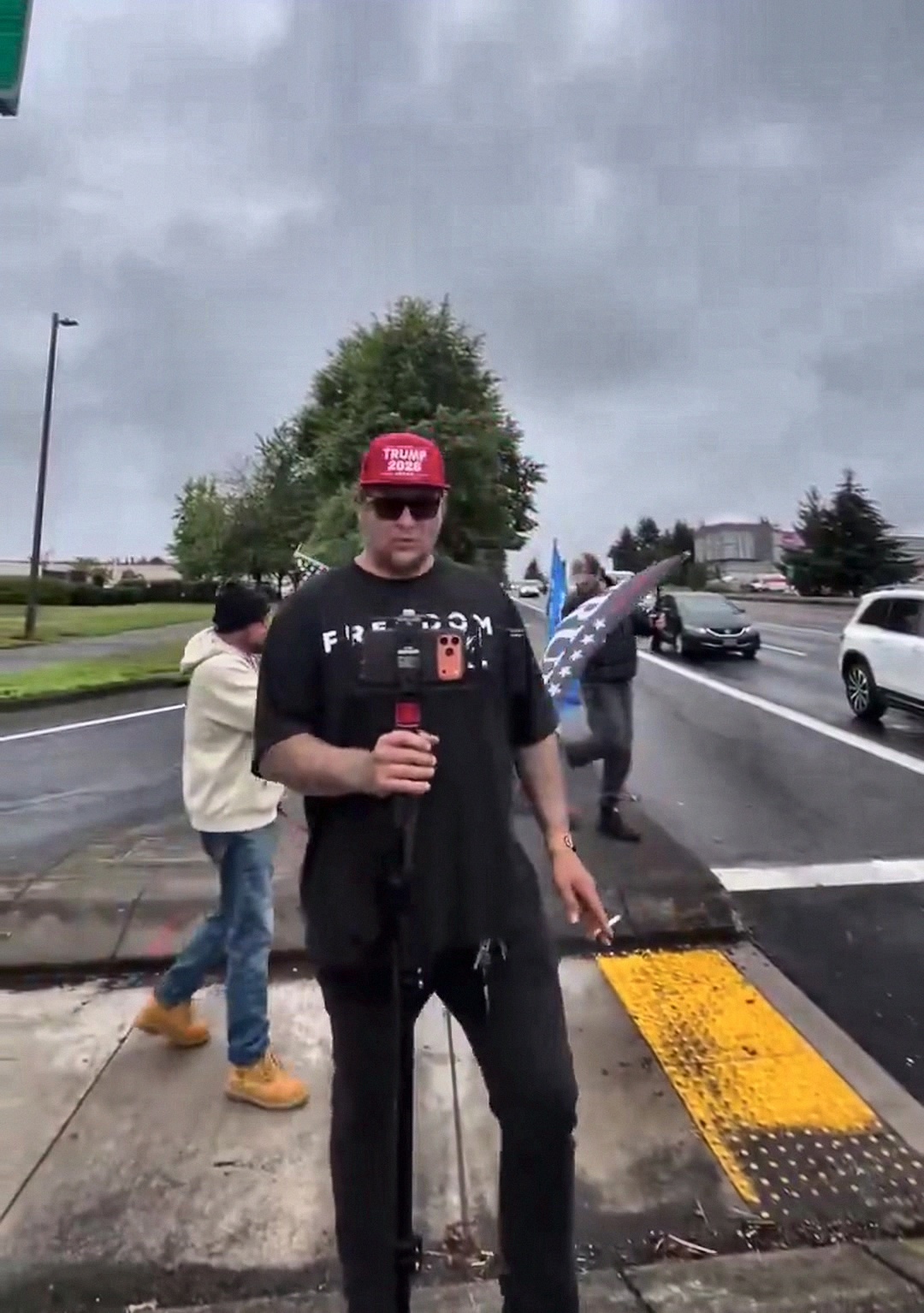
- A man wearing a red cap and dark sunglasses stands on the corner of a multi-lane roadway, holding a phone-mounted camera rig and a large flag.
- A second man in a white hoodie approaches from the right side of the frame, crossing the pavement to confront the broadcaster directly.
- The exchange escalates into a rapid verbal back-and-forth, with the broadcaster repeatedly turning his lens to frame his own face and the approaching figure.
- The confrontation plays out against a backdrop of passing vehicles, a large blue banner in the roadway, and a small American flag set up on a stand nearby.
What the Recorded Footage Captures: Chronological Breakdown
The first frames place the broadcaster near the yellow tactile paving of a curb ramp. He wears a black t-shirt with white lettering, a red cap, and dark sunglasses, and his rig – a phone clamp mounted on a short black grip – is held at chest height. The sky is flat and overcast; the asphalt shines with recent rain. Behind him, a tall sign and a line of evergreens frame a wide, multi-lane road.
Within seconds, a figure in a light-colored hoodie enters from the right, moving with purpose along the sidewalk. The broadcaster stops mid-sentence, pivots, and raises the camera. His posture shifts – shoulders back, chin lifted – as he positions himself between the curb and the approaching man. The ambient sound is a wash of tires on wet pavement and a low, steady wind.
The escalation arrives fast. The two men close the distance, and the broadcaster’s voice sharpens. He gestures with his free hand toward the road, then toward the man beside him. The man in the hoodie gestures back, and for a moment the two are locked in a tight, mirrored stance – one leaning forward, the other planted. The camera bobs as the broadcaster tries to keep both faces in frame. Then the man in the hoodie turns and walks out of the shot, and the broadcaster swings the lens back toward himself, breathing hard.
Critical Blind Spots: What the Lens Leaves Unresolved
What the recording does not show is how the encounter began. The frame opens with the broadcaster already in place, already speaking, already holding the camera. Whether the man in the hoodie approached on his own initiative or was drawn in by something said before the recording started is never made clear. The lens favors the broadcaster’s perspective – his framing, his pacing, his narration – and the other man’s full words are often muffled by traffic noise.
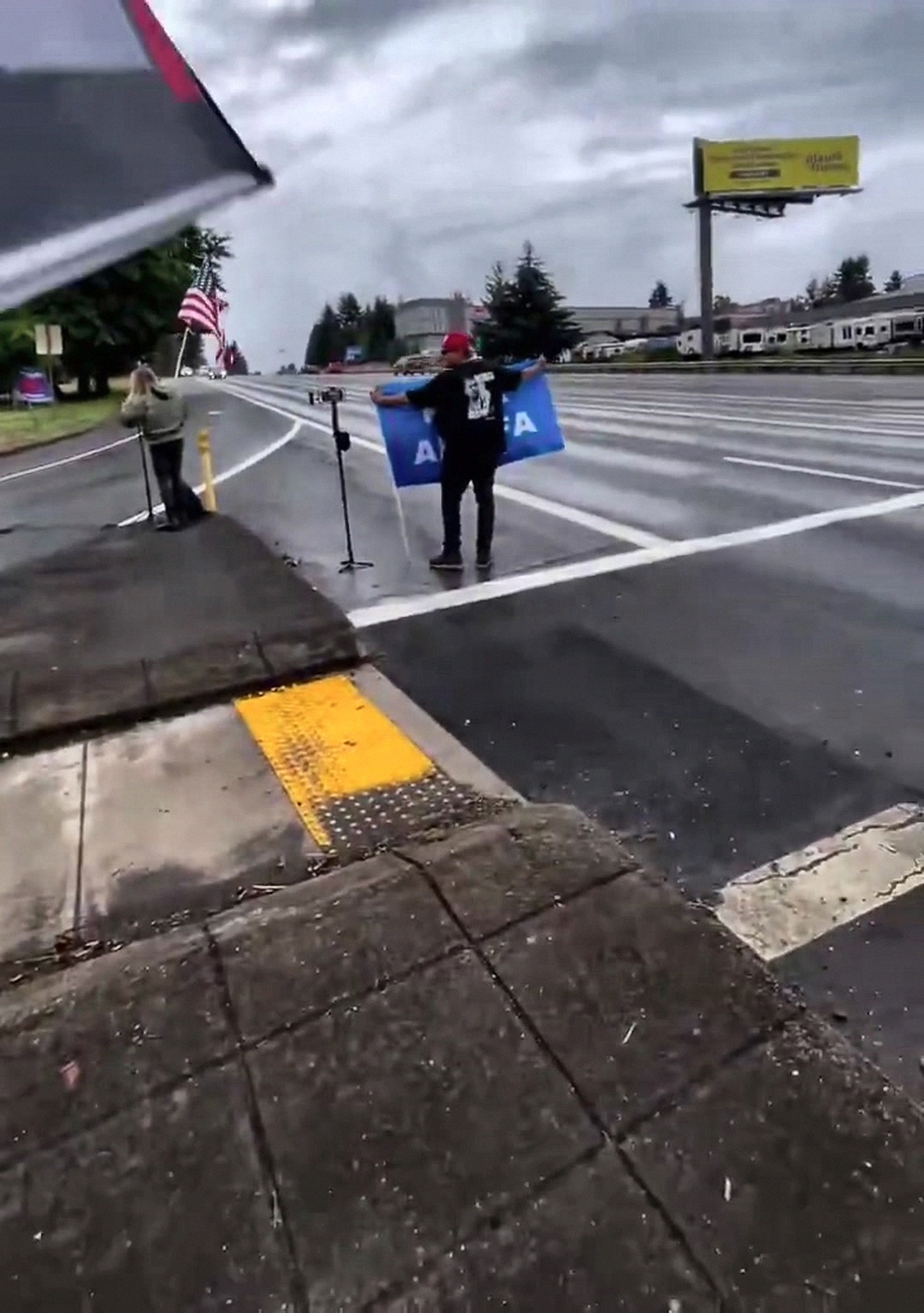
Off-camera context is thin. A second figure appears briefly in the background near a large American flag mounted on a stand, and a dark blue banner with white lettering lies partially in the road. Who placed that banner, and why it rests across the crosswalk, is never addressed. The surrounding sidewalk is largely empty; the only witnesses are passing drivers, none of whom stop. The mood is less explosive than it is raw – two people talking past each other while a camera records every breath.
Statutory Framework and Protocol Analysis
The encounter sits at the intersection of two ordinary activities: a person recording in a public place and a person moving through that same space. In most American jurisdictions, filming on a public sidewalk is protected, and pedestrians retain the right to pass. The friction arises when those two uses collide – when a camera becomes a barrier and a passerby becomes a subject.
| Incident Parameter | Observation at the Scene |
|---|---|
| Location | Curb ramp at a multi-lane roadway, overcast sky |
| Primary actor | Man in red cap and sunglasses, holding camera rig |
| Approaching figure | Man in light hoodie, entering from the right |
| Display present | Large blue banner in roadway, small flag on stand |
| Duration of exchange | Under one minute of visible confrontation |
| Witness presence | Passing vehicles only, no bystanders stopping |
| Recording method | Handheld phone mount, first-person framing |
Read more:
Read more: Seatbelt Excuse Fails as Trooper Holds Firm on Camera →
Core Questions and Institutional Review
- Who initiated the verbal exchange before the camera was raised?
- Was the blue banner placed in the crosswalk intentionally, and by whom?
- Did either party attempt to leave the scene before the recording ended?
- What was said in the moments immediately after the man in the hoodie walked away?
The footage ends as abruptly as it begins – the broadcaster alone again, the road still humming, the banner still sagging across the white lines. What remains is the image of two people occupying the same small patch of wet pavement, each convinced the other was the one who crossed a line. Where does a public sidewalk stop being a shared space and start being a stage?
Practical Takeaways
- Public recording is common, but framing and proximity can turn observation into confrontation.
- Shared pedestrian space requires leave-and-let-leave; blocking a crosswalk escalates tension fast.
- Brief clips rarely show the full exchange; context matters more than the loudest moment.
- Bystanders and passing drivers are poor witnesses when no one stops to observe.
Sources
- A left-wing agitator and open-borders activist showed up at … – https://x.com/RheinAmacher/status/2117432130037059690
LATEST DEVELOPING INCIDENT
An even more shocking incident just erupted hours ago that has stunned onlookers nationwide. Full investigative breakdown and on-scene evidence documented below.
BREAKING: READ NEXT SHOCKING INCIDENT – LATEST CASE ↓
Colorado Flood: Home Floats Down River, Slams Into Bridge
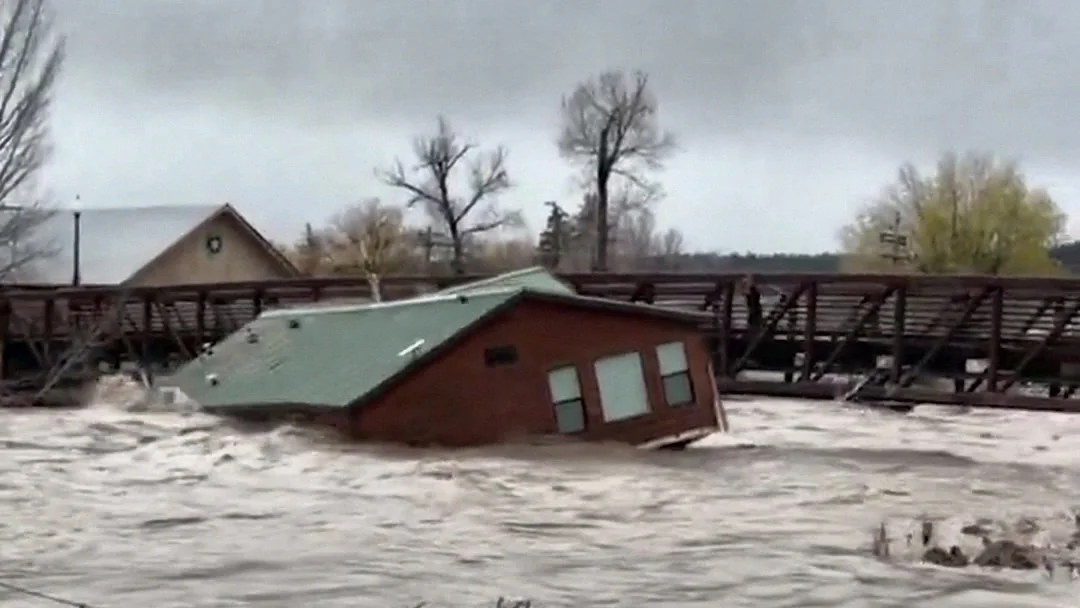
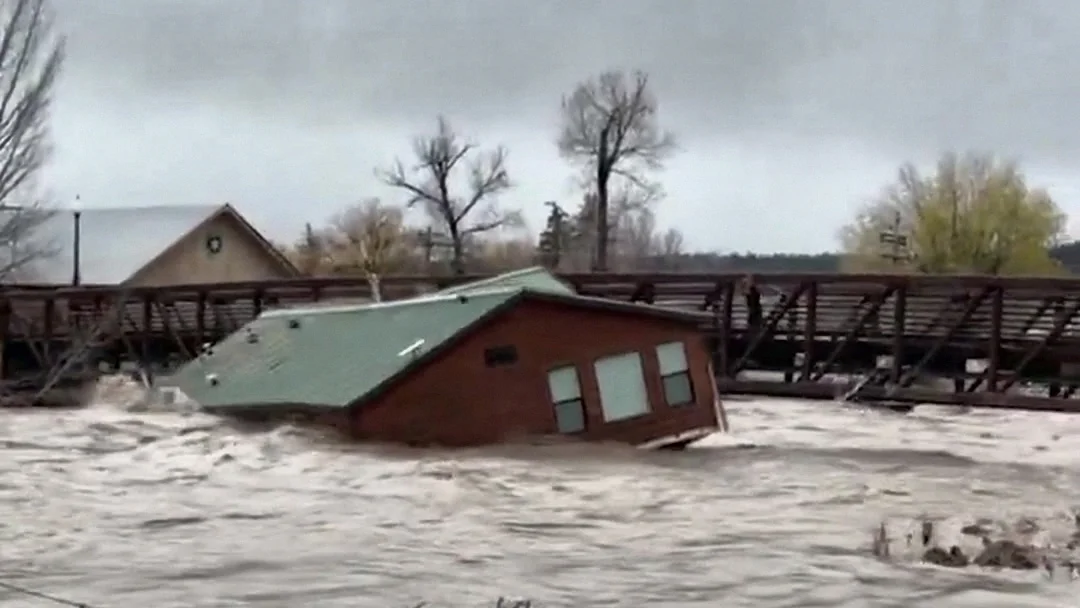
The muddy San Juan River had already swallowed the riverbank when a two-story structure broke free from its foundation and began moving downstream. Onlookers near Pagosa Springs could only watch as the swollen current carried the entire building toward a low steel bridge. What happened in the next ninety seconds turned a natural disaster into a scene of raw, helpless disbelief.
- The scene: A residential structure dislodged from its lot along the rain-swollen San Juan River near the resort town of Pagosa Springs, Colorado, drifting downstream with the current.
- The friction: The floating home moved directly toward a low-lying steel bridge, drawing frantic shouts from bystanders who realized the collision was unavoidable.
- The intervention: No physical intervention was possible; the current simply carried the structure into the bridge span, where it crumpled against the steel supports.
- The aftermath: Residents in low-lying areas were forced to evacuate as the river continued to surge, leaving debris and shattered timber in the churning water.
What the Recorded Footage Captures: Chronological Breakdown
The first frames show a swollen, brown river running fast past a stand of autumn trees, their yellow leaves the only bright color under a flat gray sky. A modest single-story building with dark siding and pale trim sits close to the waterline, already half-surrounded. The camera shakes slightly as the person holding it adjusts their footing on the wet ground. Then the building begins to move.
It does not lurch or explode apart. Instead, the structure simply detaches and slides, rotating slowly until it faces downstream. A woman's voice rises above the roar of the water: "Holy cow. Oh my living word. Oh my god." The camera tracks left, following the building as it gathers speed in the current.
As the structure nears the bridge, the shouts intensify. "Off the bridge! Hey! It's coming!" someone yells, though there is nowhere for anyone to go. The impact is not a clean break. The building hits the bridge span and folds, its roofline collapsing as water explodes upward in a white spray. Debris scatters across the surface. The camera jolts, then steadies, catching the last of the structure as it pins against the supports, swallowed by foam.
Critical Blind Spots: What the Lens Leaves Unresolved
The footage captures the collision, but it cannot show what happened inside the building in the moments before it broke free. Whether the structure was empty, whether anyone had been inside earlier that day, or whether residents had evacuated in time remains outside the frame. The camera operator's view is fixed on the river, meaning the condition of the surrounding neighborhood, the state of the roads, and the whereabouts of the displaced residents are all left to the imagination.
What the lens also cannot resolve is the structural timeline. How long had the foundation been compromised before the building gave way? Was the structure already weakened by earlier flooding, or did the current simply overwhelm it in a single surge? The audio offers only the reactions of onlookers, not the assessments of engineers or the warnings that may have preceded the collapse.
Finally, the footage ends before the river's peak. The water level in the final frames is still rising, and the fate of nearby homes remains uncertain. The clip offers a single, devastating moment but no closure on the wider damage that followed.
Statutory Framework and Protocol Analysis
When a river overtops its banks, local emergency management protocols typically move through a series of escalating warnings, beginning with voluntary evacuation notices and culminating in mandatory orders for low-lying zones. Residents near the San Juan River faced exactly this sequence as the water rose. The speed of the current in the footage suggests that any warning window may have been short, leaving little time for residents to secure property.
Building codes in flood-prone areas often require structures to be elevated or anchored to resist scour, but no code can guarantee survival against a river moving with this kind of force. The bridge itself, a low steel span, appears to have held despite the direct impact, a detail that speaks to the engineering of the crossing even as it highlights the vulnerability of everything around it.
| Incident Parameter | Recorded On-Scene Evidence |
|---|---|
| Location | Near Pagosa Springs, Colorado, along the San Juan River |
| Structure type | Two-story residential building with pale trim |
| River condition | Fast-moving, muddy brown, debris-laden |
| Weather | Overcast, gray sky, autumn foliage |
| Bridge type | Low steel span crossing the river |
| Collision outcome | Structure folded against bridge supports |
| Onlooker reaction | Shouts of alarm, audible distress |
Read more: {NOIBO}
Core Questions and Institutional Review
- Was the structure occupied at the time it broke free, and had residents received adequate evacuation notice?
- What was the condition of the foundation prior to the flood, and had the property been subject to previous flood damage assessments?
- How did the bridge hold under direct impact, and what does that reveal about the structural tolerances of the crossing?
- What happened to the surrounding homes and residents in the hours after the clip ends, as the river continued to rise?
The camera captured a building's final journey, but the story of the people behind it remains largely untold. What responsibility do communities bear when they allow homes to stand in the path of a river that has already proven it can take everything?