Cemetery Confrontation: Car Drives Into Día de los Muertos Circle
WATCH: On-scene video documentation is embedded below →
LISTEN TO THIS ARTICLE
Audio Narration • English (US)
The hum of a cemetery afternoon in South Sacramento was split by a single, sharp voice. A silver sedan crept forward, inch by inch, toward a ring of people dressed in traditional regalia, and the question hanging in the air was brutally simple: who had the right to be here, on this day, on this ground?
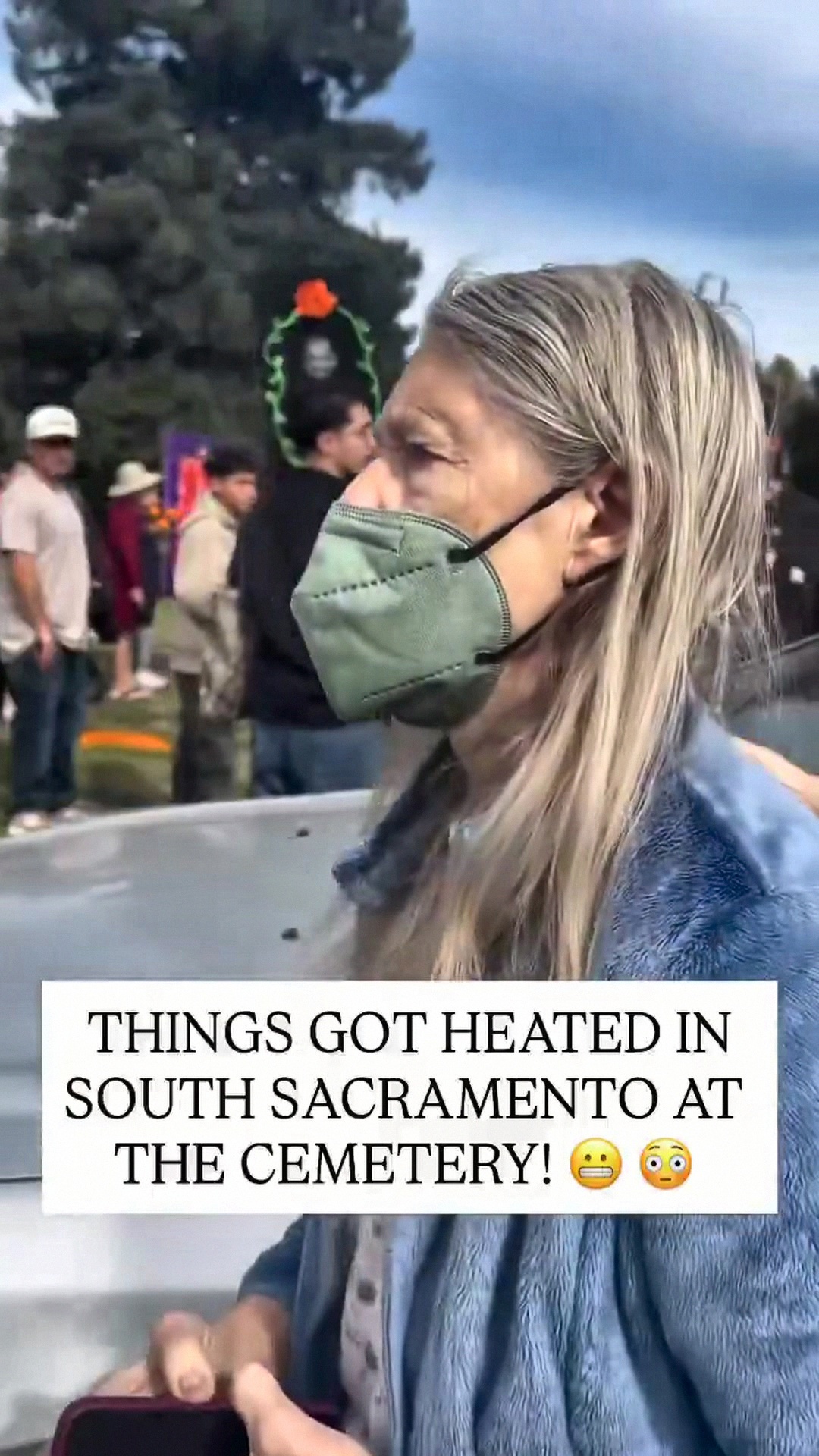
What followed was not a fistfight but something more intimate and uncomfortable – a war of words staged between a windshield and a circle of mourners, recorded in a sixty-second clip that has since pulled nearly a hundred thousand views and hundreds of comments.
- A group gathered at a South Sacramento cemetery to observe Día de los Muertos, honoring deceased loved ones with ceremony, regalia, and an intentionally closed circle.
- An older woman driving a silver sedan attempted to pass through the gathering, insisting she needed access to reach her own vehicle or exit route.
- The group refused to break formation, at one point chanting "Close the circle" and positioning their bodies between the car and a small child standing nearby.
- The confrontation escalated into accusations and raised voices, with the ceremony continuing around the vehicle as the woman sat behind the wheel.
What the Recorded Footage Captures: Chronological Breakdown
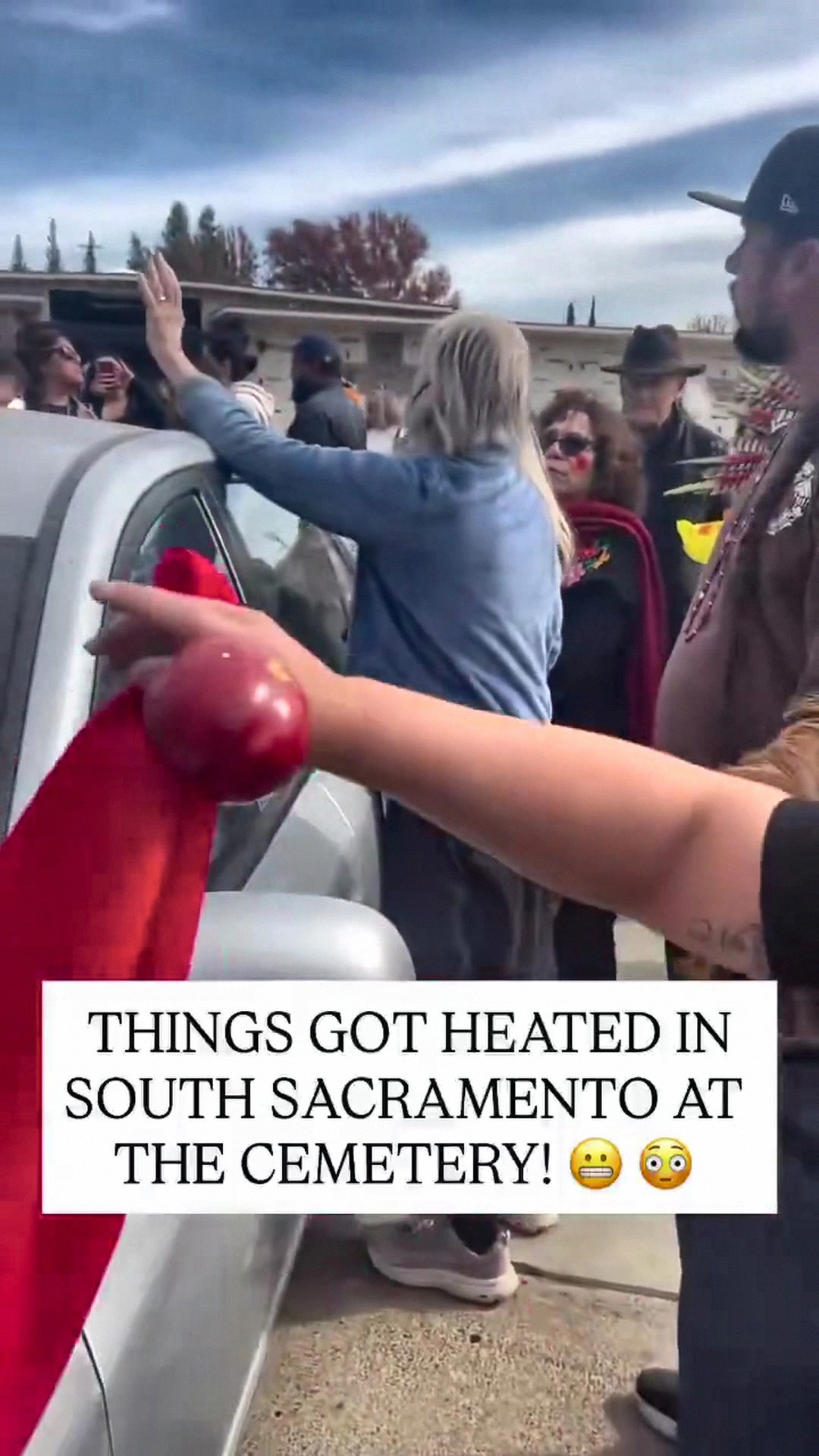
The first frames are deceptively calm. A silver car idles at the edge of the frame, its windshield reflecting a row of blue-clad figures standing shoulder to shoulder. A woman in a teal shawl with dark hair pulled back extends one arm across the hood, palm open, as if to say: not this way. The caption burned into the video reads, in plain block letters, "THINGS GOT HEATED IN SOUTH SACRAMENTO AT THE CEMETERY." A single figure in a red-and-black headdress of long pheasant feathers stands at the car's flank, unmoving.
Then the audio sharpens. "Get away from me," a woman's voice says, flat and defensive. "Don't push down. Get away from me." The voice belongs to the driver, an older woman with long silver-blonde hair and a green fabric mask pulled high over her nose and mouth. She is framed in profile through the driver's window, chin lifted, eyes fixed forward. Behind her, a man in a dark cap holds a bouquet of yellow and orange flowers, watching. "We need permission to be here on this day," someone in the crowd answers her. "I'm sorry. Listen, I'm sorry." The apology lands without softening anything.
By the middle of the clip the group has organized itself into a deliberate response. "Close the circle," a voice instructs, and bodies shift to tighten the ring around the vehicle. Another voice protests "There's a little kid right here," and the driver's reply cuts through: "I don't care." A chant rises – "Sacred ceremony. This is our land" – and someone calls out, "Continue with the ceremony. The ceremony is long enough." The video ends mid-tension, with the circle unbroken and the car still hemmed in.
Critical Blind Spots: What the Lens Leaves Unresolved
The camera, held by someone inside the gathering, captures the group's perspective with total clarity and everything else with almost none. We never see the cemetery's layout – whether the sedan was parked in a legitimate lane that the ceremony had blocked, or whether the driver had simply chosen to cut through a gathering out of impatience. We do not see the first words exchanged. The clip begins after the temperature has already risen, which means the inciting remark was delivered off-camera.
One viewer comment under the original post raises precisely the question the footage cannot answer: "What's the actual context? Were they blocking other graves? Were they blocking her from visiting her loved ones?" That is a fair question and the video supplies no answer. The driver's own stated motive – that she was trying to get to her car – is swallowed by the argument and never clarified. Did she arrive before the ceremony began? Was she a visitor to a neighboring plot, or simply a motorist taking a shortcut through cemetery grounds?
What the lens also obscures is the driver's face for most of the confrontation. She is largely a voice behind glass and a flash of silver hair, which makes her easier to cast as an intruder than to read as a person. The group's restraint is visible, but so is its refusal to negotiate. Two claims of belonging collide, and the camera only records one of them.
Statutory Framework and Protocol Analysis
Cemetery management typically sets hours, designated vehicle lanes, and rules about gatherings – and the decisive fact in almost every case like this is whether a ceremony was permitted in advance. If the group had a scheduled observance, the grounds staff would ordinarily have roped off or redirected traffic. If they gathered informally, the driver's claim to a clear path carries more weight than the crowd's claim to the ground under her tires. Neither answer is visible in the recording.
What is visible is a community operating on a code the driver does not share. To the group, the closed circle was not a protest but a ritual boundary; the phrase "This is our land" was spoken as ceremony, not litigation. To the driver, the circle was an obstacle and the ceremony an inconvenience. The shouting match was really about which code applies when a public burial ground becomes, for a few hours, a sacred one.
| Incident Parameter | Recorded On-Scene Evidence |
|---|---|
| Location context | South Sacramento cemetery during a Día de los Muertos observance |
| Central actors | An older woman in a silver sedan; a group in traditional regalia |
| Trigger of tension | Sedan advancing into a deliberately closed ceremonial circle |
| Verbal escalation | Driver: "Get away from me"; crowd: "Close the circle" |
| Reported concern | A small child standing near the vehicle's path |
| Physical contact | None visible; hands extended in stopping gestures, no force used |
| Resolution shown | Unresolved within the clip; ceremony resumes as car remains blocked |
Read more:
Read more: Reporter Nearly Run Over Outside Maine Treatment Center →
Core Questions and Institutional Review
- Who was present at the cemetery first – the ceremonial group or the driver – and did either party have a scheduled reservation for that space?
- Did the driver attempt to communicate her need before the recording began, or was the first exchange already confrontational?
- Was cemetery staff present at any point, and did anyone attempt to redirect the vehicle through an alternate lane?
- What was the initial remark that caused the crowd to describe the driver's words as disrespectful, given that it happened off-camera?
The clip ends without a verdict. The ceremony continued, the car remained where it stopped, and the two sides separated into their own versions of the same minute. Whether this was an act of disrespect toward the dead or a simple case of a driver caught in a ritual she never expected, the recording refuses to decide – and that ambiguity may be the most honest thing about it. Where does the right of a gathering to hold its ground end, and the right of an individual to pass through begin?
Sources:
- Part 1: An older woman who interrupted a group honoring their … – https://www.facebook.com/916today/videos/part-1-an-older-woman-who-interrupted-a-group-honoring-their-loved-ones-during-a/1463049589099175/
- Part 1: An older woman who interrupted a group honoring … – https://www.instagram.com/reel/DfQip-ZP6W9/
- Part 1: An older woman who interrupted a group honoring … – https://x.com/916today/status/2117425298384040073
LATEST DEVELOPING INCIDENT
An even more shocking incident just erupted hours ago that has stunned onlookers nationwide. Full investigative breakdown and on-scene evidence documented below.
BREAKING: READ NEXT SHOCKING INCIDENT – LATEST CASE ↓
Seatbelt Excuse Fails as Trooper Holds Firm on Camera
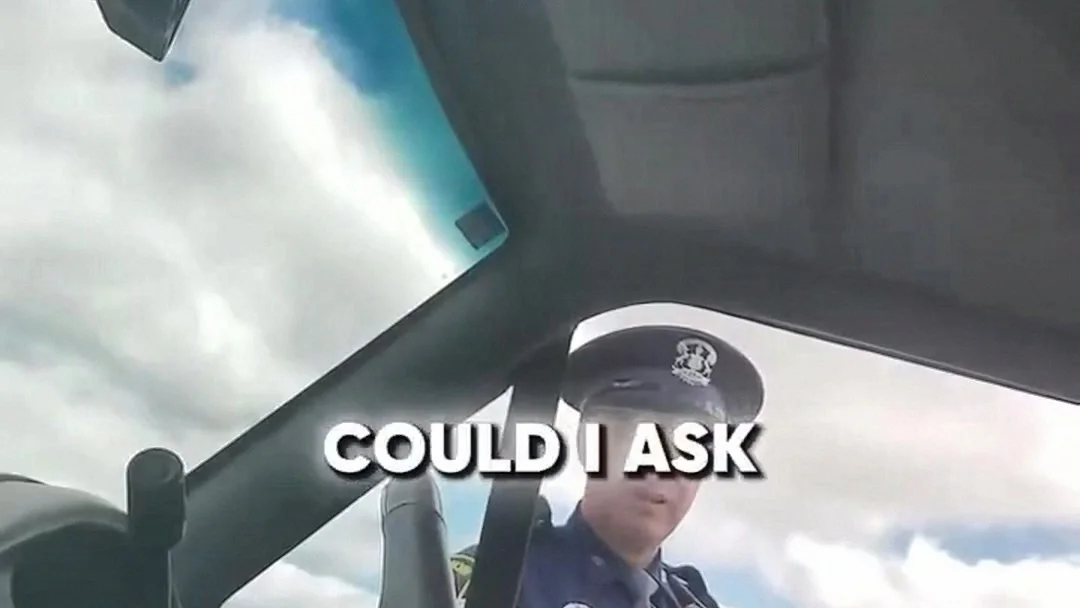
The trooper leaned into the open window, his expression flat and immovable, while the driver gripped a folded paper in his lap and insisted the seatbelt simply did not fit. What began as a routine traffic question quickly hardened into a quiet contest of wills, all recorded from inside the vehicle as the conversation tilted toward consequence.
- A highway patrol trooper approaches the driver's side window of a stopped vehicle on a bright, cloud-scattered day.
- The trooper opens with a direct question about the missing seatbelt, and the driver answers that it does not fit.
- The trooper counters that if the belt does not fit, the vehicle cannot be driven, calling it a matter of common sense.
- The exchange widens into a larger dispute about privilege, documentation, and the driver's request for clarification on the timeline moving forward.
What the Recorded Footage Captures: Chronological Breakdown
The recording opens at a low angle from the driver's seat. A rearview mirror hangs against a wash of pale blue sky and torn white clouds visible through the windshield. The trooper's face appears at the window, framed by the dark A-pillar, his cap badge catching the daylight. His tone is steady but clipped as he asks why the belt is not fastened. The driver's reply is immediate and matter-of-fact: "It doesn't fit."
The trooper does not soften. "You can't be driving then," he says, the words landing with bureaucratic finality. "Pretty common sense there." A pause stretches across the cabin. Then the driver pushes back, arguing that a poor fit should not strip him of the privilege to drive. The camera holds on the trooper's hands as he gestures, then on a folded document the driver lifts into view. The interior of the car is bright and close, the silence between sentences heavier than the engine noise.
The trooper shifts to procedure, asking for license and registration. The driver asks whether he is being pulled over, and the trooper answers with visible impatience. "Weren't you listening?" The driver then asks where the victim is in this situation, a remark that draws a sharp reply. "We'll have this conversation all day long and you'll lose all day." The trooper repeats a name back for his notes, and the driver offers a brief thank-you before the trooper launches into an explanation of the timeline set by state legislation.
Critical Blind Spots: What the Lens Leaves Unresolved
The camera angle is locked to the interior, so the roadside behind the trooper remains unseen. There is no wide shot of the patrol vehicle, the traffic passing nearby, or any second officer who may or may not have been present. The frames never reveal the weather conditions on the roadway itself, nor how long the stop had already been underway before recording began.
What the lens also leaves unresolved is who initiated the recording and why. The driver's voice carries a note of performance, as if aware of an audience beyond the windshield. The trooper's body language, by contrast, is controlled but visibly taxed by the repeated challenges. Off camera, other vehicles may have slowed, but the audio captures no bystander reactions, no passing horns, no ambient voices.
The most significant gap is the paperwork itself. The driver lifts a folded document toward the window, but the text is never legible. Whether it was a citation, a warning, or an informational slip remains unknown, leaving the true legal outcome of the stop hanging in the bright afternoon air.
Statutory Framework and Protocol Analysis
Traffic stops of this kind follow a standard arc: an observed violation, a request for identification, an explanation of the alleged infraction, and a decision on whether to warn or cite. The trooper here stays inside that script, even as the driver tries to reframe the stop as a philosophical debate about rights rather than a safety violation.
The driver's argument rests on a genuine practical problem wrapped in a legal misunderstanding. A belt that does not fit is a real inconvenience, but the remedy under most statutory frameworks is an aftermarket extender or a different seating position, not continued operation without restraint. The trooper's closing explanation about contacting the court within a set number of days reflects the ordinary administrative path for contesting a citation.
| Incident Parameter | Recorded On-Scene Evidence |
|---|---|
| Location of stop | Roadside, observed from inside the stopped vehicle |
| Lighting conditions | Bright daylight, broken clouds through windshield |
| Opening exchange | Trooper asks about the unfastened seatbelt |
| Driver's stated reason | The seatbelt does not fit properly |
| Trooper's position | If the belt does not fit, the vehicle cannot be driven |
| Documentation request | License and registration requested mid-conversation |
| Stated next step | Contact the court within a defined window |
Read more: {NOIBO}
Core Questions and Institutional Review
- Was a seatbelt extender ever offered or discussed as an alternative during the stop?
- What specific document was handed through the window, and was it a citation or a warning?
- Did the driver later contest the stop through the court process described by the trooper?
- How often do similar fit-related excuses surface in routine seatbelt enforcement?
The exchange ends without a raised voice and without a clear resolution on camera, just a trooper explaining a deadline and a driver absorbing it. The scene is a small, ordinary collision between a practical complaint and an inflexible rule, and it leaves a question worth sitting with: when a safety device genuinely does not fit the person it is meant to protect, should the answer be a hard stop or a better-fitting solution?
Practical Takeaways
- A seatbelt that does not fit is a solvable problem, not a valid reason to drive unrestrained.
- Keep registration and license within reach to shorten any roadside interaction.
- Ask directly whether a stop is a warning or a citation before the conversation escalates.
- Extenders are widely available through dealers and aftermarket suppliers.
- Stay calm and factual; repeated challenges rarely improve the outcome of a stop.