Police SUV Crash Then Ambulance Hits Second Cruiser
WATCH: On-scene video documentation is embedded below →
LISTEN TO THIS ARTICLE
Audio Narration • English (US)
An already mangled police cruiser sits pinned against a guardrail on a gray afternoon, and the camera swings toward an approaching red ambulance. What follows is a split second of metal-on-metal that turns a routine response into a compounding disaster, all captured by a witness whose reaction shifts from stunned curiosity to genuine alarm as the rescue vehicle plows into yet another patrol unit.
- A dark police SUV rests against a roadside guardrail, its front end deformed after an apparent single-vehicle impact.
- A red and white ambulance arrives on scene as first responders and bystanders linger near the wreckage.
- The approaching rescue vehicle collides with a second patrol car positioned near the collision site, creating a chain reaction of damage.
- A witness recording the scene reacts audibly, while personnel on the ground scramble to reassess a situation that has suddenly doubled in severity.
What the Recorded Footage Captures: Chronological Breakdown
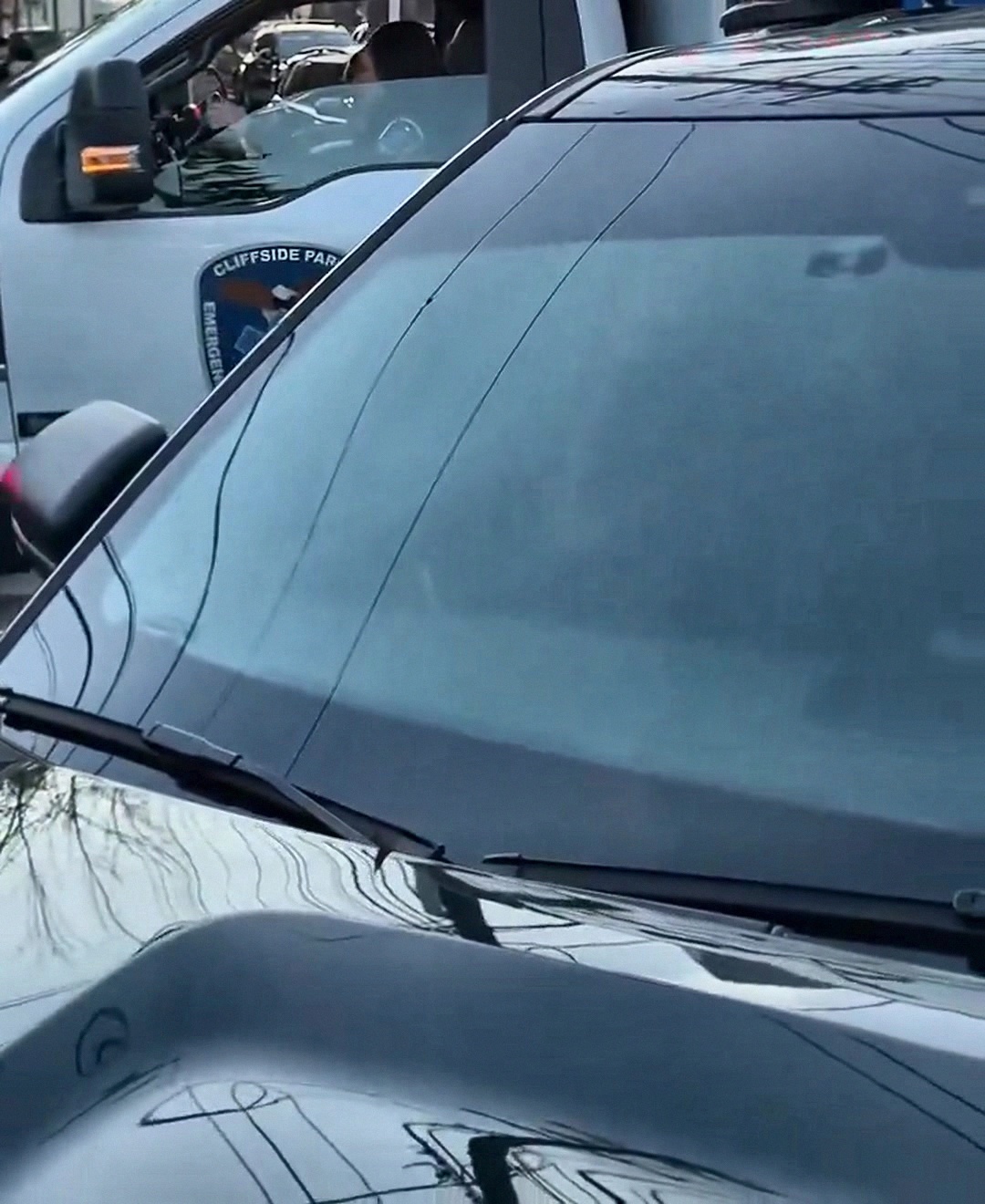
The clip opens tight and low on a dark wheel and tire of a police SUV, the black rim catching a flat, overcast light as the vehicle sits at an unnatural angle against a yellow-painted concrete curb. The framing is handheld and restless, the operator moving in close before pulling back to reveal a wide windshield and the curved hood of a patrol unit marked with a circular emblem reading Cliffside Park. The glass is smeared with the reflection of bare tree branches and a pale sky, and a wiper blade cuts a diagonal line across the view. There is no chatter from the officers, only the ambient hum of a stopped road and the anxious breathing of the person holding the camera.
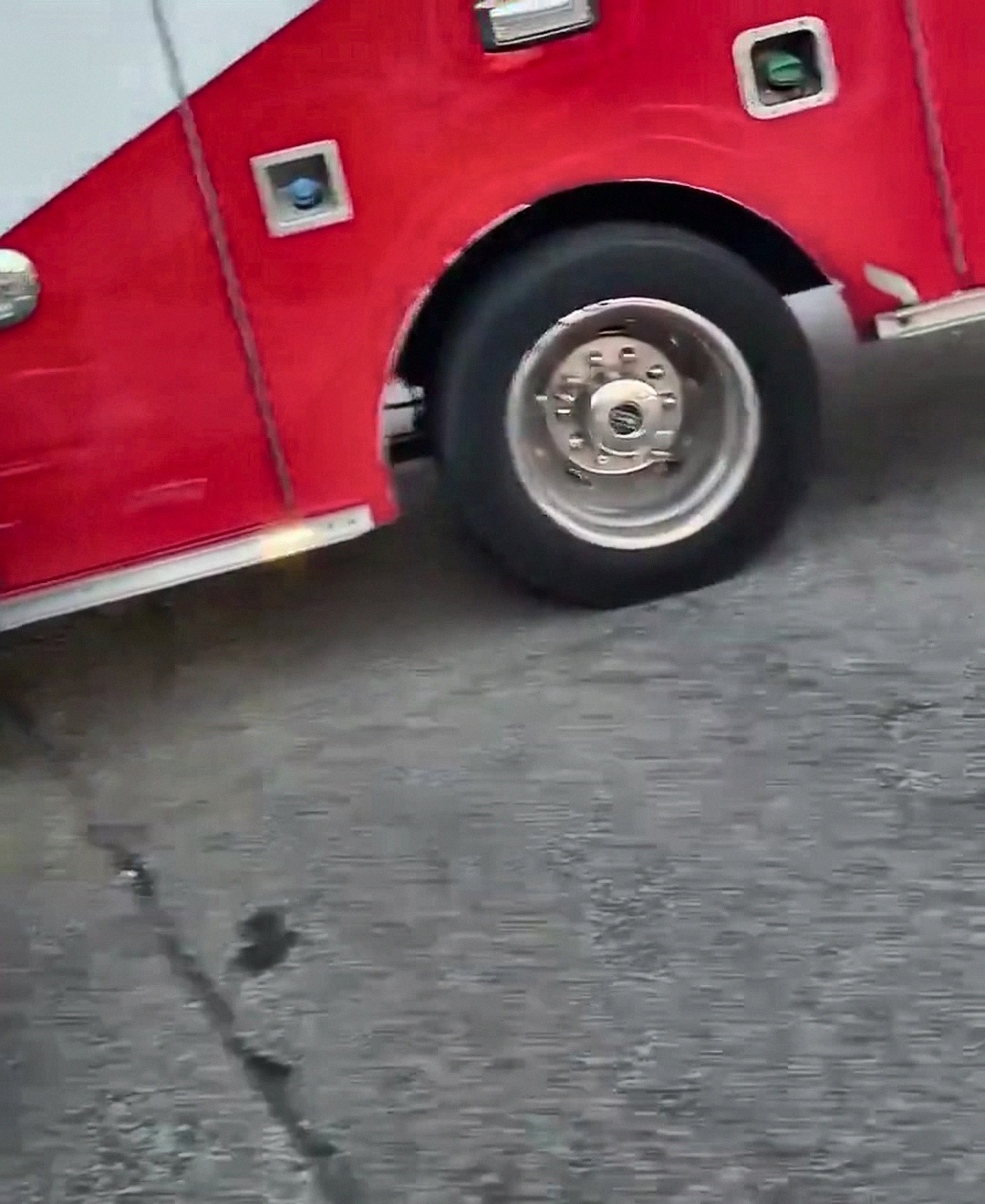
The camera drifts. A red and white emergency vehicle enters the frame from the left, its boxy body moving with the deliberate caution of a driver navigating a tight corridor. The lens dips low again, catching a polished wheel with exposed lug nuts turning slowly across cracked asphalt. A dark streak on the pavement, a spill of fluid or shadow, passes beneath it. And then the moment the clip pivots on: the ambulance is suddenly far too close to the second police cruiser, and the audible realization lands almost before the visual one.
"Bro, this is wild."
The voice is half-laughing, half-disbelieving, the way people sound when reality outpaces their expectations. Another voice pushes back with a warning, then a sound of impact, a flash of red bodywork filling the frame, and the ground-level shot catches a scatter of debris near a curb. A pair of legs in dark trousers with a bright yellow stripe steps past the fragments, and the camera operator exhales a sharp, involuntary curse.
Critical Blind Spots: What the Lens Leaves Unresolved
The framing is claustrophobic, focused on wheels, glass, and pavement, which means the wider geometry of the scene is never fully revealed. We do not see how the initial patrol SUV came to rest against the guardrail, whether it was alone, or what conditions preceded that first impact. The camera never tilts up to show traffic control, and the placement of the second patrol car relative to the arriving ambulance is left to inference rather than clear view.
Perhaps the most striking omission is the human element inside the vehicles. The officer or officers involved in the first crash are never shown climbing out or speaking, and the ambulance crew's reaction to the secondary collision is entirely off-frame. The witness audio carries a note of rising stress, with a strained exchange about a wheel that will not turn, but the camera never resolves whether that voice belongs to a trapped driver or a bystander narrating the scene.
Statutory Framework and Protocol Analysis
The presence of a civilian recording mere feet from damaged patrol vehicles highlights an ongoing tension around public documentation of crash scenes. Onlookers are rarely the cause of an incident, but their proximity can complicate the work of responders who must manage both the wreckage and the wandering attention of a crowd. The footage here suggests a scene that had not yet been fully secured at the moment the rescue vehicle arrived.
From a procedural standpoint, the sequence raises familiar questions about scene management under stress. A first collision draws resources; those resources arrive into an environment that is itself dangerous. Whether the second patrol car was properly positioned as a buffer, whether the ambulance driver had clear sightlines, and whether the position was marked with cones or flares are all details the lens does not settle.
| Incident Parameter | Recorded On-Scene Evidence |
|---|---|
| Initial impact | Dark police SUV resting against a guardrail |
| Vehicle markings | Circular department emblem reading Cliffside Park |
| Secondary vehicle | Red and white ambulance entering frame from the left |
| Second patrol unit | Cruiser positioned near the collision site |
| Secondary collision | Audible impact and red bodywork filling the frame |
| Debris field | Fragments scattered across cracked asphalt near a curb |
| Witness reaction | Handheld audio capturing disbelief and alarm |
Read more:
Read more: Deputy Saves Choking Child During Traffic Stop →
Core Questions and Institutional Review
- What was the sequence of events that led the initial patrol SUV into the guardrail before the camera began rolling?
- Was the second patrol car positioned as a protective buffer at the time the ambulance arrived on scene?
- Did the ambulance crew have a clear line of sight to the second cruiser, or was visibility compromised by the congestion of the response?
- How did the responding personnel adapt in the seconds after the secondary impact, and were there additional injuries from the chain collision?
The witness never stops filming, and the footage ends mid-scene, with the debris still fresh and the red bodywork still filling the frame. What the clip leaves behind is a question that lingers far longer than the sound of the impact: when the very vehicles sent to make a scene safer become part of the damage, how should a community measure the readiness of the systems meant to protect it?
LATEST DEVELOPING INCIDENT
An even more shocking incident just erupted hours ago that has stunned onlookers nationwide. Full investigative breakdown and on-scene evidence documented below.
BREAKING: READ NEXT SHOCKING INCIDENT – LATEST CASE ↓
Halloween Porch Dispute Over 40 Juice Boxes Goes Viral
A suburban Halloween evening turned into a sidewalk interrogation over a few dollars' worth of juice boxes, captured frame by frame as a homeowner challenged a family leaving his yard. What began as a routine handout of treats became a tense, recorded confrontation over a simple question: when a bowl is left outside, how much is too much?
- A homeowner in Illinois confronted a family of trick-or-treaters after discovering his entire supply of juice boxes had disappeared from a porch left open for self-service.
- The confrontation was recorded on a phone and later shared widely by online commentator Matt Van Swol, whose caption described the homeowner shouting about forty missing juice boxes.
- A woman in the group pushed back, arguing that the treats were placed outside and therefore available, a rationale the homeowner rejected as theft.
- After the exchange, a child reportedly returned the juice boxes from the family's car, but the homeowner waved them off, telling the group to keep them because they had taken from other children.
What the Recorded Footage Captures: Chronological Breakdown
The footage opens on a pale green SUV parked at the curb, the family's vehicle doubling as a makeshift stage for the argument. The camera, held by the homeowner, sweeps across the side of the car where a child sits in the back seat, and the audio picks up the homeowner's voice cutting through the evening air: "You took 40 juice boxes. I did. So where's it at?"
The camera then pans back toward the front yard, where a white picket fence sits behind a row of steps covered in scattered yellow leaves. Two young trick-or-treaters in costumes stand near the sidewalk, and the homeowner narrates the scene directly to his audience, a running commentary layered over the dispute. At one point a child's voice floats above the recording, and the homeowner answers, "That's not how you do stuff. You don't steal. That's what you get for stealing. You get put on blast."
The confrontation then turns back toward the vehicle. A woman in the group covers her face with her hand as the camera presses in, and the homeowner tells her, "Alright, don't give me nothing back." The tension is thick but contained, two feet of sidewalk separating the camera from the car door. The camera wobbles as voices overlap, and the homeowner insists he had more than 160 pieces out on the porch, a claim the family disputes. "I was gone 10 minutes and everything's gone," he says, the disbelief in his voice stretched thin.
The scene reaches its loudest point when the woman fires back at the camera: "Get the f*** out of my face. What's wrong with you, ruining kids' Halloween." She can be heard moving the children back into the vehicle, and the audio fills with overlapping chatter, a door closing, and the homeowner's repeated refrain about who was stealing from whom. The footage ends not in violence but in a slow deflation, the argument running out of steam as the family settles into the car and the camera keeps rolling, as if waiting for someone to admit fault.
Critical Blind Spots: What the Lens Leaves Unresolved
The recording starts well after the juice boxes vanished, which means the most important minutes of the evening played out off-camera. We never see how many treats were initially on the porch, who took what, or whether other children were cycling through during the homeowner's reported ten-minute absence. The gap between a full porch and an empty one is the entire dispute, yet the camera only arrives for the argument that followed.
It is also unclear whether the juice boxes were presented as self-serve or whether a sign invited a set limit. The homeowner says he put out more than 160 pieces; the family counters that the children did not take that many. The camera captures no inventory, no bowl, and no signage, leaving the actual quantity a matter of competing recollection.
The woman's hand covering her face is the most telling image in the footage, an instinctive shield against a phone lens now pointed at her in front of her children. What she says behind that hand is only partly audible, and the homeowner's own commentary competes with her words for space on the audio track, meaning the viewer hears an edited argument rather than a complete conversation.
Statutory Framework and Protocol Analysis
On a normal suburban street, the expectation of Halloween is straightforward: porch lights on, treats left in a bowl, children encouraged to take a reasonable handful. When a bowl is left unattended, the social contract is tested. Some homeowners accept that an unattended bowl may be emptied by a single early visitor; others expect a steady trickle of children throughout the evening.
The homeowner's response reflects a widely shared instinct that theft should not be tolerated simply because the items were left accessible. The woman's reported view, that the treats were placed outside and therefore fair game, reflects a different reading of the same porch. Both positions are visible in the comments that followed the video, which debated porch etiquette, parenting, and whether a confrontation in the street was ever the right response.
| Incident Parameter | Observation at the Scene |
|---|---|
| Location | Residential street in Illinois, reported but not independently confirmed |
| Time of year | Halloween evening, porch decorated with pumpkins and fall leaves |
| Disputed item | A supply of juice boxes removed from an unattended porch |
| Principal voices | A male homeowner holding a phone, a female parent speaking from a parked SUV |
| Bystanders | Several young children in costumes visible along the fence line |
| Resolution attempt | A child reportedly returned the juice boxes from the car |
| Documenter | Phone recording later shared online by a commentator |
Read more: {NOIBO}
For homeowners, the lasting lesson is a practical one: an unattended bowl may not last the evening, and a sign with a printed limit is a cheap safeguard. For families, the footage is a reminder that a public street is not a courtroom, and a camera turned on someone's face can escalate a disagreement faster than it resolves one. The scene settles into that uncomfortable space where neither side walks away vindicated, and the neighborhood carries the story forward by word of mouth.
Core Questions and Institutional Review
- What did the porch actually look like before the camera started rolling, and how many treats were originally placed outside?
- Was there any written instruction or sign suggesting a limit per trick-or-treater, and did the family encounter it?
- What led the family to gather the remaining juice boxes and drive back toward the porch after the argument?
- Did the homeowner's stated intent, that the children had taken from other kids, ever translate into an actual return of the items?
The answers may never surface, because the argument is the only part that was recorded. Still, the video leaves an uncomfortable truth in its wake: two adults standing on a leaf-covered sidewalk, both certain they were right, neither willing to be the first to walk away. In the quiet after the camera stops, the real question is not who took the juice boxes, but what a neighborhood loses when the bowl outside becomes a test of character.
Key Takeaways
- The incident centers on a simple dispute over a supply of juice boxes left outside on Halloween.
- The recording is a running commentary by the homeowner, not a neutral document of the entire evening.
- The family viewed an accessible porch as permission, while the homeowner viewed the emptied display as theft.
- The footage offers no clear inventory, no sign, and no definitive resolution, making it a story of competing accounts.
What part of this story would you want to see verified first, the condition of the porch before the confrontation or the conversation that led the family back to return the treats?