Walmart ID Refusal Turns Into Felony Battery Arrest
WATCH: On-scene video documentation is embedded below →
LISTEN TO THIS ARTICLE
Audio Narration • English (US)
Walmart ID Refusal Escalates Into Felony Battery Charge
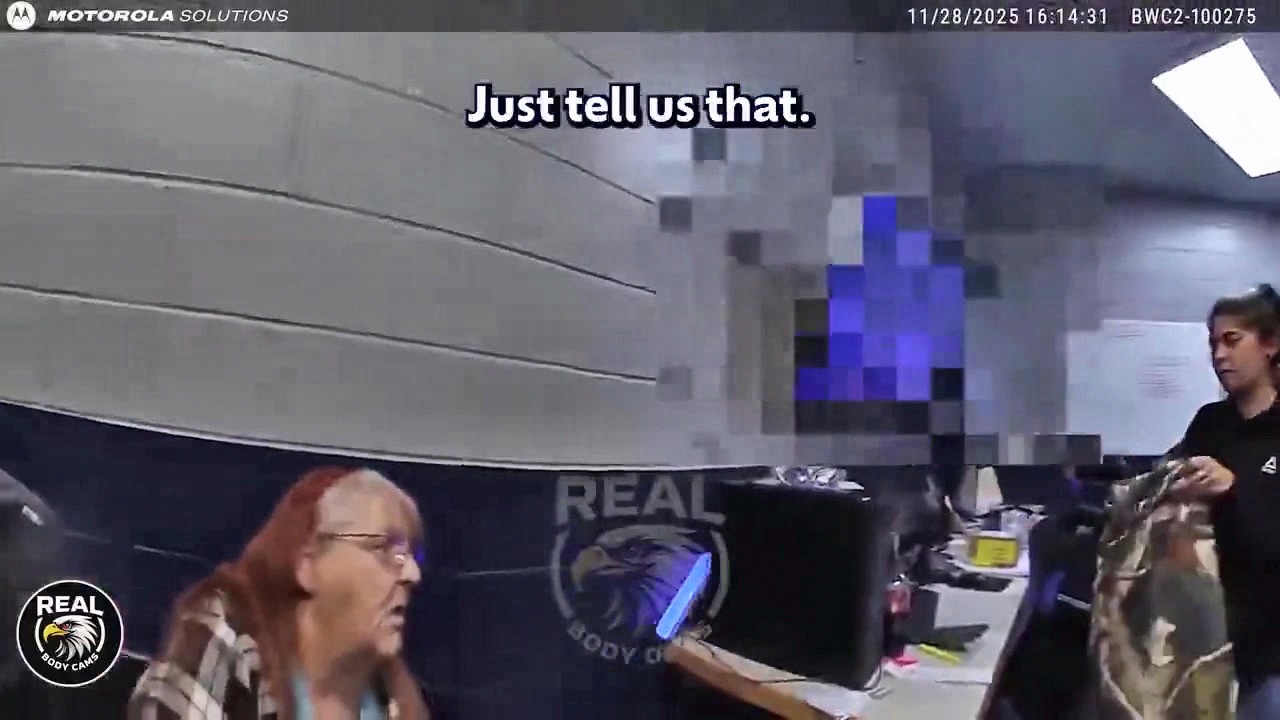
A routine loss-prevention stop at a Florida Walmart self-checkout turned into a violent arrest after a 63-year-old woman refused to hand over her identification and told the officer to take her to jail, according to body camera footage circulated by the account Real Body Cams. What began as a suspected skip-scan at the register ended with a felony battery allegation against the older woman, a struggle against handcuffs, and a daughter-like plea from a family member watching it unfold.
- Loss prevention at a Florida Walmart stopped a 63-year-old woman at self-checkout after she allegedly skipped scanning items, according to the video description from AmericanPapaBear.
- When the officer asked for her identification, the woman refused and repeatedly invited him to arrest her instead.
- The confrontation escalated from a verbal standoff into a physical struggle captured on body camera as officers moved to handcuff her.
- During the struggle the woman yelled that she was being hurt, and per the source account she kicked the officer.
- According to the same account, she later pleaded no contest to resisting and theft and was ordered into anger management and apology letters.

A Refusal at the Register
The footage opens inside a cramped Walmart asset-protection office, a space crowded with cardboard boxes, a rolling chair, a rolling cart and a water bucket. A woman with reddish hair, glasses and a light blue patterned top sits on a bench while the officer explains the situation in a flat, businesslike tone.
"So ma'am, you're under detainment right now for shoplifting. So you don't have a choice," the officer tells her. He repeats the point when she pushes back, describing the stop as a lawful investigation and insisting that producing identification is not optional.
The dispute traces back to the self-checkout aisle. As the officer puts it on camera: "So you missed a bunch of items at the register. So that's why you're in here." He then emphasizes the strength of the store's surveillance system, telling her that Walmart's cameras are "better than the police department's cameras."

The woman's response stays consistent. She denies wrongdoing outright, saying "Well, I did nothing," and when asked directly for her ID, she answers with a single word: "No." The officer's warning follows immediately, and she meets it head-on, telling him to take her to jail. He accepts the offer: "I absolutely will."
The Standoff Hardens Into Arrest
The exchange in the office grows tense as the officer explains that refusal itself carries legal weight. At one point he frames the conduct as obstruction, and the woman's resistance becomes a test of whether she believes the threat is a bluff. She offers a reason for wanting to leave: a handicapped brother waiting outside. The officer acknowledges it but does not back down.
"I get that, but I just watch everything," the woman says, apparently referring to what she believes the cameras recorded. The officer counters with his own record of the encounter, telling her that she intentionally skipped scanning items and reminding her that he had asked politely.
The officer also warns her about the consequences ahead, telling her there will be no bond because the conduct is treated as a violent crime. The woman protests that she cannot leave her brother and his friends behind. The officer's reply is blunt: "I understand that. Probably should have thought about it before everything that transpired."

The Struggle and the Felony Turn
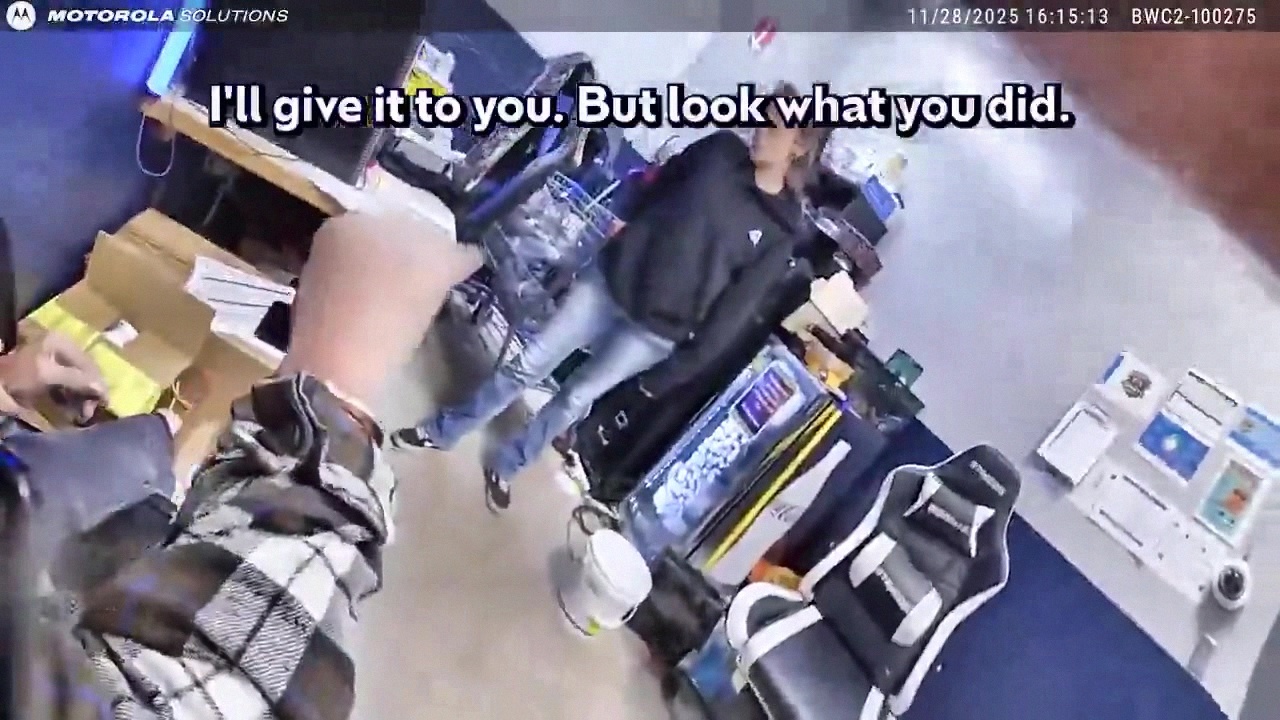
The confrontation reaches its peak when officers move to apply handcuffs. The body camera jolts and blurs as the woman resists, and her voice rises into repeated cries that she is in pain.
"Get off of me. You're hurting me. You're hurting me," she yells. The officer fires back that he asked her nicely, and the woman insists she understands she is under arrest but that the cuffs are tearing her skin. At one point she appears to relent, telling him, "I'll give it to you, but look what you did."
The struggle does not end cleanly. The officer issues commands for her other hand, and per the source account she kicks him during the struggle. That detail is what converts the encounter from a suspected misdemeanor theft into the felony charge the officer describes on camera. The video's final moments show a pixelated view of the office as the arrest is completed.
What the Record Shows
The aftermath, as described by the source account, is a case that carries consequences far beyond a single missed scan at a self-checkout kiosk. The author of the post frames it as a lesson in honesty, noting that the woman's refusal to produce an ID cost her far more than the merchandise in question.
| Incident Parameter | Recorded Observation / Field Evidence |
|---|---|
| Location | Florida Walmart, per the source description |
| Subject | 63-year-old woman detained at self-checkout |
| Initial allegation | Skip-scanning items at a self-checkout register |
| Officer request | Identification during a lawful investigation |
| Subject response | Refused ID, invited arrest, "Take me to jail" |
| Physical escalation | Fought the cuffs, cried out in pain, kicked the officer per the source |
| Charge upgrade | Battery on a law enforcement officer, a felony in Florida |
| Reported disposition | No contest plea to resisting and theft, anger management, apology letters |
Read more:
Read more: Lancaster Body Cam Footage Shows Deputy Standoff With Armed Man →
Core Questions and Unresolved Issues
- Did the woman believe the officer's arrest threat was a bluff, or was she simply unwilling to hand over a card?
- At what point does a refusal to identify cross from a store policy dispute into criminal obstruction under Florida law?
- How does the presence of a handicapped family member outside the store factor into how officers handle detention decisions?

A Costly Refusal
The viral clip has drawn divided reaction, with some commenters arguing that compliance would have ended the encounter in minutes and others questioning the officer's tone during the exchange. What remains undisputed in the footage is the sequence: a request for ID, a refusal, an invitation to jail, and a struggle that escalated into a felony allegation.
Was the refusal a matter of principle, or a moment of pride that cost far more than the items at the register?
Read more
- Lancaster Body Cam Footage Shows Deputy Standoff With Armed Man
- {“hook”: “A bystander keeps demanding to see a warrant while federal agents physically pull a restaurant owner from his vehicle.”, “bai”: “**Bystander Demands Warrant as ICE Agents Arrest New York Restaurant Owner**\n\nA tense roadside confrontation in Mount Morris, New York, unfolded on October 20 as federal immigration agents took a local restaurant owner into custody while a bystander repeatedly demanded to see an arrest warrant. The encounter, captured on camera, shows the man resisting before agents physically remove him from a white vehicle, raising immediate questions about due process and the limits of warrantless immigration enforcement.\n\n## Incident Overview and Key Developments\n\n- **Dian Zhao Lin**, a Mount Morris, New York restaurant owner, was taken into custody by ICE on October 20.\n- ICE records list the same individual under the name **Sin Di Ling**, according to the source description.\n- A bystander repeatedly asked agents whether they had a warrant and whether they had shown it to the man.\n- The man does not appear to speak English and physically resists as agents pull him from a white vehicle.\n- A verbal dispute over the man’s **keys** erupts between the bystander and agents during the arrest.\n\n## The Scene at the Vehicle\n\nThe footage opens tight on a white vehicle with its door open, sunlight glaring off the glass. A man in a red shirt is visible inside the cabin, and a federal agent in a black tactical vest marked **POLICE ICE** leans into the doorway. The camera is close enough to capture the friction of the moment, with the agent’s equipment and the vehicle’s frame filling the shot.\n\nFrom the first frames, the situation is clearly physical. The agent is not standing back to talk; he is reaching into the vehicle, and the man inside appears to be holding his ground. The camera operator’s voice cuts in almost immediately, asking whether the agents have a warrant for the arrest. That question becomes the spine of the entire recording.\n\nThe confrontation is not a chaotic chase or a hidden stakeout. It is a daylight, open-door arrest in what appears to be a public setting, with bystanders close enough to intervene verbally. That proximity is what turns a routine enforcement action into a documented dispute over procedure.\n\n[IMAGE_QUERY: federal agents in tactical vests standing beside an open vehicle door on a sunny street | CAPTION: Archival visual context documenting the incident via Pexels / Public Domain Archive.]\n\n## The Warrant Question Takes Center Stage\n\nThe most repeated line in the recording is a direct challenge: **\”Do you have a warrant for his arrest? Did you show him the warrant?\”** The question is asked more than once, and it is not answered with a document. Instead, the response captured on audio is a flat dismissal, with the agent saying he is \”good\” and does not need to comply with the demand as framed.\n\nThe bystander does not let it go. The voice presses on the man’s behalf, framing the demand as a matter of fairness: **\”I’m making sure you’re doing right by them.\”** That line reframes the encounter from a simple arrest to a question of whether the people being detained are being treated correctly. It is the moment the recording shifts from observation to advocacy.\n\nThe back-and-forth also includes a question about **why force is being used** on the man. That question lands while the physical removal is already underway, which makes it less of a procedural inquiry and more of a protest against what the camera is capturing in real time.\n\n> Important Note: The core legal dispute in this footage is whether a judicial warrant is required for this particular arrest, and the recording captures a bystander asserting that requirement while agents proceed without producing one.\n\n## The Struggle at the Door\n\nThe physical confrontation escalates as the agent works to pull the man from the vehicle. The man in the red shirt is seen resisting, and the camera captures the awkward, grinding mechanics of an arrest that is not going smoothly. Arms and shoulders fill the frame as the agent leans in, and the vehicle rocks slightly with the effort.\n\nA second voice can be heard asking for names, including **\”What’s your name? What’s your last name?\”** That request for identification is another accountability tactic, aimed at making the agents traceable after the fact. It is a familiar move for bystanders who know they cannot stop an arrest but can at least document who is carrying it out.\n\nThe man himself is largely silent in terms of English. The source description notes he does not appear to speak a word of English, which adds a layer of isolation to the scene. He is being pulled from a vehicle by agents while a stranger argues on his behalf, and the language barrier makes the bystander’s advocacy the only verbal defense in the frame.\n\n[IMAGE_QUERY: close view of an agent in a tactical vest leaning into an open car door during an arrest | CAPTION: Archival visual context documenting the incident via Pexels / Public Domain Archive.]\n\nThe agent’s face becomes visible in the frames, showing a bearded man in a green cap with sunglasses perched on the brim, a radio on his vest and a baton at his side. His expression is flat and focused, and the camera does not catch him addressing the warrant question directly beyond the brief dismissal captured in the audio.\n\n## The Dispute Over the Keys\n\nAs the removal continues, the focus narrows to a surprisingly small object: the man’s **keys**. The audio captures a rapid exchange, with someone insisting, **\”Let him get his key,\”** and the man himself repeating, **\”my key.\”** The struggle over something so mundane becomes a stand-in for the larger fight over control of the moment.\n\nA voice asks, **\”Can I have his key? Let me have his key,\”** while another voice orders someone to **\”back up.\”** The tension spikes as the bystander refuses to yield ground, and the audio captures the sharp reply: **\”No, I need to back up now. Yes, you do.\”** It is the sound of a confrontation that has moved past procedure and into pure friction.\n\nThe bystander then turns personal, asking the agent, **\”Do you feel good about yourself?\”** That line hangs over the footage because it is not a legal argument at all. It is a moral one, aimed at the person doing the arrest rather than the policy behind it.\n\n> \”Do you have a warrant for his arrest? Did you show him the warrant?\”\n\n## What the Record Actually Shows\n\nThe footage does not show a warrant being produced, nor does it show a warrant being read aloud. What it shows is a bystander demanding one and an agent continuing with the arrest. That gap is the factual core of the dispute, and it is what makes the video circulate far beyond Mount Morris.\n\n| Incident Parameter | Recorded Observation / Field Evidence |\n|—|—|\n| Date of custody | October 20, per source description |\n| Location | Mount Morris, New York |\n| Individual taken into custody | Dian Zhao Lin, listed by ICE as Sin Di Ling |\n| Occupation noted in source | Restaurant owner |\n| Vehicle involved | White vehicle with open door |\n| Bystander’s central demand | Production of an arrest warrant |\n| Language noted | Man does not appear to speak English |\n\nRead more: {NOIBO}\n\nThe recording also captures the limits of bystander intervention. The person filming can ask questions, request names, and demand documents, but none of that stops the physical removal. The video ends with the man being taken into custody and the argument over keys and backup still unresolved.\n\n[IMAGE_QUERY: wide view of a white vehicle on a sunlit street with agents and bystanders nearby | CAPTION: Archival visual context documenting the incident via Pexels / Public Domain Archive.]\n\n## Core Questions and Unresolved Issues\n\n- Did federal agents possess a judicial warrant at the time of the arrest, and was any document shown to the man or to bystanders?\n- What specific legal authority allowed the arrest to proceed without the warrant the bystander demanded?\n- How will the language barrier affect the man’s ability to understand the charges and challenge his custody?\n\n## A Local Business Owner in the Spotlight\n\nThe source identifies the man as a **restaurant owner**, which places the arrest in the context of a small community rather than an anonymous enforcement statistic. A local business owner being pulled from a vehicle in daylight is the kind of event that neighbors remember, and the video makes that personal dimension impossible to ignore.\n\nThe bystander’s repeated invocation of **\”them\”** suggests the man was not alone in the broader sense, even if he was alone in the vehicle and without English in the moment. The recording captures a community member stepping into a gap, however briefly, to demand accountability on the record.\n\nWhat remains is the footage itself: an open door, a red shirt, a tactical vest, and a voice asking the same question over and over. The video does not resolve the legal debate it has sparked, and it does not pretend to. It simply documents the moment the question was asked and the arrest continued anyway.\n\nWhat should bystanders be allowed to demand during a federal immigration arrest, and does the answer change when the person being detained cannot speak the language of the agents? \n\nfb”: ” A bystander demanded to see a warrant, and seconds later the agents kept pulling him from the car.\n\nSee how the incident ended and read the full outcome in the comments below \n\n#ICEArrest\n\n[BÌNH LUẬN]\n\nWhat happened after the camera cut: watch the full video below “, “best_frame”: 4, “inline_frames”: [2, 5], “seo”: {“seo_title”: “ICE Arrest of NY Restaurant Owner Sparks Warrant Dispute”, “meta_description”: “Bystander demands a warrant as ICE agents arrest Mount Morris restaurant owner Dian Zhao Lin on October 20, capturing a tense roadside confrontation on video.”, “slug”: “ice-arrest-mount-morris-restaurant-owner-warrant-dispute”, “focus_keyword”: “ICE arrest warrant dispute”, “category”: “Community Watch”, “tags”: [“ICE arrest”, “Mount Morris New York”, “Dian Zhao Lin”, “warrant dispute”, “immigration enforcement”, “bystander video”]}}
- Officials Reveal Facts Behind Viral ICE Arrest Video