ASU Wants a 124-Year-Old Phoenix Home for Its Medical Campus. The Owner Is 89 and Has Lived There 50 Years.
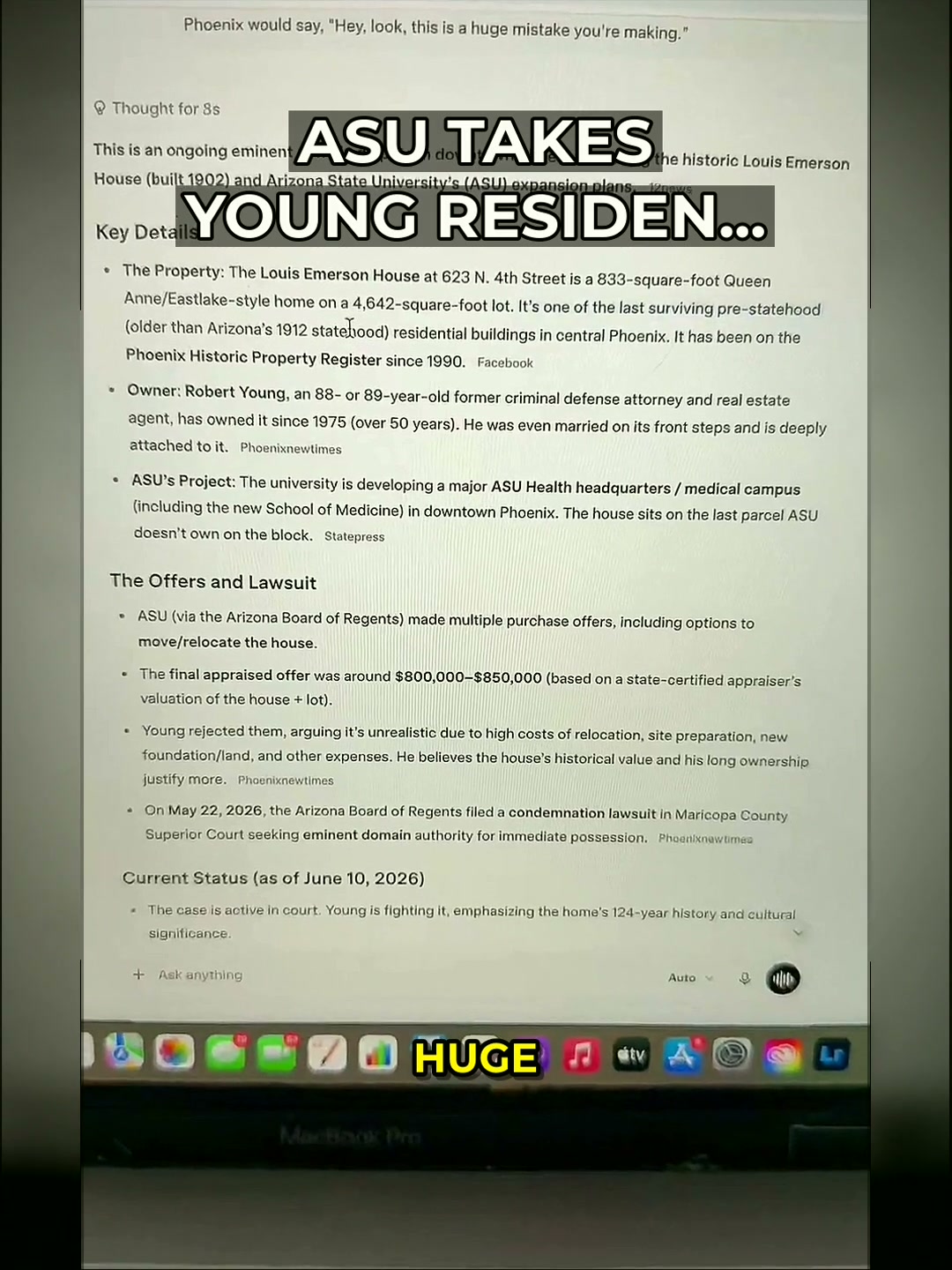
A university’s push to expand its downtown health campus is colliding with one of the last surviving pre-statehood homes in central Phoenix — and the senior citizen who still calls it home.
- Arizona State University filed to take a 124-year-old Phoenix home through eminent domain for its downtown health campus.
- The owner is an 89-year-old senior citizen who has lived in the house for 50 years.
- The property has sat on the Phoenix Historic Property Register since 1990 and predates Arizona statehood.
- The case raises hard questions about medical expansion, property rights, and who pays when institutions grow.
Imagine a knock at your door after five decades of memories. The house you raised a family in. The porch you repaired yourself. The neighborhood you watched change around you. Now imagine a letter saying the government can take it — not because you failed to pay, not because you broke a law, but because a university wants the land.
That is the reality facing an 89-year-old Phoenix homeowner. Arizona State University has filed to acquire his property through eminent domain, the legal power that lets government entities seize private land for what courts call “public use.”
The stated reason: ASU needs the parcel for its downtown health campus.

The home is not just old. It is rare. According to historical records, it is one of the last surviving pre-statehood residential buildings in central Phoenix — older than Arizona’s 1912 statehood. It has been listed on the Phoenix Historic Property Register since 1990.
For the owner, though, the value is not measured in register listings. It is measured in 50 years of mornings in the same kitchen.
The Medical Campus Math Nobody Explains Up Front
Here is where the story hits every American household. Health campuses do not appear out of thin air. They are built on land, funded by bonds, grants, and revenue streams — and sometimes assembled parcel by parcel through legal pressure.
Patients rarely see this part. They see the shiny new facility, the expanded emergency wing, the specialty clinics. What they do not see is the family that was displaced to make room for it.
The tension is not abstract. Medical expansion is presented as a public good, and often it is. But the cost of that good does not fall evenly. It falls hardest on the individual who happens to own the last piece of the puzzle.
“It’s one of the last surviving pre-statehood residential buildings in central Phoenix. It’s been on the Phoenix Historic Property Register since 1990, and they want to tear it down to build a medical facility.”
Read that again. A building that existed before Arizona was a state. A structure that survived two world wars, the Great Depression, and decades of urban transformation. Slated for demolition.
What This Means for Ordinary Homeowners
The instinct is to think this is a Phoenix problem. It is not. Every state has its own version of this statute. Every growing city has an institution that needs more square footage. Every homeowner is technically one filing away from the same letter.
For seniors, the stakes are especially brutal. An 89-year-old man cannot simply restart. He cannot take out a new 30-year mortgage. He cannot absorb a relocation, a legal battle, and a disrupted routine without real cost to his health and finances.

This is where healthcare costs and property rights collide in a way most people never plan for. The same system that is supposed to heal people is, in this case, the entity pushing a man out of his home.
And the compensation process is not a simple check. Fair market value is a number. Fifty years of life is not.
The Legal Precedent
Eminent domain cases involving universities and medical institutions have moved through U.S. courts for decades. The core question is almost always the same: does the taking serve a genuine public purpose, and is the compensation truly just?
Courts have generally sided with condemning authorities when a legitimate public benefit can be shown. But the bar is not unlimited. Owners can challenge necessity, contest valuation, and in some cases argue that the taking is disproportionate to the stated benefit.
What makes this case unusual is the historic designation. A property listed on a local historic register carries additional review layers. Demolition is not supposed to be automatic. Community input is supposed to matter.
Whether those protections hold up against a major university’s legal filing is the question now hanging over a 124-year-old house and the 89-year-old man inside it.

The filing is on the record. The house is still standing. The owner is still there — for now.
And every homeowner reading this should ask one uncomfortable question: if it can happen to a pre-statehood landmark owned by a senior citizen, what exactly protects the rest of us?