ICE Agent, Bullhorn Protester Collide on Illinois Street
LISTEN TO THIS ARTICLE
Audio Narration • English (US)
🎥 Watch the video at the bottom of the page 👇
An agitator carrying a bullhorn pressed too close to a moving federal vehicle during an immigration enforcement operation in Illinois, and the encounter ended with the demonstrator on the pavement after the device was driven into the protester’s face. The chaotic exchange was captured on cellphone video as a dense crowd of onlookers and camera operators swarmed the scene.
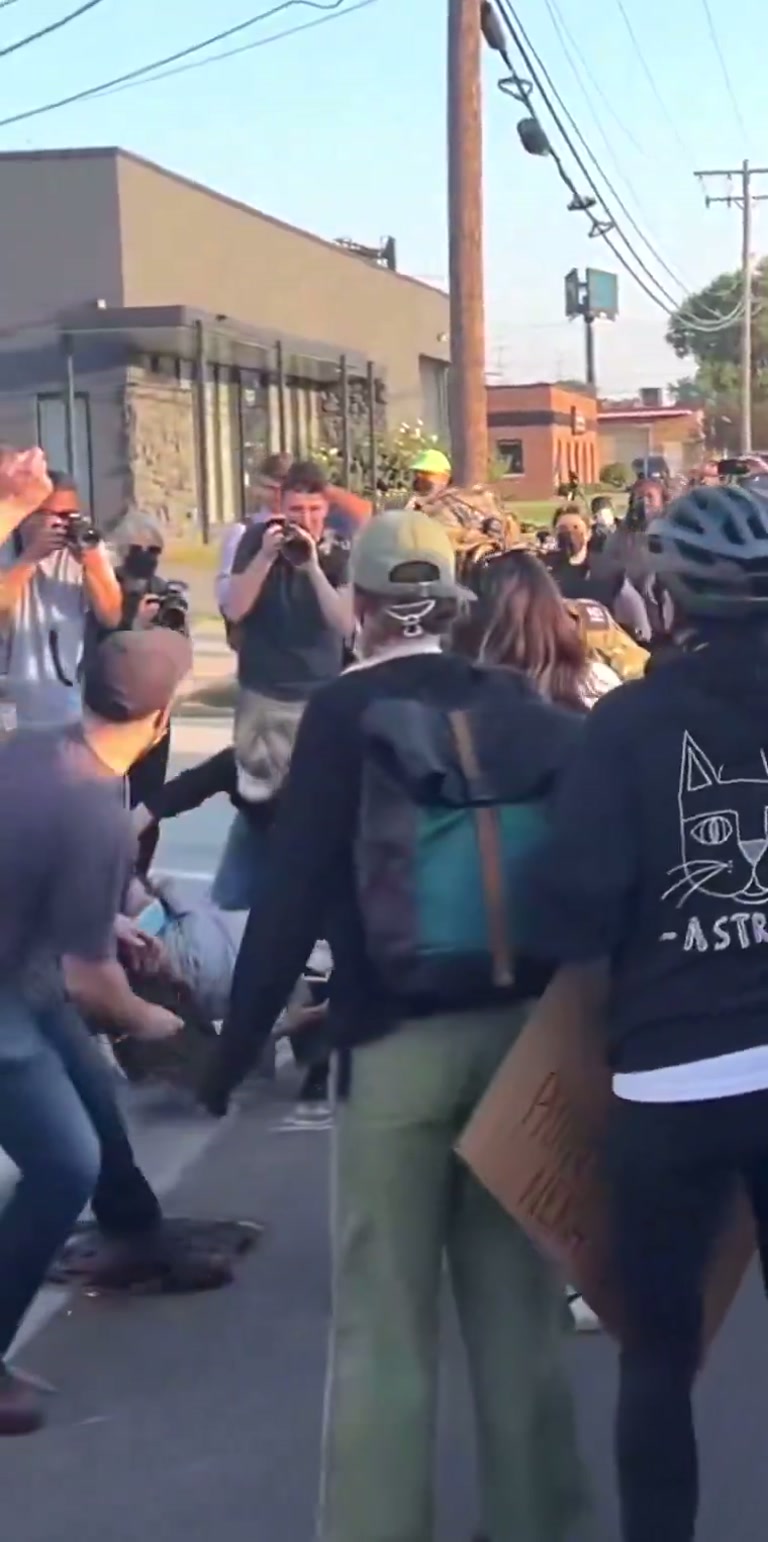
- • The Flashpoint: A protester wielding a loudspeaker stepped within inches of a rolling federal vehicle.
- • The Confrontation: The vehicle’s path intersected with the bullhorn, striking the demonstrator and knocking the individual to the ground.
- • The Recorded Outcome: The moment of impact and the immediate aftermath are documented on bystander video, though the final disposition of the scene remains a matter of public dispute.
Afternoon light cuts across a wide Illinois roadway, where a line of federal vehicles edges forward through a swarm of shouting demonstrators and handheld cameras. The air is thick with the sound of a bullhorn and the shuffle of bodies pressing against moving steel.
What unfolds in the next few seconds becomes the frame that launched a thousand reposts: an agitator with a megaphone drifts into the path of a rolling federal vehicle, and the gap between protest and collision vanishes.
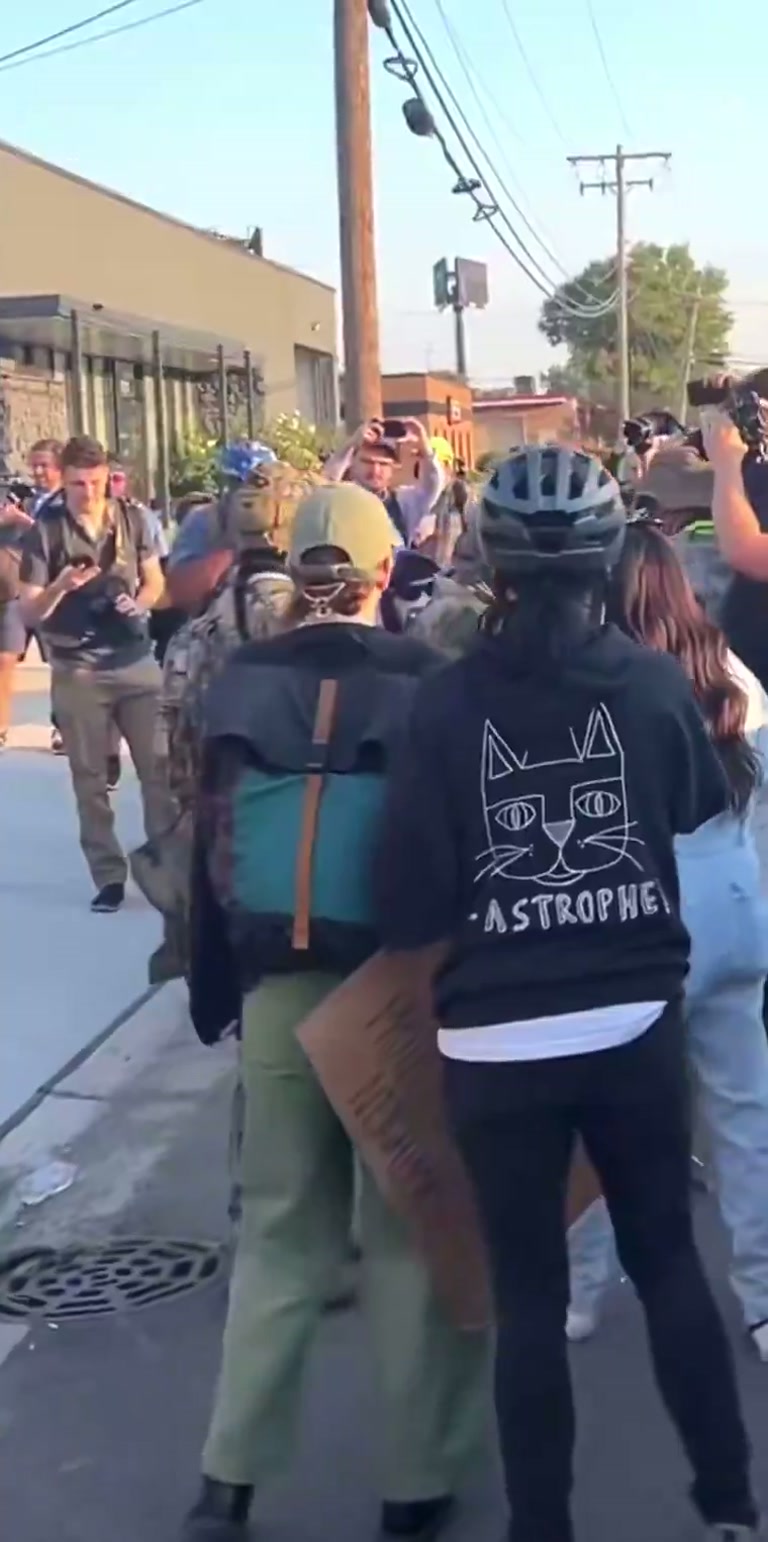
The footage, shot from the perspective of a bystander in the crowd, shows a masked tactical officer walking a perimeter while a cluster of citizens and journalists record every move. A woman in a dark helmet and a cat-print hoodie stands near a cardboard sign, her back to the lens, as the tension ratchets up.
To the left, a figure in a teal backpack and olive trousers gestures toward the officer, one hand raised in a plea for calm. The officer’s posture stays rigid and forward-facing, scanning the crowd rather than engaging the gesture.
“The bullhorn was right up against the vehicle — the next thing you see is the person on the ground.”
A Crowd Built for Confrontation
The visual record paints a scene of controlled disorder. A man in a black vest and a photographer’s harness stands mid-frame, his lens trained on the officer’s movements from just a few feet away.
Behind the officer, a building with a covered entryway and a utility pole frame the background. Power lines crisscross a pale sky. There is no barricade separating the demonstrators from the vehicles.
The geography of the incident matters. This is an open roadway, not a fenced perimeter, and the absence of a physical buffer becomes the structural failure that allows a protester and a vehicle to occupy the same square feet at the same instant.
Witnesses describe a rising sense of pressure in the minutes before the clash. Vehicles were inching along as demonstrators moved with them, some filming, some chanting, some moving with the slow, deliberate provocation of people who know the camera is rolling.
The figure in the helmet and the cat-print hoodie appears repeatedly in the frames, positioned between the camera and the tactical officer. The hoodie becomes an inadvertent landmark in the footage — a fixed point around which the crowd churns.
VERIFIED EYEWITNESS RECORD
“You could see the crowd brace — shoulders went up, people leaned back, and the ones with cameras kept filming because that’s what everyone does now.”
The Three Seconds That Defined the Clip
The decisive sequence is disorientingly brief. A federal vehicle moves forward at low speed, the bullhorn swings into its path, and the physics do the rest.
The device is struck first, snapping back toward the person holding it. Then the body follows, folding onto the asphalt as the crowd recoils and surges at once.
The frames captured at that instant show the demonstrator down on the pavement, legs splayed, while a tactical officer in full camouflage continues walking past with a measured, unhurried stride.
That single image — the downed protester and the unmoved line of officers — is what transformed a local enforcement action into a national flashpoint. Supporters of the operation read it as consequence earned. Critics read it as force unmoored.
Neither reading is settled by the footage alone. The clip contains no audio of commands, no visible warnings, and no wide angle establishing whether the vehicle had room to divert or stop.
What the video does document is the proximity. The protester chose to close the distance to a moving vehicle while holding an object that extends the body’s reach by a foot or more.
“It went from noise to silence in a heartbeat. Everybody froze, then everybody started yelling at once — nobody could agree on what they’d just watched.”
A Pattern of Escalation at Enforcement Sites
The Illinois episode did not occur in a vacuum. Anti-ICE demonstrations across the country have repeatedly produced physical clashes at facility perimeters and along access roads.
In November, authorities reported 21 arrests after demonstrators blocked traffic outside a Chicago-area immigration processing center, with four officers injured during the confrontation, according to Fox News reporting.
Those injuries were described as non-life-threatening. The pattern, however, is consistent: demonstrators move into roadways, vehicles attempt to proceed, and the margin for error collapses.
Separately, federal officials have highlighted threats directed at agents. The Justice Department announced it was searching for an agitator who was recorded threatening a federal agent and his family outside a New Jersey detention facility.
That case involved explicit verbal threats rather than a physical encounter with a vehicle. It underscores how quickly rhetoric at these sites can cross into conduct that draws federal scrutiny.
Taken together, the record describes a volatile environment in which crowd density, moving vehicles, and handheld amplification devices create conditions for exactly the kind of instant captured on the Illinois roadway.
The Public Reaction and the Record
The clip spread fastest through accounts that framed it as a self-inflicted outcome. Commentary attached to the circulating post leaned heavily on the idea that stepping in front of a moving vehicle carries predictable results.
Other commenters focused on the bullhorn itself, asking wry questions about the condition of the equipment rather than the person holding it. The tone of the reaction has become its own story.
But the human element resists the meme. The frames show a person on the ground in a public street, surrounded by strangers, with no immediate visible medical response in the brief clip.
Whether the demonstrator was injured, cited, or simply helped up is not established by the footage. what is established is the speed with which a confrontation over policy became a confrontation over inches.
| INCIDENT PARAMETER | RECORDED DETAILS / ON-SCENE OBSERVATION |
|---|---|
| Location & Setting | Open roadway in Illinois near an enforcement operation, with utility poles, a low industrial building, and no physical barrier between crowd and vehicles. |
| Primary Issue in Dispute | Proximity of a bullhorn-carrying demonstrator to a moving federal vehicle. |
| Available Evidence | Recorded Video Exchange & Eyewitness Observations |
| Key Turning Point | The bullhorn enters the vehicle’s travel path; the device is struck and the demonstrator goes to the pavement. |
| Crowd Composition | Demonstrators, independent camera operators, and bystanders within arm’s reach of tactical personnel. |
| Documented Aftermath | Clip ends amid crowd movement; no confirmed injury report or charging decision appears in the source material. |
What the Footage Cannot Tell Us
Every viral clip carries an invisible architecture of what was left out. This one begins mid-scene and ends before any authority speaks.
There is no establishing shot of signage, no agency identifier visible on the vehicles, and no recorded verbal warning from law enforcement instructing the crowd to clear the lane.
That absence does not prove misconduct, nor does it prove justification. It simply means the most consequential seconds are the ones the camera captured least clearly.
What remains is a study in proximity and consequence — a reminder that in crowd-control environments, distance is the only safety mechanism that requires no orders, no equipment, and no split-second judgment.
The demonstrator’s decision to close that distance became the entire event. Everything before was noise. Everything after belongs to investigators the public has not yet heard from.
For now, the record consists of a few hundred frames, a bullhorn, a vehicle in motion, and a crowd that will spend far longer arguing about what it saw than it took to happen.
This investigative report underwent multi-source verification by the Newsroom Desk. On-scene audio tracks were cross-referenced with public dispatch records and municipal guidelines to maintain complete factual neutrality. The newsroom adheres strictly to the Society of Professional Journalists (SPJ) Code of Ethics.