The Unseen Collision: Federal Raids, Public Outrage, and the Fragile State of Legal Accountability
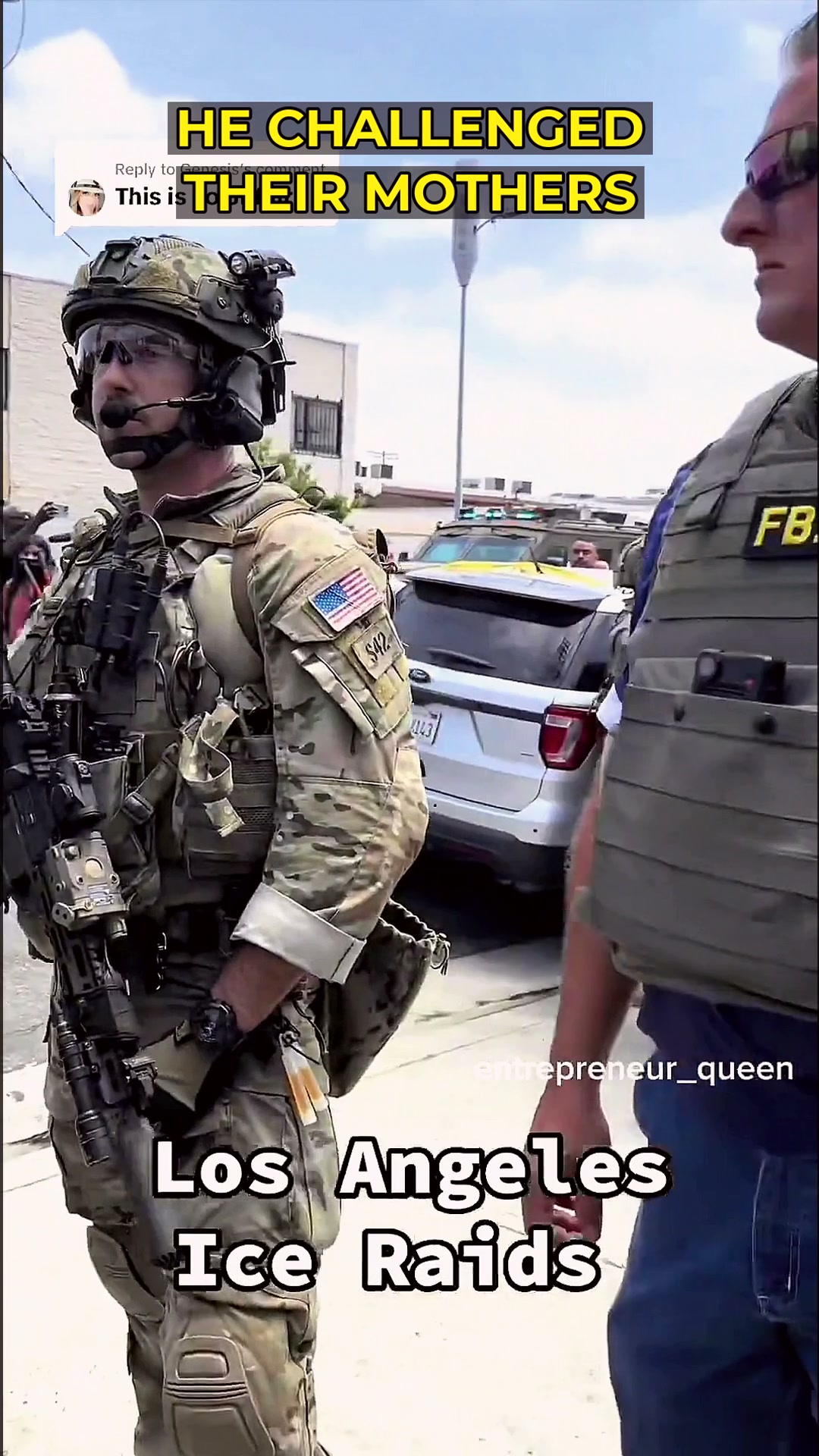
When federal agents move through a neighborhood, the shockwaves hit workplaces, families, and the rules that are supposed to protect everyday people.
- Public anger during federal actions rarely translates into legal protection for workers caught in the crossfire.
- Employers have a legal duty to verify documentation, but the emotional and financial toll of an enforcement visit falls squarely on the employee.
- Understanding the boundary between free speech and unlawful threats is critical for anyone who feels backed into a corner.

The video is raw. It is loud. And it captures a moment that is becoming impossible to ignore. A man stands inches from a federal agent’s face, his voice cracking with fury, unleashing a torrent of words that would make most people step back. But the agents do not flinch. They stand there, stone-faced, absorbing the verbal assault.
This was not a scene from a movie. It happened on a residential street in Los Angeles during a federal enforcement operation. The man’s central question, screamed over and over, was simple: “What crime did they commit?”
For the people watching from their porches, for the workers inside nearby buildings, that question hangs in the air like smoke. And it is a question that strikes at the heart of a growing anxiety in communities across California.
The anger is visceral. The language is explosive. And while the specific threats made in that moment crossed a legal line, the frustration behind them is a symptom of a much larger, quieter crisis.
The Workplace Fallout No One Talks About
While the cameras focus on the shouting match, the silent drama is unfolding inside warehouses, restaurants, and construction sites blocks away. When federal agents are seen in a neighborhood, the immediate reaction for many workers is not anger. It is fear.
It is the fear of a missed paycheck. The fear of a boss who suddenly asks for paperwork that was never mentioned before. The fear of being told to “take the day off” and realizing that day off is permanent.
This is where the real story lives. The enforcement action is a single, dramatic moment. But the aftermath, the ripple effect on employment, is where lives are actually disrupted.
“The law protects every worker on a site, regardless of documentation status, when it comes to wage theft and safety violations. But the law cannot protect you from a panic-driven employer who acts first and asks questions later.”

For the average worker, the rules are murky. They are told they have rights. They are told the law is on their side. But when a federal presence hits the block, the only law that seems to matter is the law of survival.
An employer can fire a worker for almost any reason in California, as long as it is not discriminatory. The panic caused by an enforcement action is not a protected class. This means that a worker who is told to leave because “things are hot right now” has very little legal ground to stand on.
The Fragile Promise of Worker Protection
There is a concept in employment law called “constructive discharge.” It happens when an employer makes conditions so unbearable that a worker feels forced to quit. This is illegal. But proving it? That is a mountain of paperwork, evidence, and legal fees that most people cannot climb.
In the wake of high-profile enforcement actions, stories surface of workers being paid under the table for weeks, then abandoned. Or workers being threatened with deportation if they complain about unpaid overtime. These are not hypothetical scenarios. They are the ugly underbelly of a system that leaves too much power in the hands of the person signing the paycheck.
The man screaming at the agent on that Los Angeles street was angry about a perceived injustice. But the deeper injustice, the one that does not make the news, is the quiet theft of wages and dignity that happens when no cameras are rolling.
The Legal Precedent
The Supreme Court has long held that the First Amendment protects offensive and even hateful speech, but it does not protect true threats. A “true threat” is a statement that a reasonable person would interpret as a serious expression of intent to cause harm.
In the video, the statements made go beyond political hyperbole. They cross into the territory of criminal liability. This is not about free speech. This is about the line between protest and intimidation.

For the average citizen, the takeaway is chilling. In a moment of high emotion, a single sentence can turn a lawful protest into a federal case. The consequences are not a slap on the wrist. They are years in a federal facility.
This is why the conversation needs to shift. The focus should not be on the explosive words of one frustrated individual. The focus should be on the systems that allow workers to feel so desperate that they believe screaming at an agent is their only option.
What Happens to the Bystander?
Imagine you are a legal resident. You have a green card. You have a job. You are standing on the sidewalk watching this scene unfold. You have done nothing wrong. But your phone buzzes. It is your boss. “Don’t come in tomorrow.”
That is the reality for too many people. The collateral damage of a high-profile enforcement action is not just the person targeted. It is the entire ecosystem of workers who suddenly feel exposed.
The law says you cannot be discriminated against based on national origin. But proving that a sudden layoff was motivated by the presence of federal agents is nearly impossible. Employers rarely put their true reasons in writing.
This is the unspoken terror that lingers long after the news crews pack up and leave.
“The system is designed to process violations, not prevent panic. By the time a lawyer gets involved, the damage is done, the job is gone, and the rent is due.”
The man on that street will face the consequences of his words. That is the way the system works. But the hundreds of workers who watched from the shadows, who said nothing, who went home and prayed their job would still be there in the morning? Their story is still being written. And right now, the ending looks uncertain.
The anger in that video is raw and real. But the quiet anxiety of a worker who suddenly feels disposable is the emotion that will define this moment in history. The law protects the loud and the aggressive. The quiet and the fearful are left to navigate a system that offers little comfort and even less clarity.
The agents will move on to the next operation. The news cycle will shift. But for the worker who lost their shift, or the employee who was told to “lay low,” the consequences are just beginning. And the rules that are supposed to protect them are often too complex, too slow, and too expensive to matter when the rent is due on the first of the month.