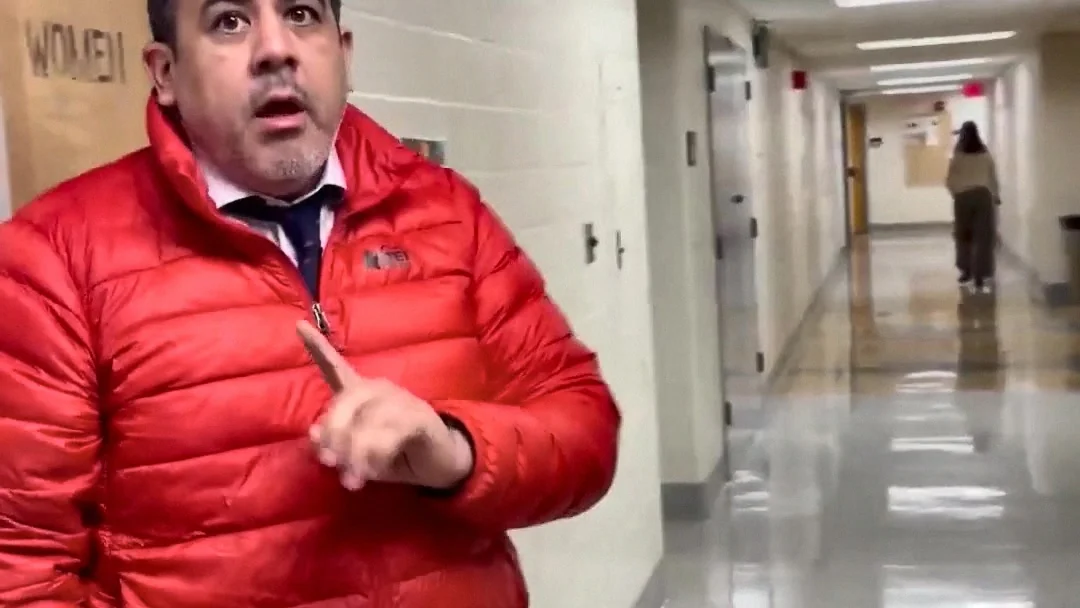
Linda Vista Skate Park Arrest: Woman’s Struggle Caught on Video
WATCH: On-scene video documentation is embedded below →
LISTEN TO THIS ARTICLE
Audio Narration • English (US)
The late afternoon light at the Linda Vista Recreation Center cast long shadows across the concrete plaza, but the atmosphere was already boiling over before the first squad car pulled up. A woman who had spent the better part of an hour hurling insults at families and children near the skate bowls suddenly found herself in a desperate, flailing struggle against a uniformed officer. What the forty-second clip captures is not a quiet detention, but a raw, snapping point – a moment where public rage meets public authority on a slab of sun-warmed pavement.
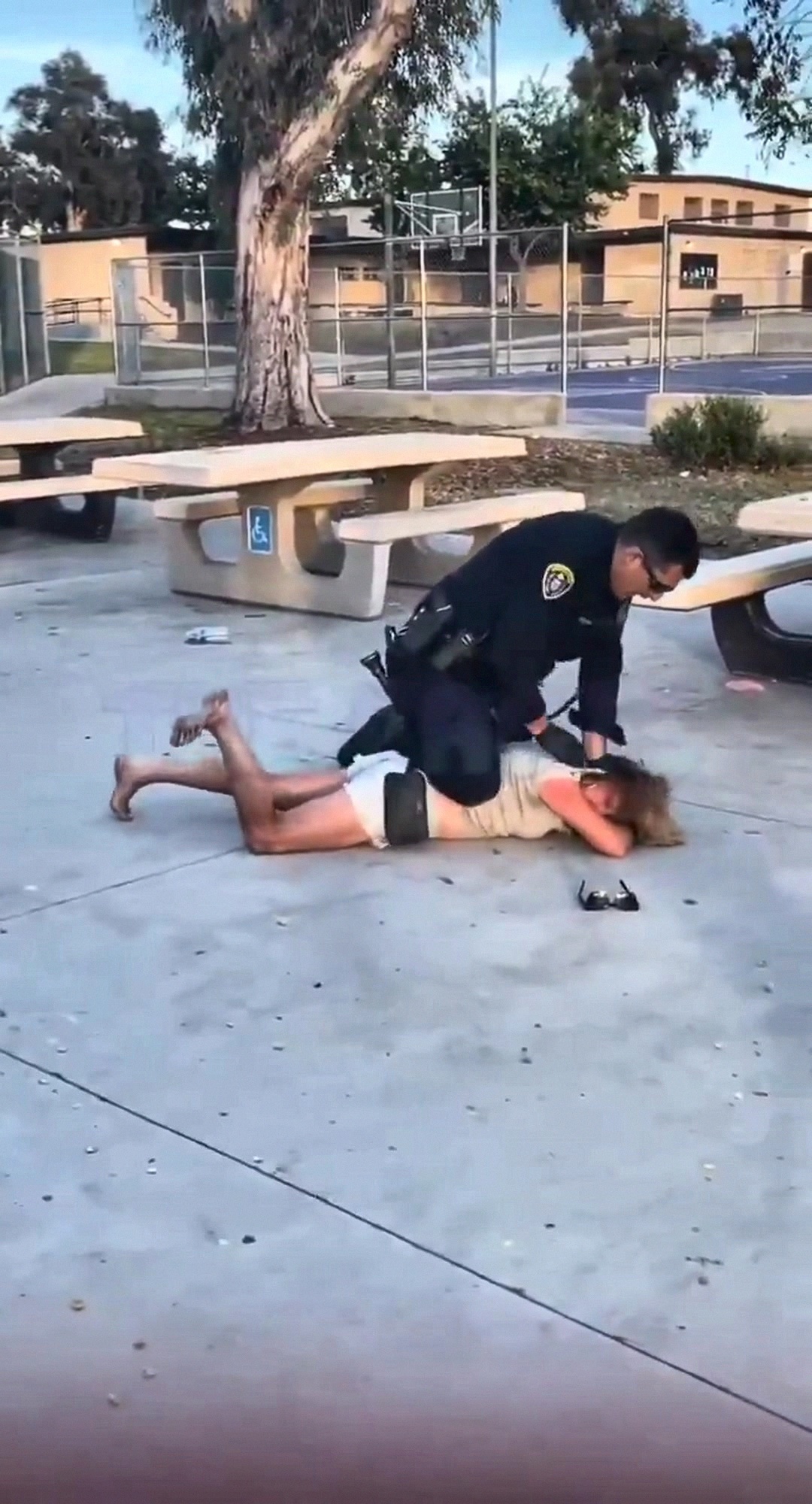
- The Scene: A paved recreation area beside a skate park in Linda Vista, California, with wooden picnic tables and a chain-link backstop framing the background as evening approached.
- The Friction: Witnesses reported the woman had been aggressively confronting adults and children at the facility, with initial calls to emergency lines describing her as verbally hostile and making inappropriate remarks toward minors.
- The Intervention: A responding officer approached her near a park bench, and the interaction escalated instantly from a tense confrontation into a physical struggle when she refused commands and pulled away.
- The Aftermath: The officer took her to the ground in a controlled takedown, restrained her on the concrete, and she was later arrested on multiple charges, including resisting an officer and assaulting an officer during the struggle.
What the Recorded Footage Captures: Chronological Breakdown
The video opens with the officer already standing over the seated woman, his left hand locked around her left wrist in a tense, tug-of-war posture. She is planted on a bench near a wooden picnic table, pulling back against his grip while her posture radiates defiance. The officer's stance is calm but braced, and the ambient sound of nearby footsteps and muffled bystander chatter fills the air. In a single, fluid motion, the officer shifts his free hand to the back of her neck and pivots her off the bench, driving her toward the pavement with a controlled hip throw.
Her body strikes the concrete hard enough to bounce, and her sunglasses skitter away across the slab, spinning to a stop a few feet from her head. Witnesses off-camera gasp audibly, their sharp reactions cutting through the heavy, still air of the park. The officer immediately rolls her to a chest-down position, settles his weight across her upper back, and begins working to secure her hands behind her. The camera shakes slightly as the person filming adjusts their position, and a silhouette of a police cruiser sits parked in the background beside the bench where she had been sitting moments earlier.
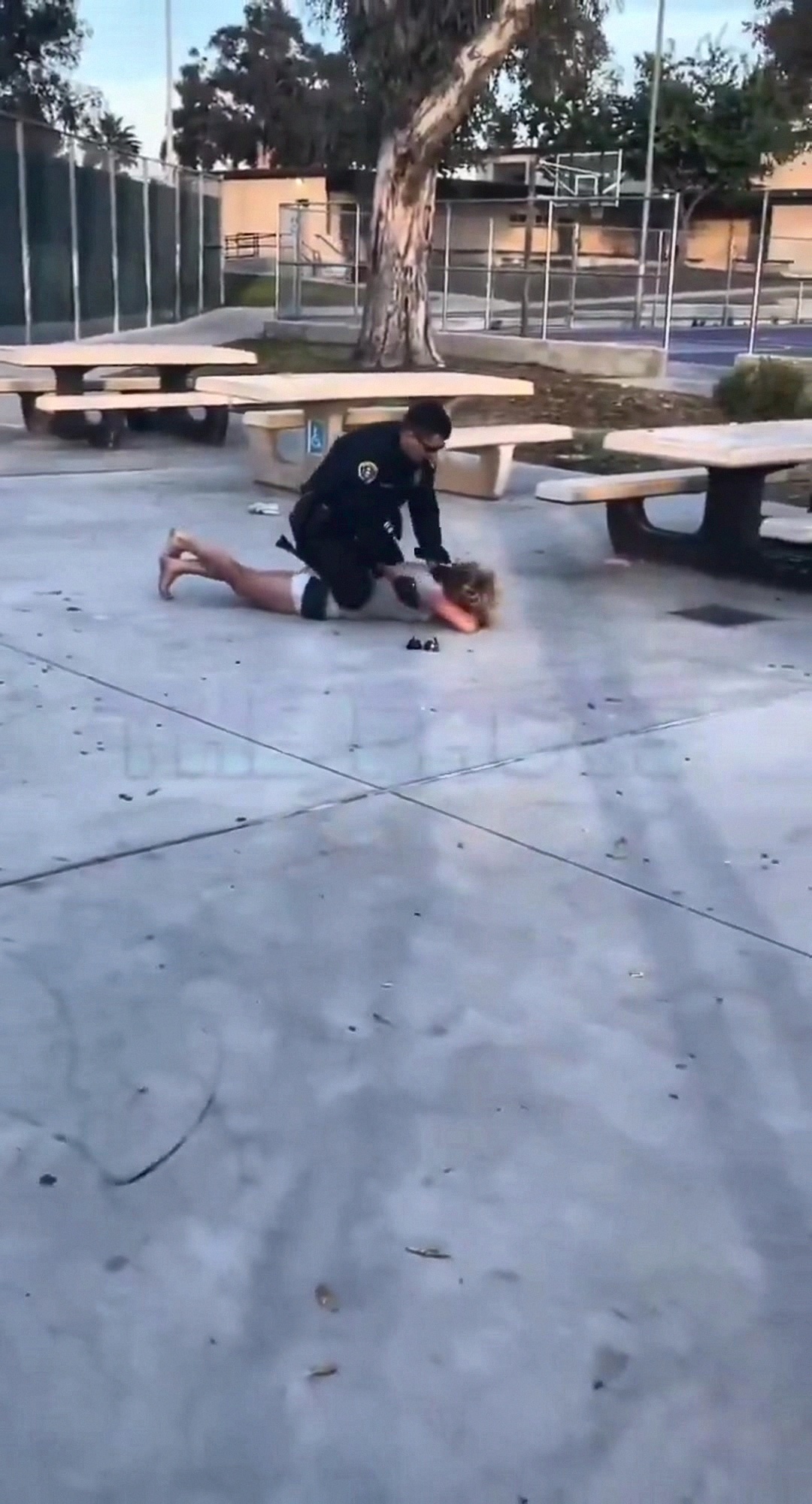
As the officer fights to lock in a wrist hold, the woman's voice erupts in a furious, ragged stream. She thrashes beneath him, shouting obscenities and threats, her words cutting through the ambient noise as she refuses to offer her arms. The audio captures her yelling at the officer, demanding he get off her while simultaneously vowing to fight. She kicks her bare feet against the concrete, her blonde hair splaying across the ground, and the officer maintains his composure, adjusting his position and speaking in a low, measured tone that the microphone fails to fully pick up. The struggle continues in a chaotic cycle of resistance and restraint until the video cuts away.
Critical Blind Spots: What the Lens Leaves Unresolved
What the clip does not show is the fifteen to twenty minutes that preceded it – the period when, according to witness accounts and the subsequent police report, the woman was allegedly shouting hostile remarks at children and parents. The camera only begins rolling at the exact moment the officer initiates the physical takedown, leaving the entire buildup of her behavior and the initial verbal commands off the record. This gap means viewers cannot see how many times she was asked to comply or what specific words were exchanged before the situation boiled over into a physical confrontation.
Additionally, the camera's angle obscures the precise mechanics of the takedown from certain vantage points, making it difficult to determine exactly when her head cleared the bench and when her body made contact with the ground. The faces of the bystanders remain largely anonymous, their voices captured only as gasps and indistinct murmurs, so their earlier testimony about her behavior is not visible in the frame. And crucially, the video ends before authorities place her fully in handcuffs and before the aftermath – her evaluation by paramedics and the officer's own injury – plays out on screen.
Statutory Framework and Protocol Analysis
In California, law enforcement officers responding to a disturbance call are generally required to issue clear verbal commands before escalating to physical force, and they are instructed to use only the amount of force reasonably necessary to gain compliance. In this incident, the officer's rapid transition from wrist-grab to a takedown suggests he perceived an imminent threat or determined that verbal commands had been exhausted. The woman's decision to pull away and then, according to the police report, bite the officer during the struggle, shifts the legal landscape – turning a disturbance call into an assault-on-an-officer investigation.
For recreation centers and parks in San Diego, staff and patrons expect a safe environment, especially during early evening hours when youth programs and family activities are in full swing. The call for service here was not a routine nuisance complaint; it was a report of aggressive behavior directed at visitors and children. Once an officer is on scene, the obligation to obey lawful commands applies to everyone, regardless of how frustrated or angry they may feel about the encounter.
| Incident Parameter | Recorded On-Scene Evidence |
|---|---|
| Location | Linda Vista Recreation Center, San Diego, near skate park plaza |
| Approximate Time | Early evening, daylight still present |
| Initial Call | Reports of aggressive behavior and hostile remarks toward visitors |
| Subject's Demeanor | Confrontational, refusing commands, physically pulling away |
| Physical Escalation | Takedown onto paved ground, visible body impact |
| Restraint Posture | Officer pinning subject chest-down, attempting to secure hands |
| Documented Injury | Officer reportedly bitten on the left hand during struggle |
Read more:
Read more: Camera Swat at Park Event Sparks Assault Claim →
The balance between individual resistance and officer safety is a fault line that runs through nearly every use-of-force review in the country. Departments typically examine the subject's level of aggression, the officer's verbal warnings, and the availability of alternative techniques. Here, the officer worked alone, with no visible partner on scene, which limits the options for a slower, more verbal resolution. Public reaction to such footage often splits between those who see necessary restraint and those who question whether the speed of the escalation was warranted.
Core Questions and Institutional Review
- What verbal commands, if any, were issued in the moments immediately before the initial wrist grab, and were they clearly audible to the subject?
- How long was the subject given to comply before the officer initiated the takedown, and did that window meet departmental policy standards?
- What were the specific statements the subject was making to children before law enforcement arrived, and how did witnesses describe their severity?
- What did the officer's injury evaluation reveal regarding the reported bite, and how does that factor into the charges filed?
The video ends with the struggle still in progress, the woman on the ground and the officer working to secure her hands. What remains unseen is the moment the handcuffs clicked shut, the moment she was lifted to her feet, and the quiet settling of a park full of onlookers who had just witnessed a confrontation they never expected at their neighborhood rec center. For every person who has watched this clip, the question lingers: at what point does a heated public disagreement stop being a matter of words and become a matter of compliance?
LATEST DEVELOPING INCIDENT
An even more shocking incident just erupted hours ago that has stunned onlookers nationwide. Full investigative breakdown and on-scene evidence documented below.
BREAKING: READ NEXT SHOCKING INCIDENT – LATEST CASE ↓
Campus Hallway Camera Confrontation Leaves Both Sides At Odds
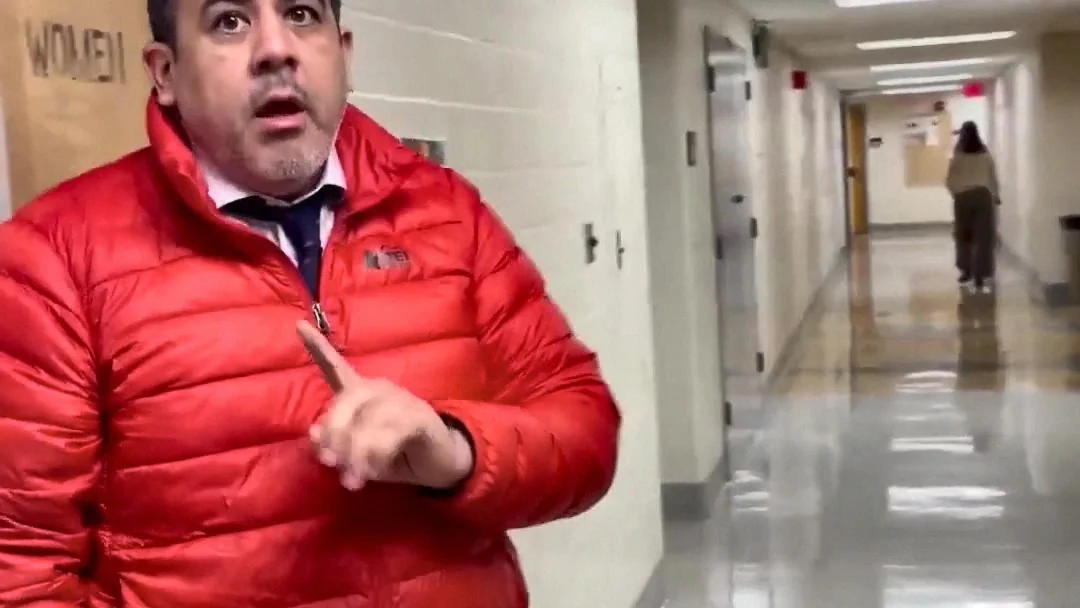
A television cameraman is pushed and sent stumbling down a brightly lit institutional hallway after a man in a bright red jacket turns on him mid-interview. The confrontation unfolds in seconds, but the audio captured on the recording reveals a sharp disagreement over one specific question and the placement of the camera itself.
The video begins with a routine pursuit. A man walks away down a polished corridor, his back to the lens, one arm gesturing dismissively over his shoulder. A second figure, a woman, is visible further down the hall, near a bulletin board. The cameraman follows at a steady pace, the camera and the question moving together in the familiar choreography of a media ambush.
What happens next is captured in a chaotic sequence of frames: the man stops, turns, and closes the distance. The lens tilts wildly. The audio captures a rush of breath, a shouted warning, and the sound of scuffling feet on tile.
- The Scene: A continuous, brightly lit hallway inside an institutional building, with cinderblock walls, a tile floor, and a wall-mounted fire alarm strobe visible in the background. Fluorescent light reflects off the polished floor.
- The Friction: A man in a red puffer jacket and gray trousers walks away from a television camera, repeatedly gesturing over his shoulder before turning to confront the person holding it.
- The Intervention: The man stops, spins around, and advances directly on the camera. The lens is suddenly filled with motion and the framing collapses into a chaotic blur.
- The Aftermath: The camera catches the man backing away with both hands raised in protest before the frame drops and a voice announces that the encounter will not continue.
What the Recorded Footage Captures: Chronological Breakdown
The opening frames establish a clear physical hierarchy. The man in the red jacket holds the center of the frame, walking away at an unhurried pace with his left hand raised near his shoulder in a repeated, dismissive wave. He is not running. He is not hiding. He appears to be treating the camera as an annoyance, a presence he refuses to fully acknowledge.
"Whoa, whoa, whoa. Whoa! Ow! I told you not to put that in my face."
The turn happens fast. The man's shoulders square, his head snaps back toward the lens, and he closes the distance between himself and the camera in a single step. The frame is momentarily filled with the red fabric of his jacket as the handheld shot dips toward the floor. The audio catches overlapping voices and the shuffle of shoe soles on the tile.
"Dude, you can't do that."
What follows is a jumble of accusations traded at high volume. The cameraman insists something was done to him. The man in the red jacket insists the camera was shoved into his face. A hand points sharply downward, then upward, then back toward the lens as the two men verbally collide in the middle of the corridor.
"Put your hands on me, sir. You put your hands on me, dude."
By the final frames, the physical distance has been restored, but the tone has hardened. The man in the red jacket is no longer walking away. He is standing his ground, one hand raised near his chest, and asking with visible disbelief whether the person behind the camera is serious. The video cuts before either side can explain what happened.
Critical Blind Spots: What the Lens Leaves Unresolved
The recording that circulates online is not a wide, fixed shot. It is a first-person perspective from the person holding the camera, which means the viewer sees exactly what the cameraman wants them to see. Every detail outside that narrow frame – how close the lens actually was to the man's face, whether the cameraman stepped into the man's path, and who made contact first – is outside the visible record.
The audio is equally selective. Both men can be heard at the moment of contact, but the full exchange that preceded the turn is clipped. The viewer never hears the exact wording of the question that triggered the reaction, only the man's stated objection: that the camera was being pushed into his face. That objection is heard clearly, and it remains the central factual claim that the footage cannot independently confirm or refute.
The broader context of the encounter is also absent. The hallway is filled with institutional signage, a bulletin board covered in pinned materials, and a fire alarm strobe mounted on the wall – all markers of a public building where members of the public, staff, and media routinely pass through. The video does not establish what the cameraman was authorized to do, whether he had permission to record, or whether the man in the red jacket was a homeowner, a professional, or both.
Statutory Framework and Protocol Analysis
In American public spaces, the act of holding a camera and asking questions is generally protected activity, but that protection does not include the right to force physical contact with another person, to block their movement, or to hold a lens within inches of a face. The distinction is not public; it is physical. Once a camera is pressed into someone's personal space, the encounter stops being a question-and-answer exchange and becomes a friction point that the person being recorded may reasonably attempt to stop.
At the same time, the standard expectation for members of the public is that walking away is the appropriate response to a question they do not wish to answer. The video captures the man in the red jacket doing exactly that for the first several seconds, before the pursuit continues and the lens closes the gap. That sequence – walk away, continue, turn, and then contact – is the entire arc of the visible record.
| Incident Parameter | Observation at the Scene |
|---|---|
| Setting | Fluorescent-lit institutional hallway with cinderblock walls and polished tile |
| Initial posture | Man in red jacket walks away with dismissive hand gesture |
| Camera position | Handheld, moving at walking pace, closing distance |
| First contact claim | Cameraman states "you put your hands on me" |
| Response claim | Man states "you shoved that camera into my face" |
| Physical escalation | Frame collapses as lens dips and tilts sharply |
| Ending state | Verbal confrontation continues; recording terminates |
A second layer of protocol applies to the person holding the camera. Professional media conduct in public corridors typically includes maintaining a reasonable distance, keeping the lens out of physical proximity to a subject's face, and disengaging if a subject declines to answer. The audio does not contain a verbal request to stop recording, but it does contain a clear statement from the man that the camera was in his face – a boundary marker that arrives too late to prevent the collision.
The scene's layout reinforces how quickly this escalated. The hallway offers limited lateral space, meaning a camera operator who wants to stay close to his subject has to follow directly in his path. With a wall on one side, a row of doors on the other, and a bulletin board at the far end, there is no easy way to create distance once the pursuit begins. The man's only unobstructed route – forward, toward the camera operator's position – is also the route that produces the confrontation.
Core Questions and Institutional Review
- What was the exact question being asked that prompted the man to stop and turn around?
- How close did the camera lens actually come to the man's face in the moments before the frame collapsed?
- Did either party state a clear desire to disengage before the physical contact occurred?
- What happens to the recording and the parties after the frames end, and is a fuller version of the encounter available?
The tape ends on a question hanging in the air, not an answer. A man stands in a hallway, hands raised, voice sharp with disbelief, while the person behind the lens protests that his own rights have been violated. Neither position is resolved by the frames, and the viewer is left holding both claims at once. When a camera is present for a confrontation, does it document the truth or does it become part of the dispute itself?
Practical Takeaways for Media Encounter Management
- Maintain a buffer of several feet between the lens and a subject's face at all times.
- If a subject turns and advances, step back and lower the camera rather than holding position.
- Record the exact wording of a firm disengagement request if one is made.
- Keep the full, uncut recording available for context, not only the moment of contact.
Quick Reference Checklist
- Verify the location's access rules before recording.
- Keep hands visible and the device steady during any dispute.
- Note time stamps for the start of pursuit and the moment of contact.
- Preserve original audio without edits to establish the sequence of events.
Closing Note
The visible record shows two men in a hallway, a camera moving forward, and a boundary crossed in a matter of seconds. Everything that came before and everything that followed remains outside the frame, which is precisely why the question of who is at fault continues to be argued by viewers who saw only one angle.
Ethical Framing
This account is limited to what the recording and the audible dialogue establish. No conclusions are drawn about either party's intent, employment status, or character, and no legal finding is implied. The purpose is to document the sequence and identify the gaps that the footage leaves open.
A Final Consideration for Viewers
The disagreement is a public dispute over proximity, but the video shows something more common: a person who believed he was being pushed past his limit and a person who believed he was simply asking a question. The truth likely sits somewhere between the two claims, and the record available to the public does not settle it.