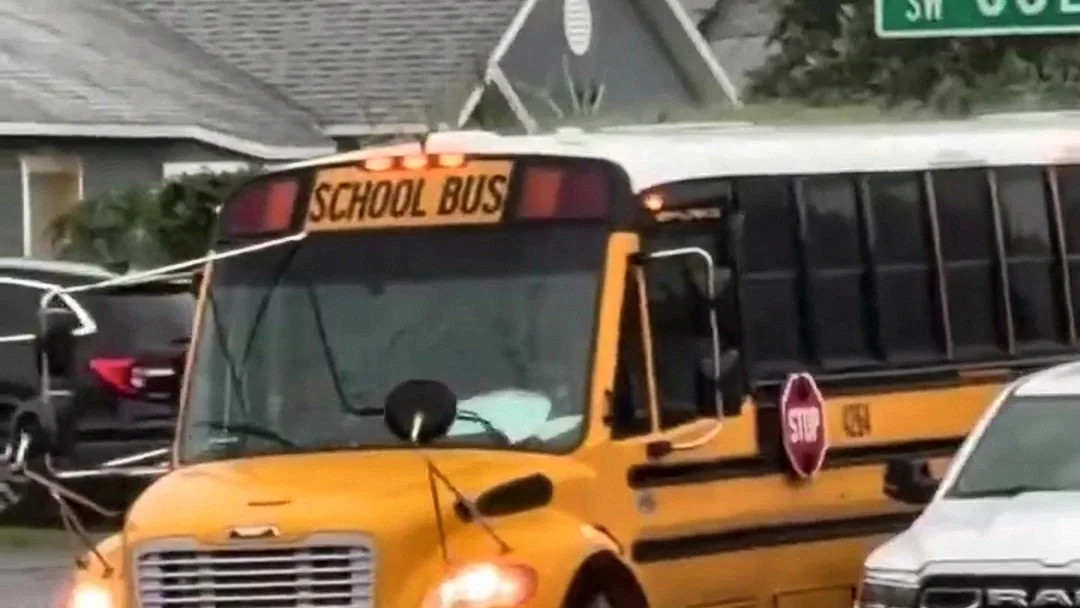
Camera Swat at Park Event Sparks Assault Claim
WATCH: On-scene video documentation is embedded below →
LISTEN TO THIS ARTICLE
Audio Narration • English (US)
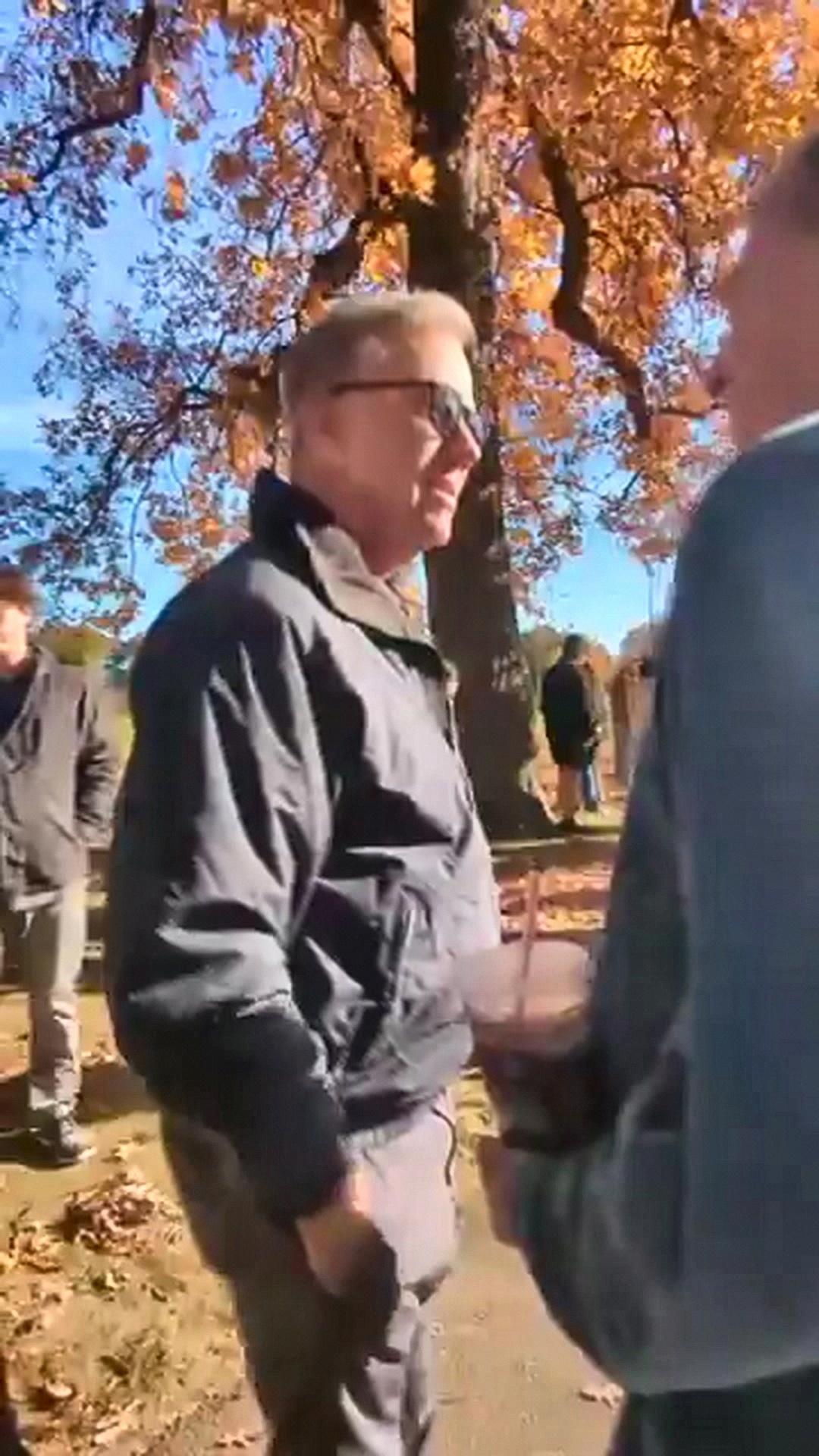
A reporter's camera frames a governor in a navy windbreaker under amber autumn leaves. Within seconds, the calm of a Saturday morning park event collapses into a disputed swat at the lens, a burst of protest, and a question that never gets answered. What the recording shows is brief, but what it leaves behind is a tangle of competing accounts about a hand, a phone, and a line that may or may not have been crossed.
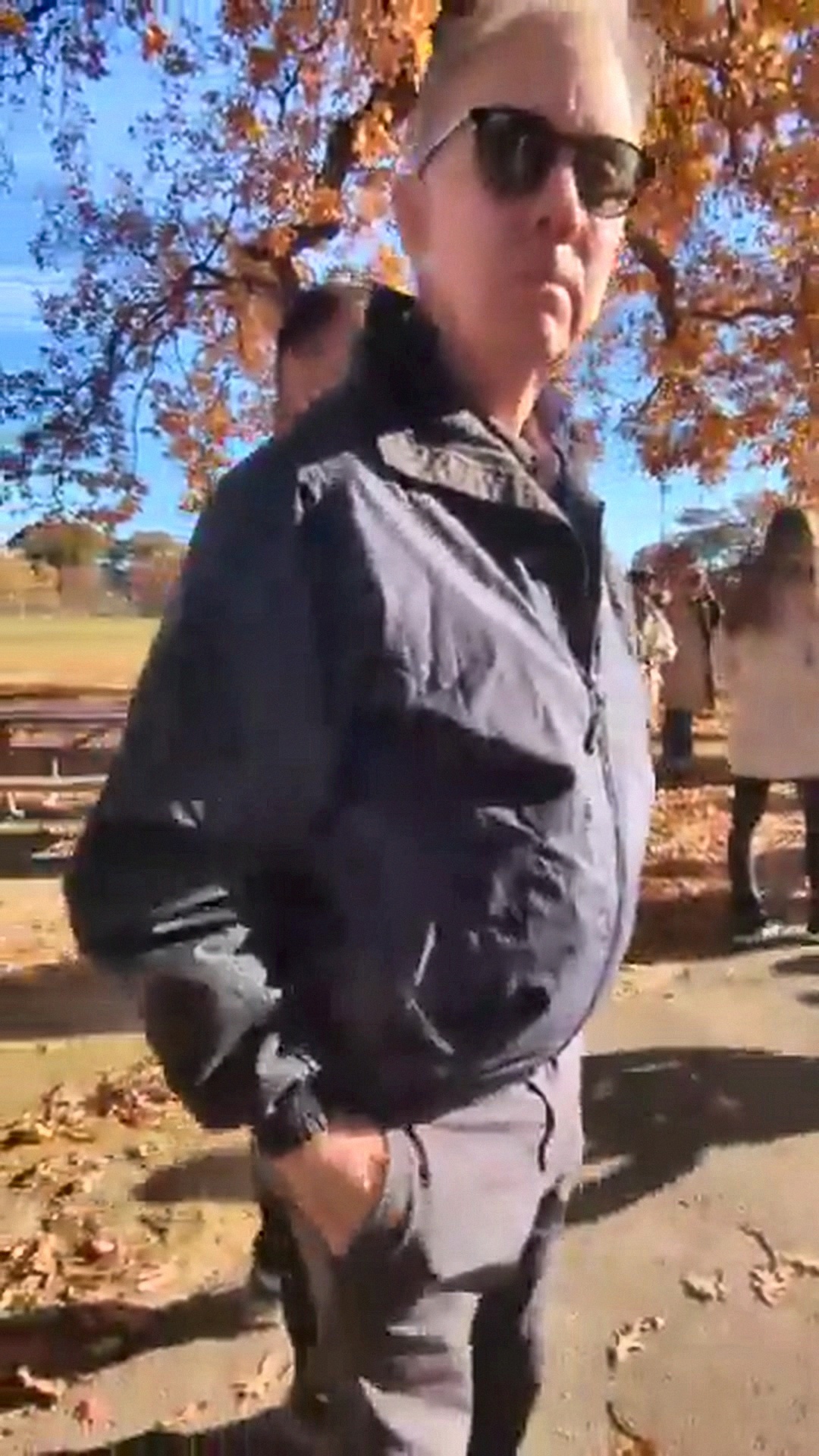
- A woman recording on her phone approaches a public figure at an outdoor gathering in a park setting, pressing a question about a campaign staffer's recent traffic stop.
- The man in the navy windbreaker, sunglasses perched on his face, turns toward the lens and his hand moves abruptly in its direction.
- The woman's voice rises immediately, declaring that touching her camera constitutes an assault and that she was only asking a question.
- The encounter ends with the man walking on and the recording continuing, leaving the physical contact and its legal meaning unresolved.
What the Recorded Footage Captures: Chronological Breakdown
The footage opens in motion. A woman in a rust-colored top and dark jeans strides across a leaf-strewn path, the camera jostling with each step. Bare branches and trees heavy with orange foliage frame a bright blue sky. Other attendees drift in and out of frame, some in light coats, a few standing near picnic tables in the distance. The audio carries the easy ambient noise of an outdoor gathering – footsteps, distant chatter, wind moving through the canopy.
Then the camera finds its subject. The man in the navy windbreaker stands with one hand resting near his pocket, his posture casual but closed. His head turns slightly as the question lands. The reporter's voice is steady, almost conversational at first, asking how the mayor is working out and then pivoting to a specific claim about a campaign manager and a police stop. The phrasing is pointed but not shouted.
That is when the frame changes. The hand comes up. It is a quick, lateral motion toward the phone, and the image jolts. The reporter's voice sharpens instantly: "Wait a minute, why don't you touch my camera? You're not supposed to be touching my camera, that's assault." A second voice – softer, almost placating – cuts in with "Oh, stop, please." The reporter fires back, "What do you mean, stop, please? I was asking a question." She repeats the name of the staffer and the details of the traffic stop, her words tumbling out faster now, the camera still rolling, still pointed at the man in sunglasses who has not broken stride.
Critical Blind Spots: What the Lens Leaves Unresolved
The recording is a narrow window. It shows a hand moving toward a device, but it does not show with certainty whether contact occurred, whether the phone was struck, or whether the motion was a reflexive flick intended to create distance. The angle is tight and the movement is fast; a single frame can be read two ways depending on where the viewer pauses.
Equally unseen is what preceded the approach. How close was the camera before the question began? Was the device held at chest height or pushed toward the subject's face? Bystanders in the background appear relaxed, but their reactions are not captured in detail, and no wide shot establishes the physical spacing between the two people at the moment of the swat.
The aftermath is also incomplete. The footage does not show the exchange ending, whether anyone intervened, or whether the reporter continued to pursue the question. What remains is a fragment – a few seconds of friction preserved on a phone – and a set of claims that will have to be sorted out by people who were standing in that park.
Statutory Framework and Protocol Analysis
For reporters working in public spaces, the standard expectation is straightforward: questions may be asked, cameras may roll, and public figures are generally expected to absorb scrutiny without physically engaging with equipment. For public figures, the corresponding expectation is that they can move through an event without being physically crowded or having devices thrust into their personal space. Where those two expectations collide, the outcome is almost always a dispute about proximity and intent.
In this instance, the on-scene evidence is thin and contradictory. Supporters of the man in the windbreaker have characterized the motion as a reflexive flick with no contact, describing the reporter as having gotten too close. The reporter's own narration, captured live, frames the same motion as deliberate contact with her equipment. Both descriptions can be offered in good faith; neither is fully proven by the frame.
| Incident Parameter | Observation at the Scene |
|---|---|
| Setting | Outdoor park gathering, autumn foliage, bright midday sun |
| Principal figures | Woman recording on a phone; man in navy windbreaker and sunglasses |
| Trigger moment | A question about a staffer's traffic stop |
| Physical action | A quick lateral hand motion toward the camera |
| Verbal reaction | Reporter declares assault; a second voice urges her to stop |
| Camera stability | Sharp jolt at the moment of the hand motion |
| Resolution on tape | Man continues walking; recording continues |
Read more:
Read more: Learjet Broke Up Before Impact, NTSB Briefing Reveals →
The broader question is one of community norms. Public events are designed to be open, but openness does not come with a manual for how close is too close or how much a public figure must tolerate before stepping away. Organizers typically rely on informal spacing and the presence of staff to manage friction. When those soft buffers fail, the result is a few chaotic seconds that neither side controls – and a public argument that outlasts the event itself.
Core Questions and Institutional Review
- Did the hand make contact with the device, and if so, what was the force and direction of that contact?
- How close was the camera to the subject immediately before the motion, and was that distance consistent with accepted reporting practice at open events?
- What did bystanders observe from angles not represented in the single vertical recording?
- What internal review, if any, will each side conduct regarding the conduct of its personnel at public gatherings?
The answers will not come from the clip alone. They will come from statements, additional angles, and the slow work of sorting claim from counterclaim. What the recording does preserve is the moment itself: the bright leaves, the calm question, the sudden hand, and the instant shift in a stranger's voice from inquiry to accusation. Whether that moment is remembered as an overreach, an overreaction, or a misunderstanding depends entirely on facts the lens never caught.
What would you have done if a camera was pointed at you and a pointed question followed – walk away, or reach for the lens?
LATEST DEVELOPING INCIDENT
An even more shocking incident just erupted hours ago that has stunned onlookers nationwide. Full investigative breakdown and on-scene evidence documented below.
BREAKING: READ NEXT SHOCKING INCIDENT – LATEST CASE ↓
School Bus Releases Student Into Thigh-Deep Floodwater
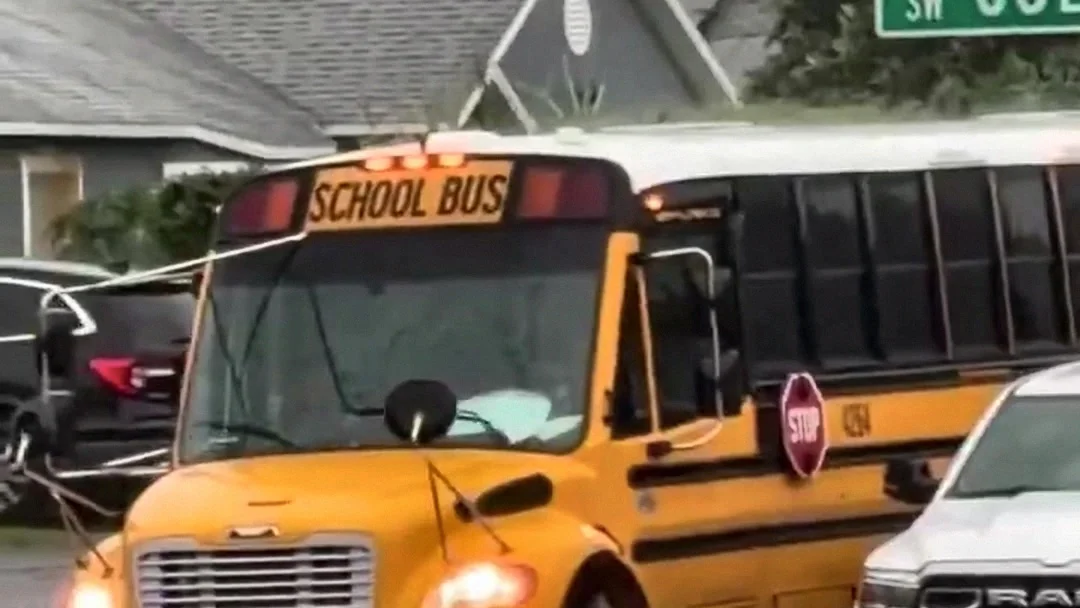
A yellow school bus idles in a flooded residential street, its door folding open onto water that reaches a child's waist. A boy climbs down and begins wading toward home while a witness behind the camera realizes, mid-sentence, that the street ahead may swallow him further.
- The scene: A Port St. Lucie, Florida, neighborhood street sits under standing floodwater after heavy rain, with a dark sedan stranded hood-deep in the middle of the roadway.
- The friction: A school bus stops and releases a student directly into the water rather than holding him aboard or diverting to dry ground.
- The intervention: A bystander filming the drop-off reacts aloud, says she is going after the boy, and then confirms he is upright and moving.
- The aftermath: The student continues walking toward his house and, per the person who filmed it, likely steps into a roadside ditch where the water deepens before he reaches his door.
What the Recorded Footage Captures: Chronological Breakdown
The clip opens on a gray, rain-soaked afternoon. Palm fronds droop into the top of the frame, heavy and dripping, framing a street that has stopped being a street at all. Brown-green water stretches curb to curb, flat and glassy except where it ripples. Just beyond the fronds, a dark sedan is stuck at an angle, its front end buried to the headlights, abandoned in the middle of the block. Overhead wires cut across a pale sky, and a green street sign reads 1100 SW COL on the corner.
The bus rolls into the frame slowly, headlights glowing warm against all that flat gray, its hazard lights blinking. Water laps at the lower panels. It is not crawling through a puddle; it is plowing through a channel. The driver brings it to a stop, and the door swings open with a mechanical wheeze, the red stop sign folding out into the rain.
Then a figure appears in the doorway: a boy, backpack on, hesitating for just a beat at the top step. He climbs down. His foot disappears into the water, then his shin, then his thigh. You can hear the woman behind the camera react in real time, her voice rising. "Oh my God," she says. The boy keeps moving, one slow step after another, his shorts dark with water, his body tilted slightly against the drag of it.
Critical Blind Spots: What the Lens Leaves Unresolved
What the camera cannot show is the conversation that put that bus in that spot. There is no audio of dispatch, no radio traffic, no route sheet. Whether the driver radioed in before opening the door, whether an alternate stop was considered and rejected, or whether this corner was simply the closest dry-ish curb the route allowed, the footage does not say. The driver's face is not visible. The route number is blurred by rain.
Nor does the lens follow the boy all the way home. The witness narrating from the porch fills in that gap with a warning rather than a picture: the yard between the curb and his front door likely hides a drainage ditch, a drop-off where the water goes from thigh-high to chest-high without warning. That is the quiet terror of flooded neighborhoods. The deepest water is often invisible, marked only by a seam in the grass.
There is also the stranded sedan parked mid-block. Nobody in the frame asks who it belongs to or whether anyone is still inside. The camera's attention stays fixed on the yellow bus and the small figure walking away from it. The boy himself never looks back.
Statutory Framework and Protocol Analysis
The visible facts are stark enough to invite scrutiny. District transportation policies nationwide generally leave the final call on unsafe drop-offs to the driver and to dispatch, with weather emergencies typically triggering a hold, a delayed release, or a reroute. Neighboring counties in the same weather system took the more cautious path, canceling or closing schools outright rather than sending buses into standing water.
| Incident Parameter | Recorded On-Scene Evidence |
|---|---|
| Roadway condition | Standing floodwater spanning curb to curb |
| Water depth at drop-off | Roughly thigh-high on the student |
| Bus behavior | Slow approach with headlights and hazards active |
| Stranded vehicle | Dark sedan stuck mid-block, front end submerged |
| Student response | Climbed down and waded away without assistance |
| Bystander response | Filmed the drop-off and voiced alarm aloud |
| Location marker | Green street sign reading 1100 SW COL |
Read more: {NOIBO}
The witness's own words carry the weight of the moment better than any policy memo. "I'm going after him," she says, and then, moments later, the relief: "Oh good. Thank you." In that brief arc, a stranger on a porch transformed from spectator to guardian, ready to wade in after a child she did not know.
Core Questions and Institutional Review
- At what water depth should a school bus driver hold a student aboard rather than release him into the street?
- Was an alternate, drier drop-off point considered for this route before the door opened?
- Who is responsible for mapping hidden drainage ditches and open drains along a flooded school route?
- What threshold of flooding, if any, should trigger a district-wide delay or closure rather than a normal dismissal?
Parents watching this clip will recognize the anxiety in it instantly. Every neighborhood has that one low corner that fills first, that one ditch nobody thinks about until it is underwater, that one afternoon when the rain comes down faster than the drains can take it. The boy in the yellow doorway made it out, and the woman on the porch kept watching until she was sure. But the system that put a child on a bus step above floodwater, and then let him step down into it, is the part still awaiting a clear answer. Should a bus driver be authorized to turn around entirely when the street itself becomes a hazard?
Practical Takeaways
- Never walk through standing floodwater if an alternate route exists, especially where drainage ditches or open drains may be submerged.
- If you witness a hazardous drop-off, film it and report the location to the district transportation office.
- Keep a phone flashlight and a change of dry clothing ready during flood season for students who arrive home soaked.
- Report stranded vehicles and submerged intersections to local public works so crews can mark the danger.