School Bus Releases Student Into Thigh-Deep Floodwater
WATCH: On-scene video documentation is embedded below →
LISTEN TO THIS ARTICLE
Audio Narration • English (US)
A yellow school bus idles in a flooded residential street, its door folding open onto water that reaches a child's waist. A boy climbs down and begins wading toward home while a witness behind the camera realizes, mid-sentence, that the street ahead may swallow him further.
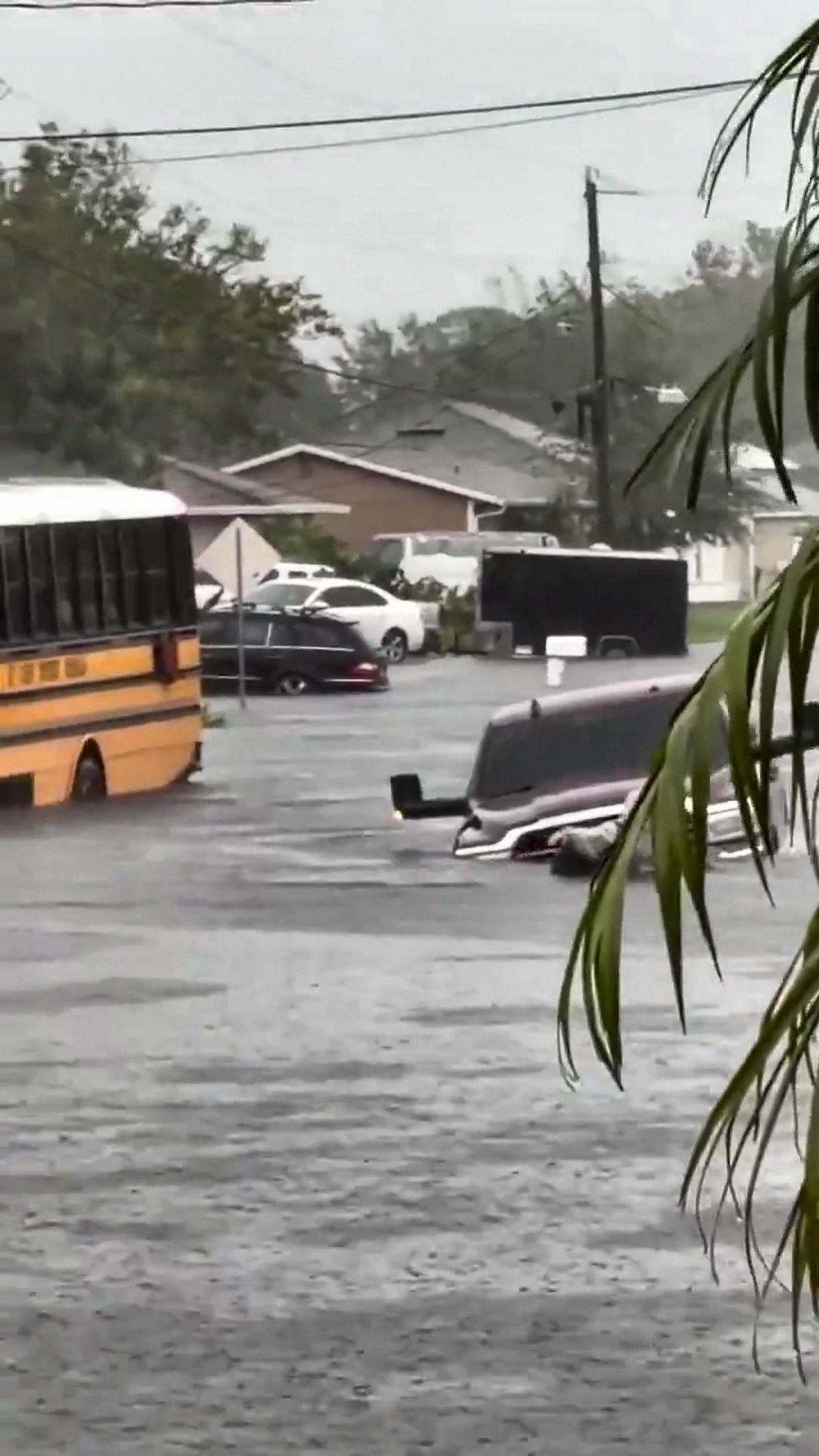
- The scene: A Port St. Lucie, Florida, neighborhood street sits under standing floodwater after heavy rain, with a dark sedan stranded hood-deep in the middle of the roadway.
- The friction: A school bus stops and releases a student directly into the water rather than holding him aboard or diverting to dry ground.
- The intervention: A bystander filming the drop-off reacts aloud, says she is going after the boy, and then confirms he is upright and moving.
- The aftermath: The student continues walking toward his house and, per the person who filmed it, likely steps into a roadside ditch where the water deepens before he reaches his door.
What the Recorded Footage Captures: Chronological Breakdown
The clip opens on a gray, rain-soaked afternoon. Palm fronds droop into the top of the frame, heavy and dripping, framing a street that has stopped being a street at all. Brown-green water stretches curb to curb, flat and glassy except where it ripples. Just beyond the fronds, a dark sedan is stuck at an angle, its front end buried to the headlights, abandoned in the middle of the block. Overhead wires cut across a pale sky, and a green street sign reads 1100 SW COL on the corner.
The bus rolls into the frame slowly, headlights glowing warm against all that flat gray, its hazard lights blinking. Water laps at the lower panels. It is not crawling through a puddle; it is plowing through a channel. The driver brings it to a stop, and the door swings open with a mechanical wheeze, the red stop sign folding out into the rain.
Then a figure appears in the doorway: a boy, backpack on, hesitating for just a beat at the top step. He climbs down. His foot disappears into the water, then his shin, then his thigh. You can hear the woman behind the camera react in real time, her voice rising. "Oh my God," she says. The boy keeps moving, one slow step after another, his shorts dark with water, his body tilted slightly against the drag of it.
Critical Blind Spots: What the Lens Leaves Unresolved
What the camera cannot show is the conversation that put that bus in that spot. There is no audio of dispatch, no radio traffic, no route sheet. Whether the driver radioed in before opening the door, whether an alternate stop was considered and rejected, or whether this corner was simply the closest dry-ish curb the route allowed, the footage does not say. The driver's face is not visible. The route number is blurred by rain.
Nor does the lens follow the boy all the way home. The witness narrating from the porch fills in that gap with a warning rather than a picture: the yard between the curb and his front door likely hides a drainage ditch, a drop-off where the water goes from thigh-high to chest-high without warning. That is the quiet terror of flooded neighborhoods. The deepest water is often invisible, marked only by a seam in the grass.
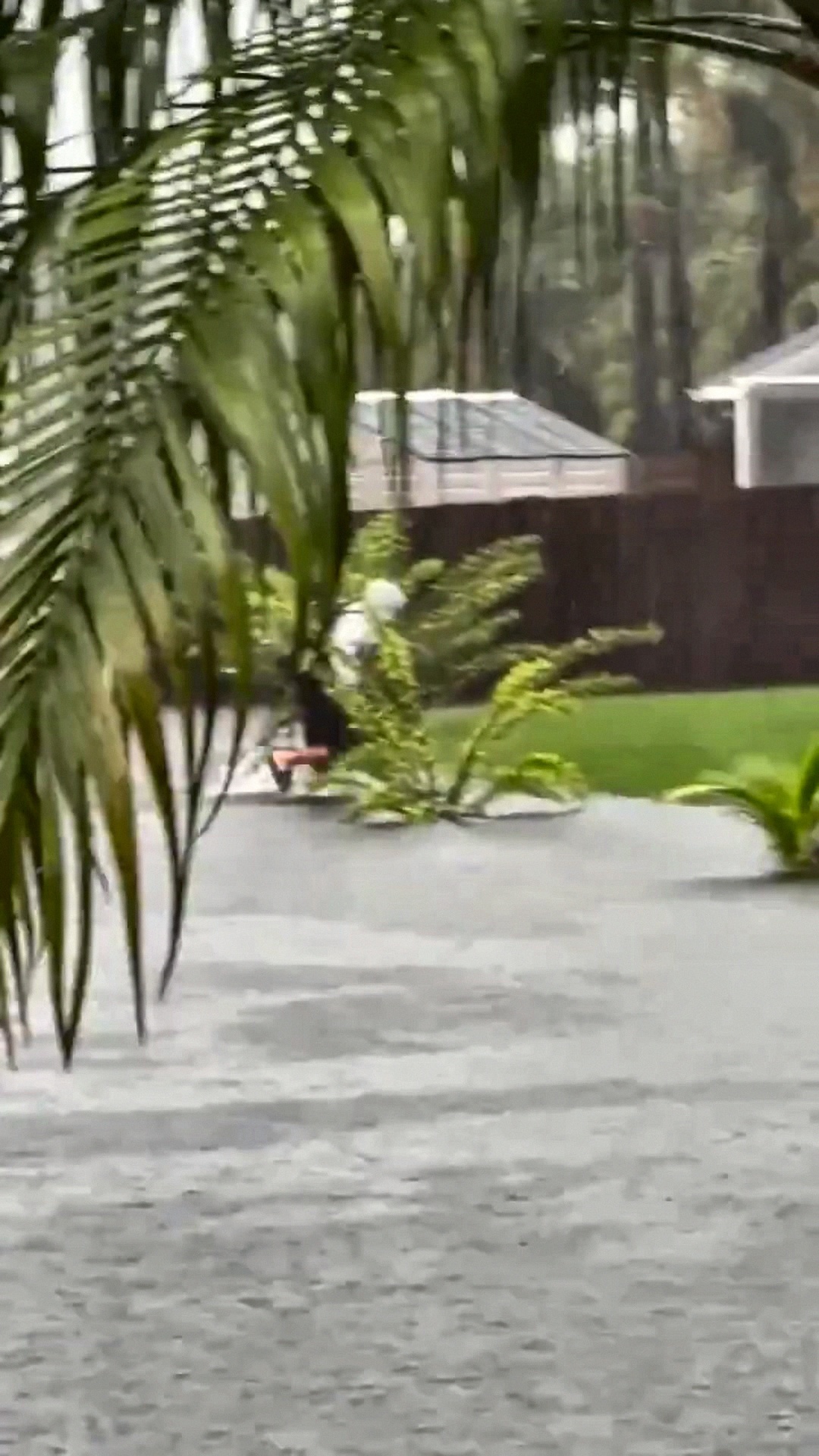
There is also the stranded sedan parked mid-block. Nobody in the frame asks who it belongs to or whether anyone is still inside. The camera's attention stays fixed on the yellow bus and the small figure walking away from it. The boy himself never looks back.
Statutory Framework and Protocol Analysis
The visible facts are stark enough to invite scrutiny. District transportation policies nationwide generally leave the final call on unsafe drop-offs to the driver and to dispatch, with weather emergencies typically triggering a hold, a delayed release, or a reroute. Neighboring counties in the same weather system took the more cautious path, canceling or closing schools outright rather than sending buses into standing water.
| Incident Parameter | Recorded On-Scene Evidence |
|---|---|
| Roadway condition | Standing floodwater spanning curb to curb |
| Water depth at drop-off | Roughly thigh-high on the student |
| Bus behavior | Slow approach with headlights and hazards active |
| Stranded vehicle | Dark sedan stuck mid-block, front end submerged |
| Student response | Climbed down and waded away without assistance |
| Bystander response | Filmed the drop-off and voiced alarm aloud |
| Location marker | Green street sign reading 1100 SW COL |
Read more:
Read more: Campus Chaos: Woman Attacks Another Woman on Video →
The witness's own words carry the weight of the moment better than any policy memo. "I'm going after him," she says, and then, moments later, the relief: "Oh good. Thank you." In that brief arc, a stranger on a porch transformed from spectator to guardian, ready to wade in after a child she did not know.
Core Questions and Institutional Review
- At what water depth should a school bus driver hold a student aboard rather than release him into the street?
- Was an alternate, drier drop-off point considered for this route before the door opened?
- Who is responsible for mapping hidden drainage ditches and open drains along a flooded school route?
- What threshold of flooding, if any, should trigger a district-wide delay or closure rather than a normal dismissal?
Parents watching this clip will recognize the anxiety in it instantly. Every neighborhood has that one low corner that fills first, that one ditch nobody thinks about until it is underwater, that one afternoon when the rain comes down faster than the drains can take it. The boy in the yellow doorway made it out, and the woman on the porch kept watching until she was sure. But the system that put a child on a bus step above floodwater, and then let him step down into it, is the part still awaiting a clear answer. Should a bus driver be authorized to turn around entirely when the street itself becomes a hazard?
Practical Takeaways
- Never walk through standing floodwater if an alternate route exists, especially where drainage ditches or open drains may be submerged.
- If you witness a hazardous drop-off, film it and report the location to the district transportation office.
- Keep a phone flashlight and a change of dry clothing ready during flood season for students who arrive home soaked.
- Report stranded vehicles and submerged intersections to local public works so crews can mark the danger.
LATEST DEVELOPING INCIDENT
An even more shocking incident just erupted hours ago that has stunned onlookers nationwide. Full investigative breakdown and on-scene evidence documented below.
BREAKING: READ NEXT SHOCKING INCIDENT – LATEST CASE ↓
Learjet Broke Up Before Impact, NTSB Briefing Reveals
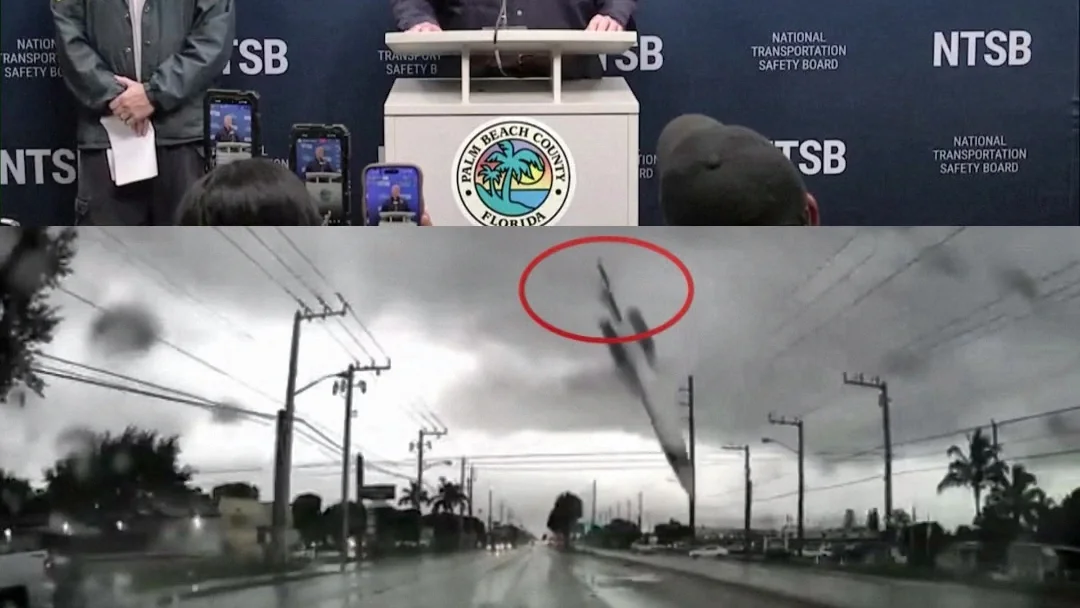
A packed press briefing in Florida turns tense as a federal investigator reveals that a doomed Learjet may have been shedding pieces in the sky before impact. As the first scattered debris is recovered across a suburban landscape, the official account and a chilling dashcam frame begin to converge on a single, unsettling question.
- The Briefing: A senior investigator at a podium bearing an official seal confirms that physical evidence suggests the aircraft disintegrated mid-air rather than striking the ground intact.
- The Dashcam: A windshield view from a moving vehicle captures a gray, overcast skyline where a dark silhouette drops toward the horizon near utility poles.
- The Inquiry: A reporter's question about the tail assembly is met with a measured refusal to identify recovered parts, leaving the suspected structural failure unresolved.
- The Aftermath: A quiet suburban corridor becomes an active recovery scene, with debris expected to be found some distance from the primary impact site.
What the Recorded Footage Captures: Chronological Breakdown
The video opens on the fluorescent-lit briefing room, where a man in a dark jacket stands at a wooden podium emblazoned with a state seal. Behind him, a wall of navy-blue fabric repeats the agency's logo in a rigid grid. To his left stands a second official in a green field jacket, arms folded, his expression fixed. The air in the room is flat and procedural, but the microphones tell a different story.
That is when the spoken words land like a hammer. "We do have some indication that the aircraft was breaking up before impact," the lead official says, his voice even, his hands resting on the lectern. The phrasing is clinical, yet the implication is violent: the machine came apart at altitude, scattering itself across the sky before it ever reached the ground.
The frame then cuts away to a gray morning on a multi-lane road. From the dashboard of a vehicle, the camera looks out across power lines and traffic lights toward a heavy, overcast horizon. In the upper center of the frame, a dark angular shape is visible, descending in a steep, unnatural line. The view is brief and distant, but it visually rhymes with the official's words – a shape in the sky, captured from a windshield, at the exact moment the ground below had no idea what was coming.
Critical Blind Spots: What the Lens Leaves Unresolved
The dashcam clip is compelling but deeply limited. The windshield imposes its own frame: the sky is compressed, the shape is small, and the resolution is thick with the grain of a consumer camera. There is no audio of the descent, no sense of scale, and no way to verify from the imagery alone whether the object is shedding components or simply falling fast. The most important events – the structural failure at altitude – occur outside the camera's field of view.
The briefing, meanwhile, is a masterclass in withholding. When a reporter asks directly whether pieces of the tail have been recovered, the official does not confirm or deny. "I don't think we're far enough along here to know what we've found," he replies. "We're finding debris, but we haven't identified parts yet." The answer is honest, but it leaves the central theory of a horizontal stabilizer failure hanging in the air.
What remains unseen are the first responders on the ground, the witnesses who heard the sky tear open, and the recovery teams walking a debris field that may stretch well beyond the impact crater. The official explicitly warns that parts could be found "some distance away," a phrase that quietly rewrites the geography of the event and raises the question of how far the wreckage traveled before the final moment.
Statutory Framework and Protocol Analysis
The standard protocol for an aviation accident investigation is to secure the debris field, document the distribution of components, and avoid premature conclusions until the wreckage is mapped. The official's careful language reflects that discipline: he acknowledges an indication of mid-air breakup while refusing to name specific parts. This is not evasion but the choreography of a formal inquiry, where a single word could shape liability and public perception for years.
| Incident Parameter | Observation at the Scene |
|---|---|
| Aircraft condition before impact | Official states indications the jet was breaking up |
| Debris distribution | Parts may be found some distance from impact site |
| Tail assembly status | Recovered parts not yet identified |
| Recovery progress | Debris being located, identification pending |
| Briefing tone | Measured, procedural, no premature conclusions |
| Camera vantage | Dashboard view of overcast sky and roadway |
Core Questions and Institutional Review
- If the aircraft was breaking up before impact, what specific structural component failed first, and when did the failure begin?
- Why did the official decline to confirm or deny the recovery of tail components, and what does that silence suggest about the investigative timeline?
- How far from the impact site will debris be found, and what does the distribution tell investigators about the final seconds of flight?
- What do witnesses on the ground report hearing or seeing, and how does their account align with the dashcam frame?
The dashcam image and the briefing podium sit side by side in the public imagination now – one a fleeting, grainy glimpse of something falling, the other a measured admission that the machine came apart in the air. Together they form a narrative with a missing middle, a gap that only the recovery teams and the final report can fill. Until then, the question that lingers is not simply what happened, but whether the evidence scattered across that quiet roadway will be enough to reconstruct the final moments of a flight that never reached its destination. What do you think the debris field will reveal about the moments before impact?