Woman Shoves Up Plane Aisle Before Door Opens in Tense Confrontation
WATCH: On-scene video documentation is embedded below →
LISTEN TO THIS ARTICLE
Audio Narration • English (US)
A woman pushes her way from the back of a packed airplane toward the front while the cabin door remains sealed, and a calm passenger standing in the aisle becomes the immovable wall she never expected. What begins as a demand for space in a cramped cabin spirals into a loudly narrated confrontation about money, seniority, and who deserves to move first – captured entirely on a fellow traveler's phone.
- A woman seated toward the rear of an aircraft walked up the aisle and demanded passage toward the front before the exit door had opened.
- A bald male passenger in a light shirt stood firm, telling her that everyone on board had paid the same fare and was waiting for the same door.
- The confrontation escalated as the woman repeatedly demanded he say "excuse me," while he answered with a flat, repeated refusal.
- The exchange turned toward threats of physical contact and consequences – assault claims, witnesses, arrest, and a lifetime flight ban – as nearby passengers watched in silence.
What the Recorded Footage Captures: Chronological Breakdown
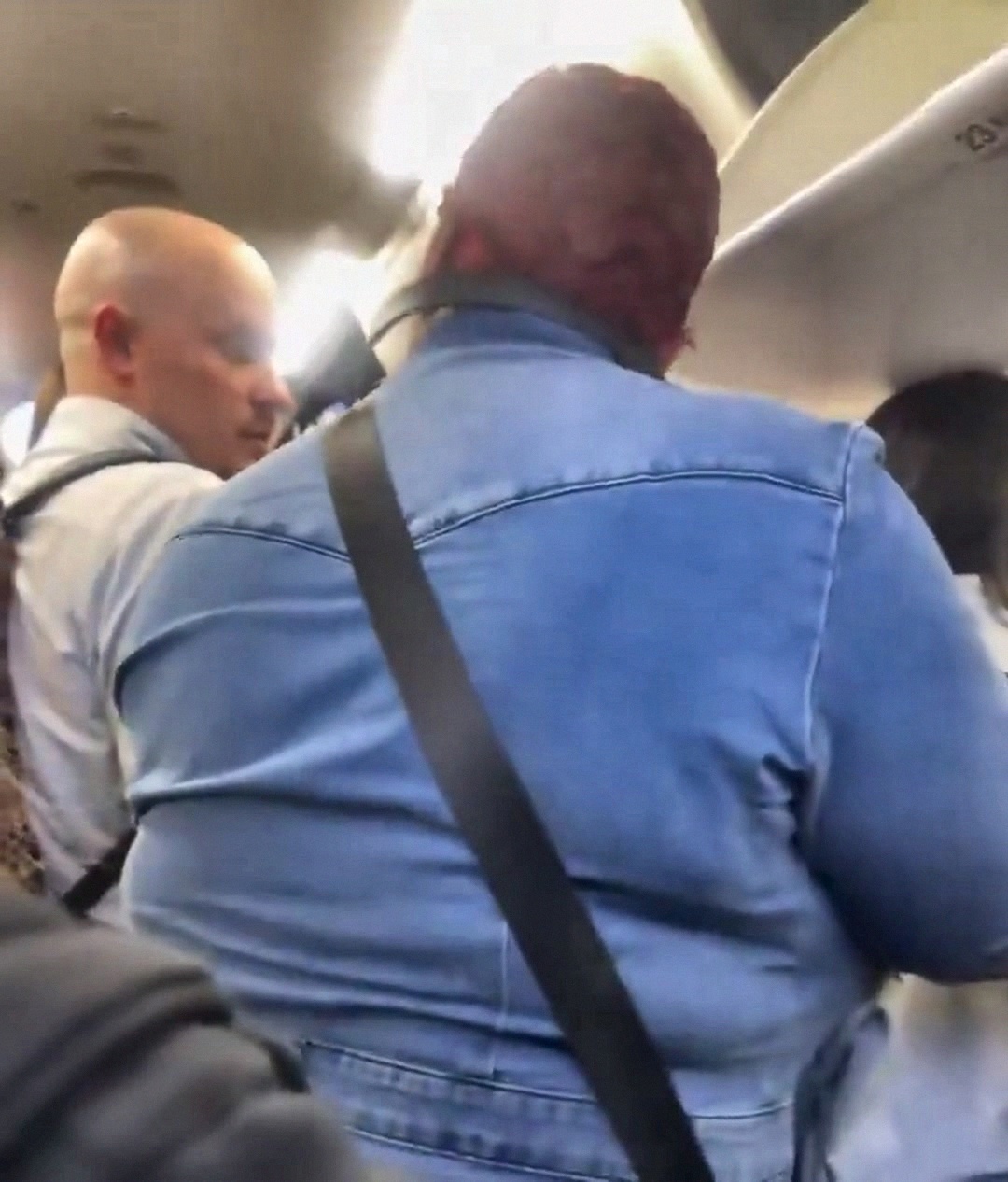
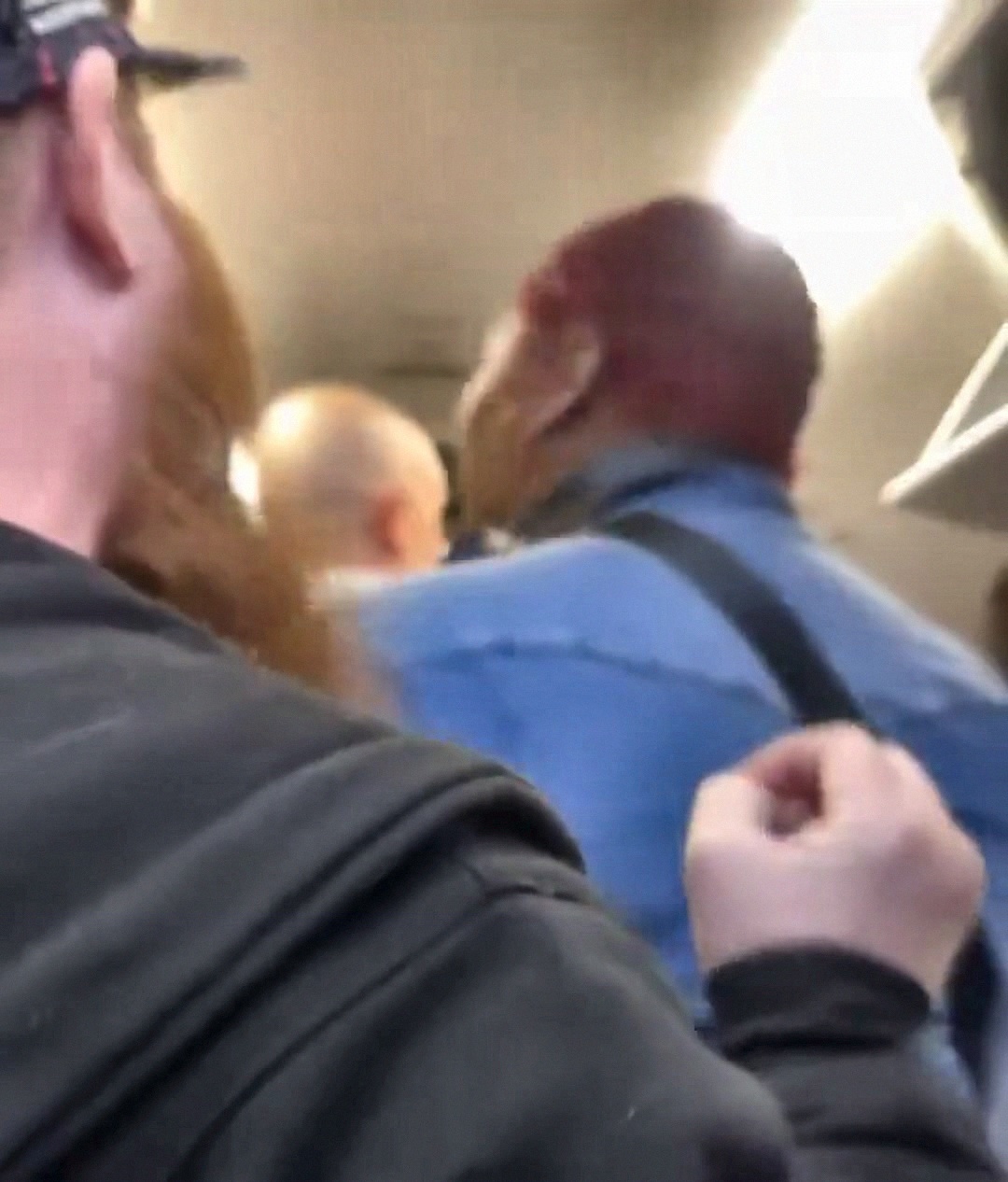
The clip opens at close range, the camera angled up from a seated row so the frame is crowded with shoulders, headrests, and the hard white glare of the overhead lights. A man with reddish hair and a dark cap sits low in the foreground; ahead of him, a broad woman in a blue denim-style top and a black shoulder strap pushes into the aisle. Around her the cabin is oddly still – a bald man in a pale button-down turns his head, saying nothing, and the air above the seats feels heavy with the sound of the engines and the shuffle of feet.
It is the moment the woman plants herself in front of the standing passenger that the scene tightens. "Excuse me," she repeats, each time with a little more edge, and each time the man answers evenly that he is not moving. "Why are you just going to everybody else?" she asks. "Why are you so special?" He answers with the plainest arithmetic of air travel: "We all paid the same goddamn money." She counters that the door is not open anyway, and he returns that it does not matter either way – nobody is getting off yet.
The escalation arrives in a single pivot. The woman announces that if she pushes past him, it will be an assault on her part, and the man agrees – flatly, almost helpfully. "And you got 30 witnesses on you, man, with the red hair," she says. "You'll get arrested, and then you will get a lifetime flight ban. You want that?" The camera does not move. Somewhere behind the lens a passenger murmurs, "She always like that," and another voice answers, "No. Thankfully." The woman keeps repeating the two words she came with – "Excuse me. Excuse me." – until they stop meaning a request and start meaning a verdict.
Critical Blind Spots: What the Lens Leaves Unresolved
The camera begins mid-argument, so the first seconds of the approach are lost. It is not clear how far the woman traveled down the aisle, whether she had asked to pass others on the way, or whether any crew member had already spoken to her before the recording began. The lens stays low and tight, framing shoulders and the back of a seat, which means the surrounding rows are almost entirely invisible – how many passengers were standing, how many were seated, and how the crowd physically parted or refused to part remain outside the frame.
More important, the record contains no uniform. No flight attendant appears in the visible footage, and no announcement, chime, or intercom instruction can be heard above the cabin noise. Whether crew members were aware of the confrontation, whether they were occupied elsewhere on the aircraft, or whether the confrontation ended before anyone in authority arrived is unknown. And once the exchange reaches its loudest point, the clip cuts – leaving the actual disembarkation, the moment the door opened, and whatever words were exchanged afterward entirely off the record.
The identities remain equally unresolved. No airline, flight number, route, or date appears in the visible footage, and the original poster shared no further context. The man's calm insistence and the woman's escalating demands are preserved, but the reasons she needed the front – a tight connection, a habit, simple impatience – are never stated.
Statutory Framework and Protocol Analysis
Standard procedure on most carriers is straightforward: passengers remain seated until the seatbelt sign is off and the door is opened, and movement toward the front begins row by row at the crew's direction. Rushing the aisle before that point creates a physical hazard if the aircraft shifts, and it creates friction in a space where there is no room to step aside. Flight attendants are trained to de-escalate precisely this kind of crowding, usually with a single calm instruction; the question here is whether any such instruction reached the aisle before the shouting did.
Federal attention to unruly passenger behavior has grown sharply in recent years, with the FAA reporting more than 1,800 unruly passenger incidents in 2024 and more than $20.9 million in fines levied since 2020. Rushing forward before the door opens sits in a legal gray area unless a passenger physically interferes with a crew member's duties – which is why the man's decision to hold his ground without contact mattered as much as the woman's threats did.
| Incident Parameter | Observation at the Scene |
|---|---|
| Cabin position | Woman moving forward from the rear while the exit door remained closed |
| Confrontation point | Aisle beside a standing male passenger in a pale button-down |
| Verbal trigger | Repeated demands for "excuse me" and a claim of special priority |
| Counter-argument | Everyone paid the same fare and waits for the same door |
| Escalation language | Assault claims, witness count, arrest, lifetime flight ban |
| Bystander posture | Nearby passengers watching silently, one filming from a seated row |
| Visible authority | No crew member appears in the recorded frame |
Read more:
Read more: James Comey Video Statement After Third Federal Charge →
Core Questions and Institutional Review
- Did any crew member issue an instruction to the woman before the recording began, and how was it answered?
- At what point did the cabin door open relative to the confrontation, and did the crowd then move in order?
- Was the incident reported to the airline after landing, and did it trigger any internal review or restriction?
- Why did the exchange end where the clip ends – was it de-escalated, redirected, or simply cut short by the camera?
The footage leaves viewers with the uncomfortable arithmetic of modern air travel: a cabin of strangers, each with somewhere to be, compressed into a space where patience is the only currency that spends. The woman's insistence that she was owed passage met a man who had decided that being polite did not require being moved. What remains is a question about the rest of us – when the aisle finally clears and the door opens, who gets to decide that the waiting was fair?
LATEST DEVELOPING INCIDENT
An even more shocking incident just erupted hours ago that has stunned onlookers nationwide. Full investigative breakdown and on-scene evidence documented below.
BREAKING: READ NEXT SHOCKING INCIDENT – LATEST CASE ↓
Ammonia Blast at Newport Seafood Plant Sends Huge Plume
A sudden white explosion threw a towering cloud of vapor across the Newport, Oregon waterfront, forcing an urgent evacuation around a seafood processing facility. As the plume rolled toward the street and the bay, the question that hung in the mist was simple: how close did workers and bystanders come to an invisible, choking hazard?
- A suspected ammonia tank failure at a seafood processing facility in Newport, Oregon sent a dense white vapor cloud billowing over the surrounding streets.
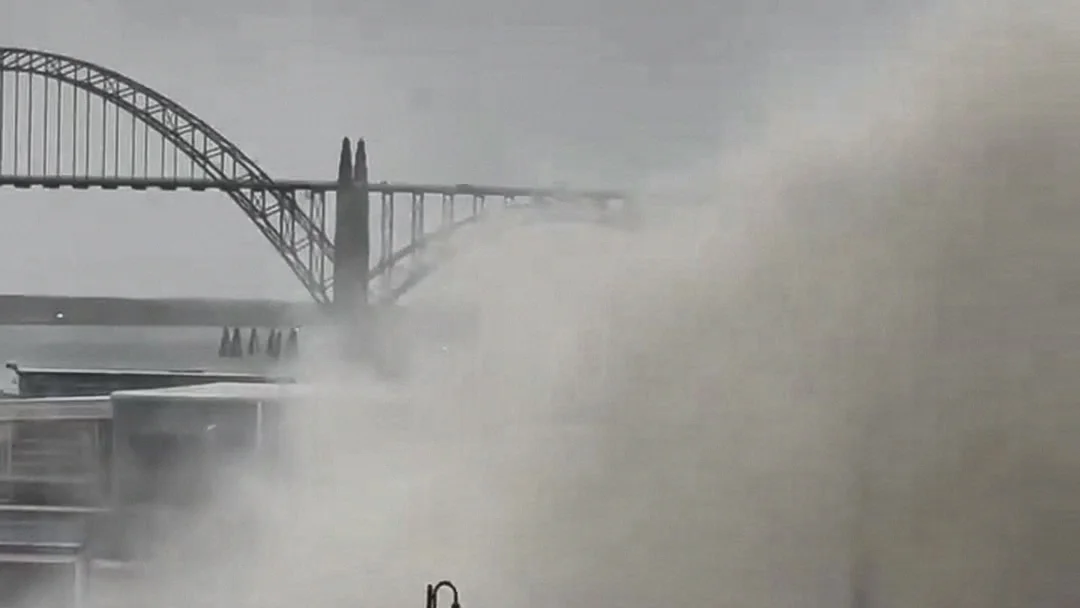
- Video captured from an elevated vantage point shows the plume swelling rapidly past parked cars and a waterfront railing, with the arched Yaquina Bay Bridge looming in the gray background.
- The area was placed under evacuation as responders moved to establish a perimeter and assess whether the tank had ruptured or was actively leaking.
- The footage ends mid-event, leaving the fate of the workers inside, the final containment timeline, and the full health assessment unresolved on camera.
What the Recorded Footage Captures: Chronological Breakdown
The clip opens in flat, overcast light. A rain-dampened roadway runs along the bottom of the frame, bordered by a black metal railing and a few parked vehicles. At first, the scene reads as ordinary coastal weather, gray sky pressing down on gray water. Then the white mass appears. It does not drift so much as pour, spilling outward in a rolling front that consumes the middle ground of the frame within seconds.
The vapor swallows the railing, then the street lamp, then the parked cars one by one. The plume thickens from a thin fog into a solid wall, bleaching out the buildings across the way and turning the waterfront into a white void. Behind it, the steel arch of the Yaquina Bay Bridge remains visible for a while, a fixed geometry against the moving mass, before the haze softens even that outline.
No fireball, no orange flash – just the quiet, total expansion of a gas cloud. The camera holds steady, a witness frozen in place while the street below empties. The last frames show the plume still growing, still curling toward the roadway, with no sign of it slowing.
Critical Blind Spots: What the Lens Leaves Unresolved
The camera sits far from the source. That distance protects the person filming, but it also strips away the crucial detail: where exactly the tank failed, whether the release was a single burst or a sustained leak, and what the workers inside the plant saw in the first seconds.
The footage also captures no faces. No one runs through the frame, no one shouts, no siren is audible over the ambient wind and water. Bystander reaction, the true gauge of how frightened people were, is entirely absent from the record – the street simply stands empty as the cloud advances.
Most importantly, the video ends before the resolution. Whether the plume dissipated on its own, whether responders shut the valve, and whether the evacuation order was lifted all happen off-screen, beyond the final frozen frame of white.
Statutory Framework and Protocol Analysis
The response to a release of this kind follows a familiar industrial-safety playbook: isolate the area, establish an upwind command post, account for every worker on shift, and test the air before allowing anyone back in. The visible evidence – an expanding cloud over a working waterfront – fits that framework, with evacuation as the first and most urgent step.
| Incident Parameter | Observation at the Scene |
|---|---|
| Location type | Coastal seafood processing facility beside a public roadway |
| Visible release | Dense white vapor plume expanding rapidly outward |
| Immediate response | Area evacuation initiated around the facility |
| Bystander presence | Street largely cleared as the cloud advanced |
| Weather conditions | Overcast, damp, low-visibility coastal light |
| Landmark in frame | Arched bridge visible behind the plume |
| Recording scope | Ends before containment or all-clear |
Communities along working waterfronts accept industrial risk as part of the local economy, but incidents like this sharpen the question of how quickly neighbors can be warned. The gap between the first visible plume and a public alert is measured in minutes, and those minutes are exactly what the camera cannot show.
Core Questions and Institutional Review
- What triggered the tank failure, and was it a sudden rupture or a slow leak that escalated?
- How many workers were inside the facility at the moment of the release, and were all of them accounted for?
- How long did the vapor remain hazardous over the roadway and nearby public spaces?
- What inspection or maintenance record preceded the incident, and will it be reviewed publicly?
The footage leaves the viewer with a single haunting image: a quiet street, a parked truck, and a wall of white swallowing the ordinary afternoon. What would you have done if you were standing on that sidewalk when the cloud began to move?
Practical Takeaways
- Never approach a visible chemical plume to film or investigate; move upwind and to higher ground.
- Follow official evacuation instructions immediately, even when the scene appears calm.
- Keep vehicle windows closed and ventilation off if a vapor cloud is nearby.
- Report the release and any respiratory symptoms to emergency responders right away.
Sources:
- Ammonia tank explodes at seafood facility in Newport, Oregon – https://www.facebook.com/thechronify/videos/ammonia-tank-explodes-at-seafood-facility-in-newport-oregon/3769975779824090/
- Fire at Seafood Processing Plant Forces Evacuations in Oregon – https://www.youtube.com/watch?v=RViFIfBb52o
- JUST IN: Ammonia tank explodes at seafood facility in Newport, Oregon – https://x.com/BNONews/status/2114406649859371268?lang=bg