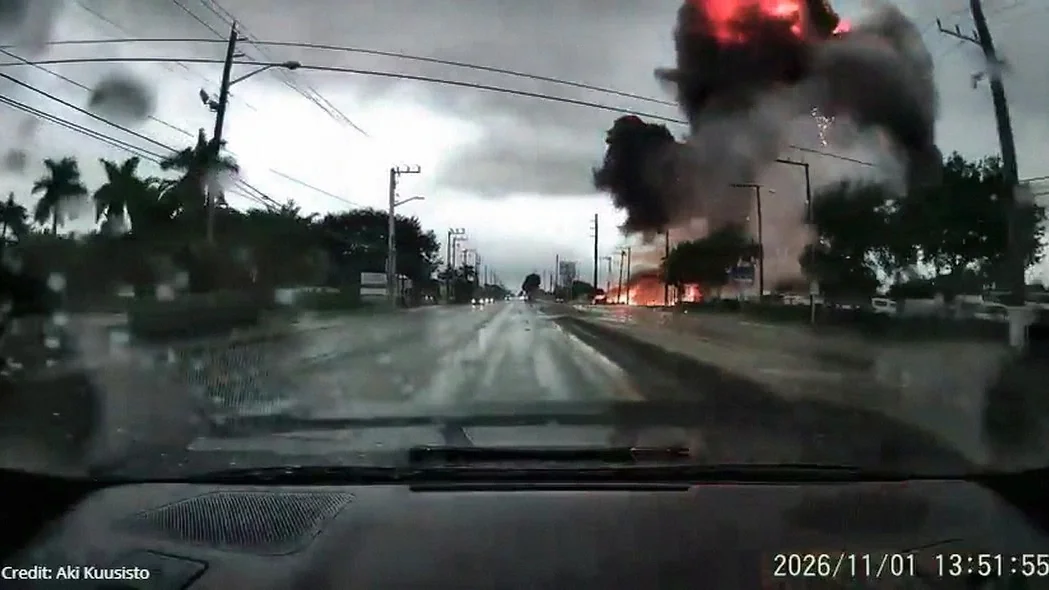
Dashcam Captures Learjet Fireball Over Florida Road
WATCH: On-scene video documentation is embedded below →
LISTEN TO THIS ARTICLE
Audio Narration • English (US)
A routine drive down a rain-slicked West Palm Beach boulevard turns into a scene of horror when a business jet drops out of a low cloud deck and explodes against the roadway. The camera never shakes, the wipers keep their rhythm, and that eerie stillness is what makes the fireball so hard to look away from.
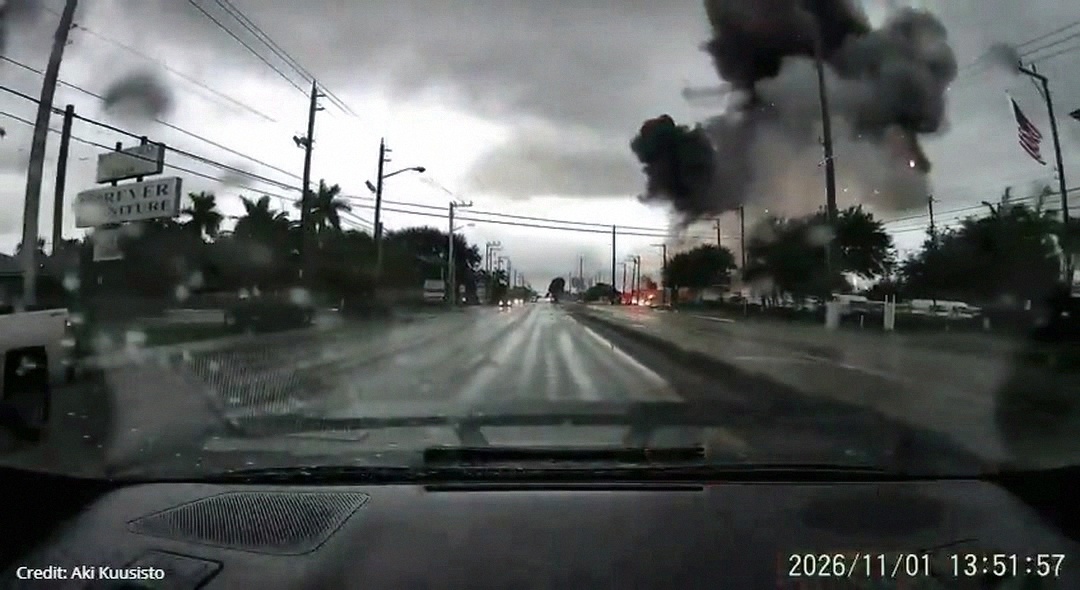
- A Learjet 60 business jet came down near a busy commercial corridor outside West Palm Beach, Florida, on a Sunday afternoon, per the source description.
- Dashcam footage said to be captured at 1:51 p.m. on November 1 shows the aircraft already in distress, trailing a plume of dark smoke as it passes low over palm trees and power lines.
- A bright orange-red fireball erupts to the right of the roadway moments later, followed by a thick column of black smoke rising above the tree line and low buildings.
- The source description states the plane was completely disintegrated on impact and that the number of casualties was initially unknown; subsequent reporting cited by CBS Mornings put the death toll at nine people aboard.
What the Recorded Footage Captures: Chronological Breakdown
The clip opens under a bruised, overcast sky. Rain beads sit heavy on the windshield, and the wipers sweep across a view dominated by wet asphalt, sagging utility lines, and a row of palms on the right shoulder. Traffic is light. A white pickup rolls along the opposite lane. Nothing about the moment suggests anything is wrong.
Then the eye catches it – a smudge of black above the rooftops that does not belong to the cloud deck. Within a heartbeat the smudge resolves into a shape trailing smoke, moving fast and low from right to left across the driver's field of view. The aircraft is already past the point of rescue, and the footage offers no sound of engines, only the hush of tires on wet pavement.
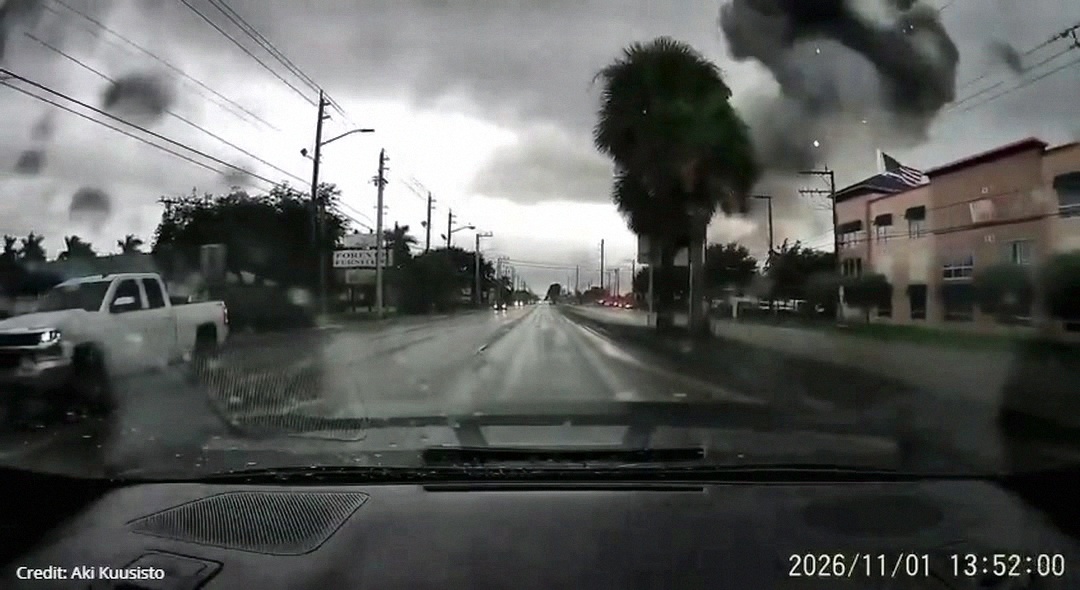
The climax arrives without warning. A brilliant bloom of red and orange tears open at the right edge of the frame, and a rising wall of smoke swallows the streetlights. The dashcam keeps recording, timestamp ticking forward, capturing the terrible casualness of the aftermath: brake lights glowing in the distance, the white pickup continuing past, and a driver's voice cutting through the silence with a stunned, half-finished question about something falling out of the sky.
Critical Blind Spots: What the Lens Leaves Unresolved
The windshield is both the frame and the limitation. Rain streaks and droplets blur the middle distance, and the camera's fixed angle means the actual point of impact sits at the extreme edge of vision. The frames cannot tell us how the jet was configured, whether any warning came over the radio, or what the cockpit crew saw in those final seconds.
Equally absent is the human geography around the crash site. The footage shows palms, power poles, and a low commercial building with an American flag, but it cannot reveal who was inside those structures, who was on the sidewalk, or how close the debris field came to occupied ground. Nothing in the clip confirms a cause, and no visible evidence supports speculation beyond what the smoke and the fireball show.
The recorded audio adds another layer of ambiguity. The only intelligible reaction is a shocked exclamation and a fragment about something falling, which suggests the driver registered the event visually before understanding it. The voice is not a witness account – it is a reflex, and investigators looking for corroboration would need far more than a single dash-mounted microphone.
Statutory Framework and Protocol Analysis
In practice, the first hours after a crash like this are governed by a sequence of protocols: securing the debris field, documenting the scene before weather or traffic disturbs it, and gathering every available recording, from dashcams to doorbell cameras to air traffic audio. The public rarely sees that machinery, but it is the reason clips like this one matter – they fix a timestamp and a sightline that no reconstruction can fully replace.
For the community along that corridor, the expectation is simpler and heavier. Residents and commuters want answers about how a business jet came to fall out of a rainy sky over a suburban road, and they want them quickly. The gap between the pace of a formal investigation and the pace of public anxiety is where rumor usually fills in, which is why officials typically release confirmed facts in measured increments.
| Incident Parameter | Observation at the Scene |
|---|---|
| Date and time marker | Dashcam overlay reads 2026/11/01, 13:51:55 |
| Weather at the moment of capture | Overcast sky, rain droplets on windshield, wet roadway |
| Aircraft behavior before impact | Low pass trailing dark smoke, moving right to left |
| Visual signature of impact | Brilliant red-orange fireball at right road edge |
| Post-impact scene | Thick black smoke column rising above tree line |
| Roadway conditions | Light traffic, wet asphalt, active wipers |
| Immediate witnesses | Driver reaction audible; passing white pickup continues |
Read more:
Read more: Stolen Plate Glued Over U-Haul Tag Unravels Florida Stop →
Core Questions and Institutional Review
- What did the aircraft's final radio transmissions and cockpit voice recordings reveal in the minutes before the descent?
- How did the jet's altitude and heading place it over a populated commercial corridor rather than an open area?
- Which nearby cameras, including business security systems, have been identified and preserved as corroborating evidence?
- What does the debris distribution suggest about the sequence of structural failure during the descent?
The dashcam clip ends abruptly, as these clips always do, leaving the smoke to rise and the driver to keep driving through a street that will never look ordinary again. What the frames capture is not the whole story but the anchor of it – a fixed point in time against which every subsequent claim will be measured. The question that lingers, for anyone who watches it more than once, is whether a single 16-second window from a rain-streaked windshield can ever be enough to explain how nine people vanished from the sky on a Sunday afternoon.
Key Takeaways
- Dashcam timestamps place the sequence at 1:51 p.m. on November 1 near West Palm Beach, Florida.
- The footage documents smoke trailing, a fireball, and a rising column but not the cause or the human toll.
- Official casualty figures and investigative sequencing must come from federal authorities, not from bystander recordings.
- Bystander video is evidentiary raw material: valuable for time, sightline, and sound, insufficient for conclusions.
LATEST DEVELOPING INCIDENT
An even more shocking incident just erupted hours ago that has stunned onlookers nationwide. Full investigative breakdown and on-scene evidence documented below.
BREAKING: READ NEXT SHOCKING INCIDENT – LATEST CASE ↓
Dashcam Captures Jet Exploding Over Residential Street
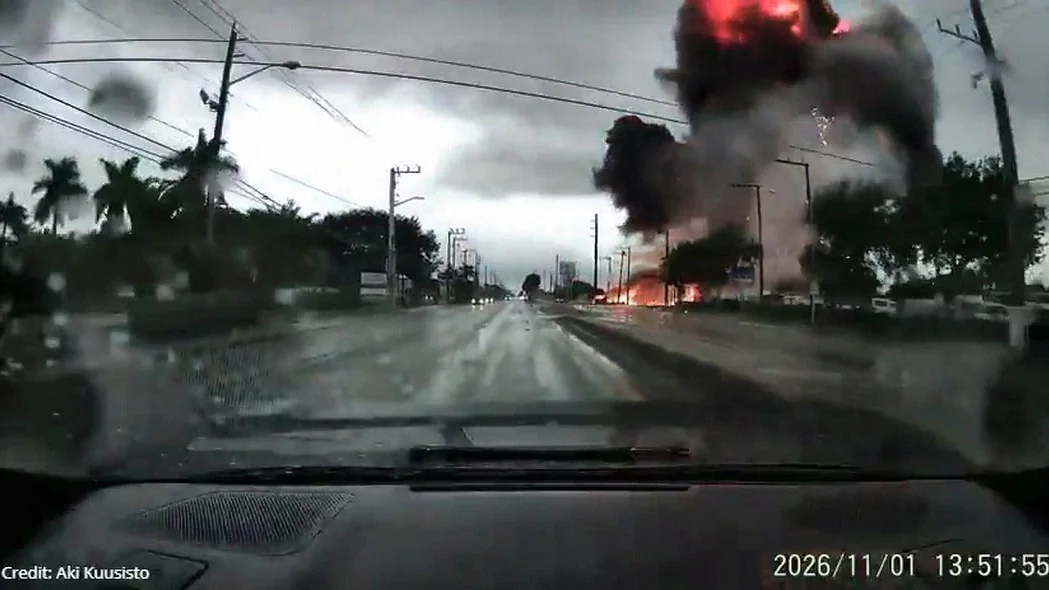
A routine drive down a rain-slicked suburban avenue becomes a front-row witness to an aviation catastrophe, captured frame by frame on a dashboard camera. The footage shows a towering black plume and a sudden flash of fire, freezing a community in the seconds between disbelief and horror.
- The scene: A residential roadway near Cresthaven, Florida, on a rainy afternoon, with traffic moving normally beneath a low, gray sky.
- The friction: The sudden, violent intrusion of a private jet slamming into the neighborhood, erupting into a massive explosion captured on a forward-facing dashcam.
- The intervention: Emergency responders and bystanders converge on the wreckage as a thick column of smoke rises over the tree line, prompting an immediate scramble for safety.
- The aftermath: All nine people aboard the aircraft were confirmed dead, and the neighborhood is left to process the shock of a disaster that unfolded in plain sight.
What the Recorded Footage Captures: Chronological Breakdown
The video opens with a wet windshield blurring the view of a wide, multi-lane road. Power lines cross the gray sky, and palm trees droop in the damp air. The driver's wipers sweep away rain as a white pickup truck passes in the opposite direction. The atmosphere is unremarkable, almost sleepy, until a dark shape tears through the sky at the upper right of the frame.
In the next instant, a bright red-orange flash erupts from the tree line, followed by a boiling black cloud that mushrooms upward with terrifying speed. The driver's voice cuts through the ambient road noise: "What in the dispute? That was a… Something just fell down." The footage timestamp clicks forward, second by second, as the fireball expands and the smoke column thickens, dwarfing the buildings along the right side of the road.
The camera keeps rolling as the driver slows, the white pickup moving past in the foreground. The explosion's glow fades to a deep, angry red at the base of the smoke, and a second, smaller burst of flame flickers near the ground. The scene holds still for a beat, the gray road empty ahead, as the realization of what just happened settles over the windshield.
Critical Blind Spots: What the Lens Leaves Unresolved
The dashcam records only what lies ahead. The aircraft's final descent, the moment of impact, and the initial explosion all occur beyond the far-right edge of the frame, leaving the lens to capture only the rising smoke and the reflection of fire on wet asphalt. The driver's reaction is audible, but the faces of bystanders, the immediate response of residents, and the first chaotic minutes at the crash site remain off-camera.
The video's timestamp places the event at 13:51 local time, but the footage offers no view of the sky above the vehicle, no indication of the aircraft's trajectory, and no clear look at the wreckage itself. What the lens leaves unresolved is the human scale of the tragedy: the nine lives lost, the identities of the victims, and the panic that surely unfolded behind the closed doors of the nearby buildings.
Statutory Framework and Protocol Analysis
The standard protocol for an aviation disaster of this magnitude involves an immediate grounding of the immediate area, a coordinated response from the Federal Aviation Administration and the National Transportation Safety Board, and a meticulous reconstruction of the flight's final moments. In this case, the local authorities and federal investigators moved quickly to secure the scene, though no cause has been disclosed.
| Incident Parameter | Observation at the Scene |
|---|---|
| Location | Residential area near Cresthaven, Florida |
| Time of impact | Approximately 12:50 p.m. local time |
| Aircraft type | 2004 Learjet, registered N722BD |
| Flight path | Departing Austin, Texas, bound for the Bahamas |
| Casualties | Nine people aboard confirmed dead |
| Visible aftermath | Massive black smoke plume and fireball |
| Proximity | About ten miles from Palm Beach |
Core Questions and Institutional Review
- What caused the Learjet to lose altitude and strike a residential street on a routine afternoon?
- How did the aircraft's flight path evade notice in the moments before impact?
- What protocols were followed by local emergency services in the first minutes after the crash?
- Will federal investigators release a preliminary report on the aircraft's mechanical condition?
The footage ends with the smoke still rising, the road ahead still wet, and the driver's question hanging in the air. The camera captured the moment, but not the answer. What the neighborhood witnessed that afternoon is now a matter of public record, yet the full story of what brought the jet down remains locked in the wreckage. As investigators sift through the evidence, one question lingers: how does a community move forward when the sky itself delivers such sudden, irrevocable loss?