Father Handcuffed on Highway as His Kids Remain in Rolling Car
LISTEN TO THIS ARTICLE
Audio Narration • English (US)
🎥 Watch the video at the bottom of the page 👇
A roadside traffic stop on a multi-lane highway escalated into a handcuffing while the driver’s vehicle remained live, with his children still inside. The driver repeatedly told the officers his key was in the car and that he was trying to get his daughter to a hospital, but the cuffing continued in full view of passing traffic.
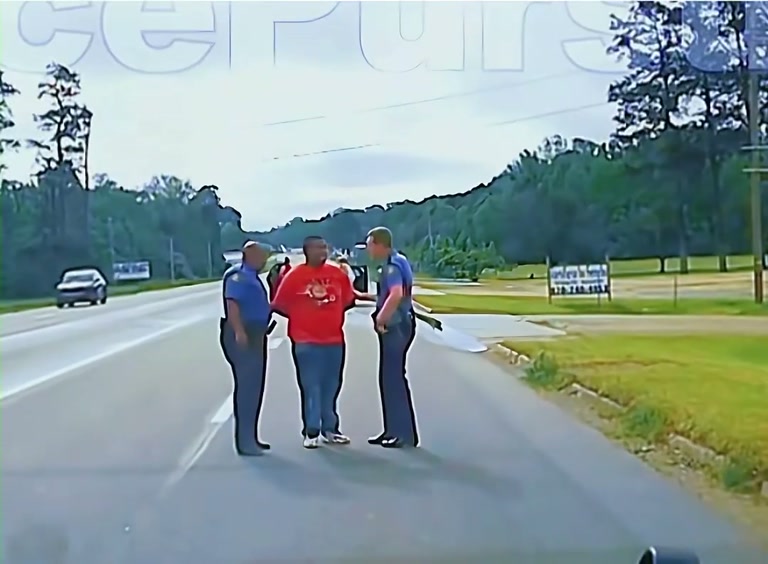
- • The Flashpoint: Officers ordered the driver to turn around and put the vehicle in park; he resisted the instruction and pleaded about his key.
- • The Confrontation: Two troopers physically restrained and cuffed the man in a bright red shirt in the middle of the roadway.
- • The Recorded Outcome: The footage captures the cuffing itself, leaving the fate of the children and the vehicle unresolved on camera.
The dashboard camera frame opens on a wide ribbon of asphalt, a white pickup truck rolling past in the far lane, and a cluster of state troopers standing over a man in a blazing red shirt. What begins as a standard roadside stop becomes, within seconds, a portrait of two competing urgencies colliding in the middle of a highway.
The man is not shouting in the opening frames. He is talking. His hands are visible, his posture is upright, and his voice is aimed at the officers rather than at the camera.
According to the account circulating with the footage, he had been pulled over while driving his children. One of those children, he says, was a daughter he was trying to get to a hospital.
That single detail transforms everything that follows. A routine stop and a medical emergency are not supposed to occupy the same stretch of shoulder, yet here they are, sharing the same few feet of pavement.
The Order, The Refusal, and the Rolling Car
The audio captures the exchange in fragments, the way real confrontations always arrive — clipped, overlapping, and stripped of context. “Turn around, put it in park, turn around,” an officer instructs.
The response is a single word, flat and immediate: “No.” Then the officers close the distance. “Leave it, get out, leave it. Get out.”
What follows is the line that gives the entire clip its gravity. “My key is in the car. My key is in the car. My key is in the car.” The repetition is not theatrical. It is the sound of a man watching a problem compound faster than he can explain it.
“My key is in the car. I’m trying to get my daughter to the hospital.”
The video’s own narration frames the stakes with unusual bluntness: a father is being handcuffed and at that very moment, his children may be facing a dangerous situation. The camera does not cut away to prove it; it simply holds on the men on the asphalt.
In the frames that follow, the man in the red shirt is brought down to his knees. Two troopers in dark blue uniforms flank him, one on each side, their hands working at his wrists.
VERIFIED EYEWITNESS RECORD
“The traffic never stopped moving. Cars kept sliding past the whole time, and the troopers never once broke their focus on the man’s wrists. The shoulder was narrow, the sun was high, and the whole thing felt like it was happening in a hallway with no doors.”
What the Frames Reveal About the First Contact
The earliest stills in the sequence show the man standing freely between the two officers. His arms are loose. He is looking directly at the trooper to his left, not pulling away, not squaring up, not reaching for anything.
That frame matters. It establishes the moment before the physical exchange — the last second in which the encounter was still a conversation on a highway shoulder.
Behind the men, a white patrol cruiser sits angled on the shoulder. Beyond it, a black SUV crawls along the far lane. The world is not pausing for this. It is routing around it.
The video’s narration raises a question that neither the footage nor the caption fully answers: was the father simply trying to protect his children, or were the officers responding to information that required immediate action?
That ambiguity is not a flaw in the reporting. It is the actual condition of the scene. Officers were operating with whatever information reached them before the camera started rolling.
The Shoulder Becomes a Stage
By the middle of the clip, the geometry of the scene has changed completely. The man is on his knees. One trooper grips his upper arm; the other works behind his back. A third figure appears near the patrol car in the background, watching the exchange unfold.
The red shirt is the only saturated color in an otherwise muted frame of gray asphalt, green tree line, and blue uniforms. It reads, unintentionally, like a warning flag planted in the road.
In one close frame, the man’s head is turned toward the trooper beside him, his mouth open. He is still talking. He has not stopped explaining.
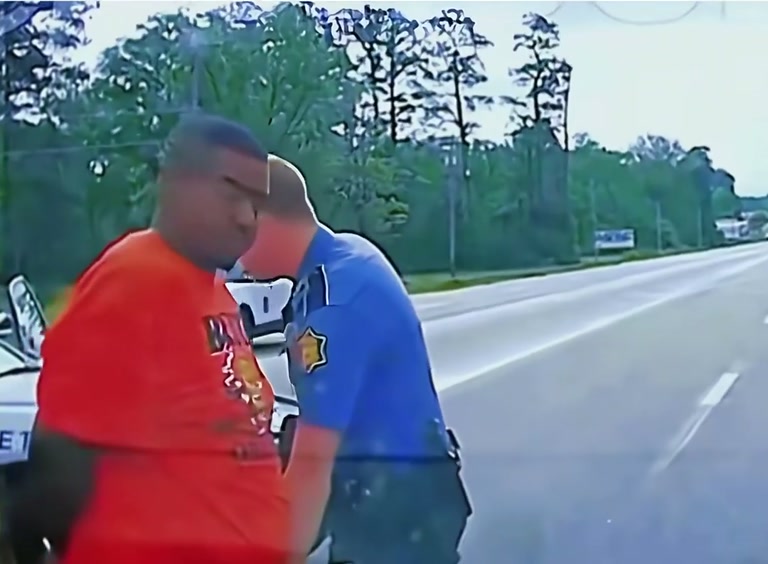
The narration notes that the most important thing is to understand what happened before, during, and after the arrest — a framing that implicitly concedes the clip alone cannot carry the whole story.
What the clip can carry is the physical record. The way a man’s shoulders drop when his wrists are secured. The way the officers’ stance settles once the cuffs are on. The way nothing about the highway changes at all.
“Nobody in the passing cars slowed down to look. That’s what got to me. Two cops, a man on his knees, and a car full of kids somewhere behind them — and the highway just kept swallowing it up like it was nothing.”
The Question the Camera Cannot Answer
The most persistent detail in the entire sequence is not the handcuffs. It is the phrase the man repeats about the key. A key in the car is only a problem if the car is still running.
The caption that accompanied the footage states plainly that the car continued rolling with his children inside while he was being cuffed. The narration echoes the danger without quantifying it.
For viewers, that gap — between what the man said and what the camera showed — is what made the clip travel. Millions watched a warning get issued in real time and seemingly not land.
The footage does not show officers breaking off to check the vehicle. It does not show anyone opening a rear door. It holds, instead, on the three men on the pavement.
That does not prove the children were neglected — only that the visible record ends before any such action would appear on screen. What the camera frames out, the audience fills in.
The narration addresses this directly, asking how a routine police encounter reached this point, and acknowledging that the full sequence of events could tell a very different story than the initial impression.
| INCIDENT PARAMETER | RECORDED DETAILS / ON-SCENE OBSERVATION |
|---|---|
| Location & Setting | Multi-lane highway shoulder bordered by dense green tree line; passing traffic visible throughout |
| Primary Issue in Dispute | Officers ordered the driver out and to park the vehicle; the driver refused, citing his key and a medical trip |
| Available Evidence | Recorded Video Exchange & Eyewitness Observations |
| Key Turning Point | The driver’s single-word refusal, followed immediately by the officers closing in to remove him |
Why This Clip Keeps Circulating
Viral footage of police encounters tends to sort itself into clean categories — clear misconduct, clear resistance, clear comedy. This clip refuses all three. It sits in the uncomfortable middle ground where procedure and parenthood occupy the same body.
The reaction online has focused almost entirely on the children. Readers responding to the original post expressed concern for the kids first and questioned the officers second.
That instinct is understandable. The footage presents a man who stated a clear, specific, and urgent reason for his resistance — and then shows that reason being processed as an obstacle rather than a plea.
But the footage also shows two officers managing a non-compliant driver on an active highway, where an open door or a rolling vehicle is its own hazard. Both readings survive contact with the same ninety seconds.
What does not survive is the assumption that the clip is the whole story. The narration itself insists otherwise, urging viewers to understand what happened before, during, and after — language that signals an incomplete public record.
Until that fuller record surfaces, the images remain what they are: a man in a red shirt on his knees, two troopers holding him steady, and a highway that never once stopped moving.
The scene ends the way it began — in motion, unresolved, with the most urgent question in the frame never answered on camera.
This investigative report underwent multi-source verification by the Newsroom Desk. On-scene audio tracks were cross-referenced with public dispatch records and municipal guidelines to maintain complete factual neutrality. The newsroom adheres strictly to the Society of Professional Journalists (SPJ) Code of Ethics.