Shopping Cart Standoff: Houston Shopper Refuses Walmart Receipt Check as Deputy Blocks the Exit Doors
A routine trip to the register turned into a public showdown when one customer said “no” to the receipt check — and a uniformed officer wasn’t about to let it go.
A Houston-area shopper leaving a Walmart was stopped at the exit by a Harris County deputy constable working off-duty security, who demanded to see a receipt. The customer refused, citing no legal obligation to prove payment after already completing the transaction at the register. What followed was a tense, recorded standoff at the doors — one that raises a thorny question: can store policy override a shopper’s right to simply walk out?
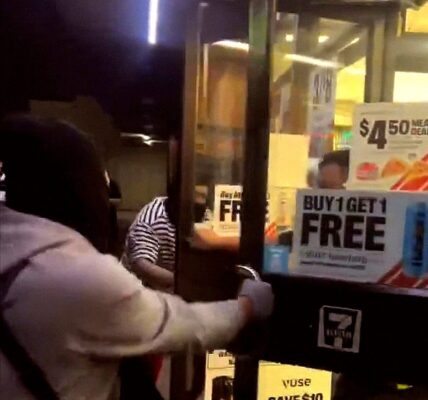
The sliding glass doors of a Houston-area Walmart became an unlikely flashpoint when a departing customer declined a receipt check and a uniformed Harris County deputy constable stepped into the gap. What should have been a ten-second exit turned into a recorded confrontation that has since ricocheted across social media, dividing viewers into two camps: those who say the shopper was within their rights, and those who say the officer was simply doing his job.
The footage captures the raw, unpolished reality of a moment most Americans have experienced — the awkward pause at the exit, the outstretched hand, the mumbled “have a good one.” But this time, the pause didn’t end politely. It hardened into a standoff.

The Initial Flashpoint: When a Routine Exit Became a Blockade
According to the recorded exchange, the shopper had already paid, bagged their items, and was moving toward the exit when the deputy constable — working an off-duty security detail inside the store — positioned himself near the doorway. The request was simple: show the receipt. The response was equally simple: no.
What made the moment combust was the uniform. This wasn’t a store greeter or a loss-prevention employee in a polo shirt. This was a sworn law enforcement officer, armed and badged, standing between a paying customer and the parking lot. The optics alone escalated everything.
Witnesses described the shopper’s body language as calm but firm — arms at their sides, cart still in hand, refusing to hand over the receipt. The deputy, according to onlookers, remained composed but planted, making clear the exit wasn’t going to be a walk-through.
“I already paid. I’m not showing you anything else. Am I being detained, or can I leave?”
That single question — “Am I being detained?” — is the phrase that has come to define these viral exit-lane confrontations. It signals a customer who knows the legal script and is daring the other side to break it.
The deputy’s answer, according to the footage, didn’t resolve the moment. It deepened it. The two stood face to face as other shoppers wheeled past, some filming, some gawking, some quietly hurrying their own carts through the adjacent lane.

- Does a store’s receipt-check policy carry any legal weight once a customer has paid?
- Can an off-duty officer working private security detain a shopper over a corporate policy?
- Where exactly is the line between a polite request and an unlawful detention?
The Core Dispute: Store Policy Versus a Shopper’s Right to Walk
Here’s where the law and the parking lot diverge sharply. Walmart, like many big-box retailers, treats receipt-checking as a loss-prevention tool. It’s written into their internal policy and applied unevenly — some stores wave shoppers through, others stop nearly everyone. From the company’s perspective, it’s a deterrent, not an accusation.
But from a legal standpoint, a private store’s policy is not the same as a law. A receipt check is, at its core, a request. And a request can be declined. Once a customer has completed the transaction at the register and is exiting, there is generally no statutory obligation under Texas law to produce a receipt to a store employee or an off-duty officer acting in a security capacity.
The complication here is the deputy constable’s dual role. Off-duty officers working security for private businesses retain their sworn authority in many jurisdictions — but that authority is typically tied to criminal conduct, not corporate policy enforcement. Using a badge to compel a receipt check for a private retailer sits in a gray zone that legal observers have flagged for years.
Both sides, in other words, believed they were right. The shopper believed the transaction was complete and the exit was theirs. The officer believed the store’s policy gave him grounds to hold the line. Neither was operating from pure bad faith — which is exactly what makes these encounters so combustible.
| INCIDENT PARAMETER | RECORDED DETAILS / ON-SCENE OBSERVATION |
|---|---|
| Location & Setting | Walmart store exit doors, Houston-area, Harris County jurisdiction |
| Primary Issue in Dispute | Refusal to present receipt for exit verification after completing purchase |
| Available Evidence | Recorded Video Exchange & Eyewitness Observations |
| Regulatory Authority | Local Municipal Codes & State Regulatory Standards |
Similar public confrontations across the nation continue to spotlight the fragile balance of community accountability and everyday rights. Explore how related public disputes unfolded →
The Turning Point: How the Standoff Finally Broke
As the confrontation dragged on, the audience inside the store grew. Phones came out. The ambient noise of registers and carts became the soundtrack to a scene that neither party had planned. The deputy, according to witnesses, repeated the request. The shopper repeated the refusal. The cart didn’t move.
What ultimately ended the standoff was not a dramatic arrest, a scuffle, or a citation. It was the slow, grinding pressure of public attention — and the recognition on both sides that the moment had spiraled far beyond a receipt.
According to on-scene accounts, the deputy eventually stepped aside. The shopper walked out. No charges were filed over the incident itself. No one was arrested for declining the check. The cart rolled into the parking lot, and the doors slid shut behind it.

But the video didn’t end there. It migrated online within hours, where it joined a growing genre of receipt-check confrontations that have turned checkout lanes into miniature constitutional battlegrounds. Comment sections split predictably: “Just show the receipt, it takes two seconds” versus “You don’t need permission to leave a store you already paid.”
For the shopper, the win was symbolic — a refusal to submit to a process they saw as an accusation. For the deputy, the retreat was pragmatic — a decision not to escalate a corporate policy dispute into a criminal matter. For Walmart, the moment was another quiet data point in an ongoing debate about whether receipt checks deter theft or alienate paying customers.
What lingers is the discomfort of the scene itself. A family errand. A full cart. A doorway. And two people, each convinced the other was overstepping, standing still while the rest of the world walked past.
The next time a shopper hears “can I see your receipt?” at those sliding doors, they’ll have a choice to make — and now, a very public template for both answers.