Chained at Dawn: The Tow Truck Standoff That Turned a Quiet Driveway Into a Neighborhood Flashpoint
He stepped outside with his coffee in hand. A commercial wrecker was already blocking his gate, chains rattling against concrete. What happened in the next twenty minutes had the entire block watching.
A homeowner stepped out to find a commercial tow truck parked across his private driveway, chains already rigged to a vehicle at the curb. The driver insisted he had authorization to remove it. The homeowner argued the truck itself was now trespassing. Neither would move. What followed was a tense, recorded confrontation over property boundaries, paperwork, and who actually holds authority on a residential street.
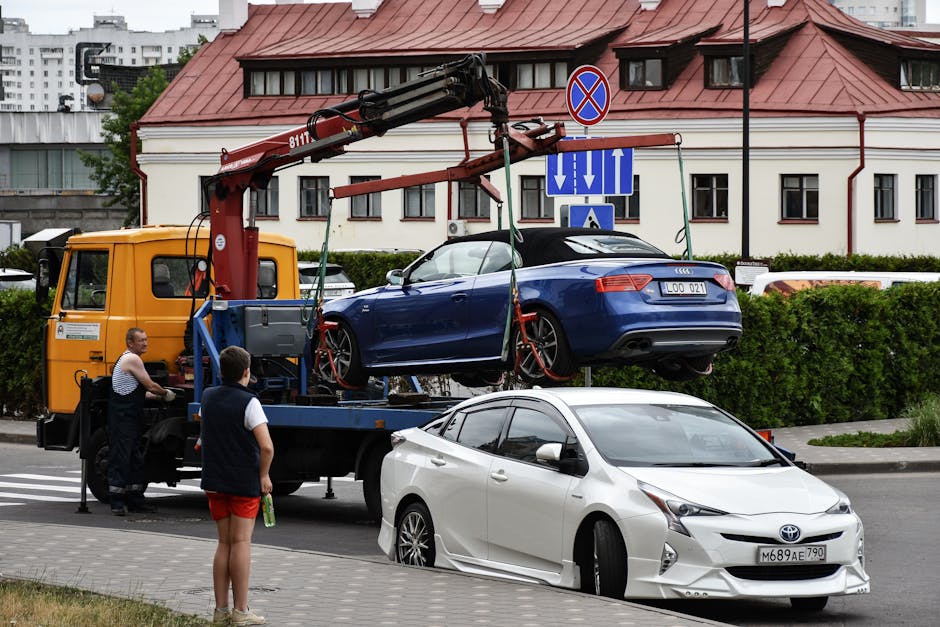
The coffee was still hot in his hand when he saw the yellow strobe lights bouncing off his garage door. It wasn’t even seven in the morning. A flatbed wrecker sat angled across the mouth of his driveway, its rear wheels planted squarely on the concrete apron he’d poured himself three summers ago. A man in a reflective vest was crouched near the curb, feeding a chain hook under the frame of a sedan parked along the street.
Nothing about the scene looked accidental. The truck wasn’t passing through. It wasn’t waiting. It was working. And it had chosen his driveway as its staging ground.
What began as a confused glance through a kitchen window would spiral, within minutes, into a face-to-face confrontation that neighbors would later describe as the strangest thing they’d seen on the block in years. No shouting match. No fists. Just two men standing six feet apart on a suburban sidewalk, each utterly convinced the other was the one breaking the law.
The 6:30 AM Confrontation: A Quiet Morning Shattered at the Driveway Gate
By the time the homeowner reached the end of his walkway, the chain was already taut. The sedan at the curb sat low, its front wheels locked at an awkward angle. The tow operator didn’t look up. He ratcheted the tensioner once, twice, and the metal groaned against the pavement.
“That’s my driveway,” the homeowner said, according to the recorded exchange that later circulated among neighbors. “You’re parked on my property.”
The driver straightened up slowly. He was calm in a way that suggested he’d had this conversation a hundred times before. He gestured at the sedan. “This vehicle’s being removed. It’s on the public right-of-way. I’ve got a work order.”
The homeowner pointed at the truck’s rear tires, sitting fully on the private apron. “I’m not talking about the car. I’m talking about you.”
“I don’t need your permission to be here. I need a signature, and I already have one.”
That line landed like a slap. The homeowner’s body language shifted — arms crossing, weight rocking back on his heels. On the recording, you can hear a screen door creak somewhere behind him. A neighbor had stepped out. Then another.
The driver reached into the cab and produced a clipboard. He didn’t hand it over. He held it at chest height, angled so the homeowner could see there was writing on it but not read a single word. It was a power move, deliberate and practiced.
“Call whoever you need to call,” the driver said. “I’m finishing this hook.”
He turned his back. That was the moment the morning stopped being a misunderstanding and became a standoff.
- Does a work order authorize a tow truck to stage on private property without the owner’s consent?
- Where does the public right-of-way actually end and a homeowner’s driveway begin?
- What happens when a resident physically refuses to let a commercial vehicle leave?
Where Authority Ends: The Contested Line Between Private Property and Commercial Orders
This is where the story gets messy, because both men were operating on beliefs that felt airtight to them — and both were only half right.
Tow operators across most US municipalities work under a patchwork of rules. On private property, a towing company generally needs either the property owner’s consent or a valid statutory basis — an illegally parked vehicle blocking access, an abandoned car, a violation flagged by a property manager with written authority. On public streets, the rules shift entirely to municipal code and whatever contract the tow company holds with the city or a private lot owner.
The sedan at the curb was the easy part. It sat on the public right-of-way. If it was genuinely subject to removal, the driver had a legal path to hook it.
The truck was the hard part. Its rear wheels rested on the homeowner’s private apron — the sloped concrete connecting the sidewalk to the garage. In most jurisdictions, that strip is unambiguously private. Staging commercial equipment there without permission can constitute trespass, regardless of what the operator is doing with the vehicle out front.
But here’s the catch that trips up almost every homeowner in this situation. The driver’s work order — whatever it said — gave him a legal basis to remove the sedan. The homeowner had no authority to stop that removal. What he could contest was the truck’s physical presence on his property. And that distinction is exactly what neither man wanted to acknowledge in the heat of the moment.
So they stood there. The chain stayed tight. The clipboard stayed closed. And the block kept watching.

| INCIDENT PARAMETER | RECORDED DETAILS / ON-SCENE OBSERVATION |
|---|---|
| Location & Setting | Private Residential Driveway and Adjoining Public Curb |
| Primary Issue in Dispute | Authorization to Stage Commercial Equipment on Private Property |
| Available Evidence | Recorded Video Exchange and Eyewitness Observations |
| Regulatory Authority | Local Municipal Codes and State Towing Regulations |
| Documentation Presented | Work Order Referenced but Not Produced for Inspection |
Similar confrontations across the country are highlighting the fragile line between private property boundaries and commercial enforcement. Explore how related neighborhood disputes unfolded →
The Stand-Off’s Turning Point: Why the Chains Were Finally Released
Fourteen minutes in, a third person entered the frame. A woman from two doors down, phone already recording, walked up the sidewalk and stood behind the homeowner. She didn’t say anything. She just held the camera steady, pointed directly at the truck’s rear wheels resting on the private apron.
The driver noticed. He glanced at the phone. Then at the homeowner. Then back at the phone.
“You’re on private property right now,” the neighbor said, calmly, from behind the lens. “That’s the part I’m filming.”
Something shifted. Not dramatically. There was no apology, no raised voice, no sudden retreat. The driver simply turned, walked to the cab, and started the engine. He released the tensioner on the chain, let it slack against the pavement, and pulled the truck forward two feet — just enough to clear the apron. The rear wheels came to rest on the public street.
He got out. Re-hooked the chain. And finished the job from a legal position.
“I wasn’t trying to take your driveway. I was trying to take the car. You made it about the driveway.”
The sedan was gone four minutes later. The homeowner stood on his walkway, coffee cold, watching the flatbed disappear around the corner. The neighbor stopped recording. Nobody had called the police. Nobody had raised a hand. But the entire block had seen something that felt, in the moment, like a small war over a few square feet of concrete.
What lingers isn’t the tow itself. It’s how quickly a routine enforcement action turned into a confrontation over boundaries that most homeowners assume are obvious — and most tow operators assume are negotiable. The line between “doing my job” and “standing on your property” is thinner than either side wants to admit.

The chains came off because a camera came on. Not because of a statute, not because of a badge, not because anyone produced a document. The presence of a witness with a phone reset the entire power dynamic in under thirty seconds. That’s the part that should unsettle any homeowner reading this. The rules existed the whole time. But what actually ended the standoff was the sudden awareness that someone was watching.
By eight o’clock, the street was quiet again. The sedan’s owner would later retrieve the vehicle from an impound lot, frustrated but legally out of options. The homeowner would spend the rest of the morning wondering whether he’d actually won anything — or just delayed the same confrontation for another day.
Down the block, a different neighbor was already checking his own driveway apron. Measuring it. Wondering where, exactly, his property ended and the street began. Because the next tow truck won’t announce itself. It’ll just show up, back in, and start pulling chain.