Chained and Defiant: The 6:30 AM Tow Truck Standoff That Turned a Quiet Driveway Into a Property Rights Battleground
A homeowner steps outside to find their car boxed in by a commercial wrecker — and the fight over who owns the curb becomes a minutes-long test of nerve, authority, and the law.
A commercial tow truck operator positioned a wrecker across a private residential driveway during an early-morning enforcement run. When the homeowner confronted the driver, the exchange escalated into a recorded standoff over authorization, boundary rights, and whether the vehicle could legally be chained or hauled. The confrontation ended only after the operator released the chains — but the deeper question of who controls a private driveway’s edge remains unresolved.
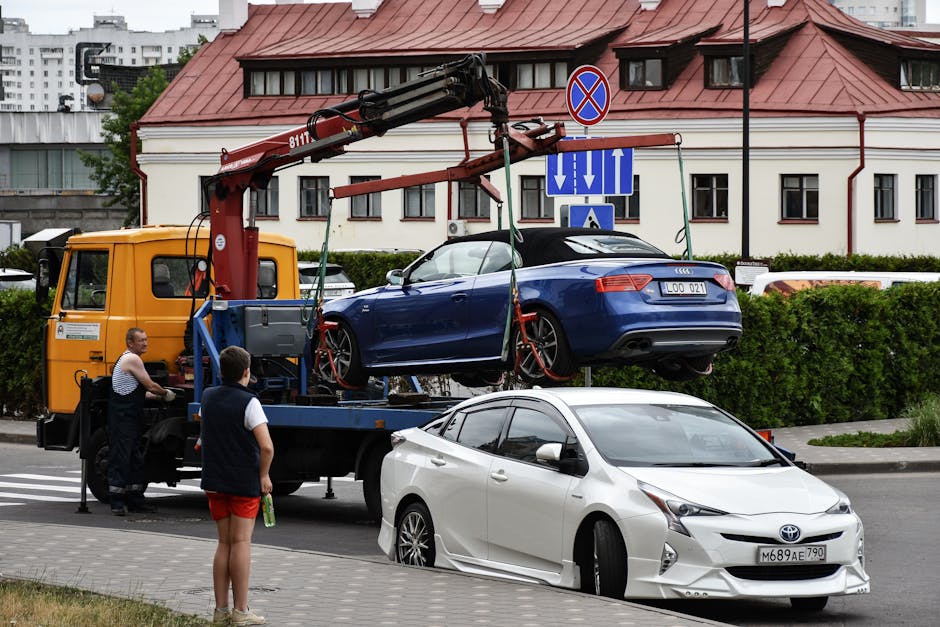
The engine idle was the first thing the homeowner heard — a low, diesel growl that didn’t belong on a residential street at 6:30 in the morning. By the time the front door swung open, a commercial wrecker had already angled its rear boom across the mouth of the driveway, its hydraulic arms hovering over a sedan that hadn’t moved in hours. What followed over the next several minutes was not a polite exchange about parking. It was a raw, recorded collision between a private citizen defending their property line and a tow operator insisting he had every right to be there.
The homeowner came out barefoot, phone already recording. The driver stayed in the cab, window cracked, refusing to make eye contact. Neither side backed down. And somewhere between the driveway’s concrete lip and the public right-of-way, the entire dispute hinged on a single, contested question: where exactly does private property end and municipal authority begin?
The 6:30 AM Confrontation: A Quiet Morning Shattered at the Driveway Gate
The footage captures the moment with uncomfortable clarity. The homeowner walks briskly toward the cab, gesturing at the sedan now pinned behind the wrecker’s frame. The driver, still seated, rolls the window down just enough to speak — not enough to be fully heard. The body language on both sides is immediate and unmistakable: this is not a conversation. It is a negotiation under pressure.
According to the homeowner’s account, no warning had been posted on the vehicle that morning. No knock on the door. No courtesy call. The sedan was simply boxed in, chains already threaded through the wheel wells before anyone inside the house knew what was happening.
The driver, for his part, maintained a calm, almost mechanical tone. He pointed toward the street, then toward a laminated sheet on his dashboard. He referenced an “authorization” — a word that would become the flashpoint of the entire exchange. The homeowner demanded to see it. The driver declined to hand it over.
“You are on my property. You do not have permission to be on my property. Take the chains off. Now.”
The driver’s response was quieter, but no less firm. He stated that the vehicle was subject to removal under a standing enforcement arrangement — one he claimed applied to the entire block, not just the public street. The homeowner fired back that the sedan was parked entirely within the driveway, behind the property line, and therefore outside any commercial tow authority.
Neighbors began stepping onto porches. One filmed from a second-story window. The scene had all the ingredients of a viral confrontation — a homeowner in pajamas, a tow driver in a reflective vest, and a sedan caught in the middle like a hostage.
- Did the driver possess a valid, property-specific authorization — or was he relying on a blanket street enforcement contract?
- Was the sedan parked entirely on private property, or did its rear bumper cross into the public right-of-way?
- Why did the operator refuse to show documentation when directly asked on camera?
Where Authority Ends: The Contested Line Between Private Property and Commercial Orders
This is where the standoff stops being a shouting match and becomes a genuine legal puzzle. The tow industry operates on layered authority: municipal contracts, private property agreements, and state-level towing statutes. Each layer has its own boundaries, and each boundary is enforced — or ignored — differently from one city to the next.
On one side, the driver clearly believed he was acting within his contractual scope. Wreckers dispatched under neighborhood enforcement agreements often work from a list of addresses flagged for repeat violations. If the sedan’s plate or location matched a flagged entry, the driver may have genuinely believed the tow was legitimate.
On the other side, the homeowner’s position was equally grounded. Private property is, in most states, exactly that — private. A tow operator cannot simply enter a driveway and hook a vehicle without either the owner’s consent or a court-ordered or statutorily authorized right of entry. A posted sign at the street entrance does not automatically grant access to a driveway that sits fully behind the property line.
The confusion multiplies when you consider the “apron” — the sloped concrete strip where the driveway meets the sidewalk. In many municipalities, that strip is technically part of the public right-of-way. If even a few inches of the sedan’s rear bumper extended over the apron, a tow operator could argue the vehicle was fair game. If it sat fully behind the apron, the driver’s authority evaporates.
| INCIDENT PARAMETER | RECORDED DETAILS / ON-SCENE OBSERVATION |
|---|---|
| Location & Setting | Private Residential Driveway, Early Morning |
| Primary Issue in Dispute | Authorization & Property Boundary Rights |
| Available Evidence | Recorded Video Exchange & Eyewitness Observations |
| Regulatory Authority | Local Municipal Codes & State Regulatory Standards |
| Documentation on Scene | Laminated Sheet Referenced by Operator, Not Presented |
| Resolution Status | Chains Released, Vehicle Left in Place |
What makes this scenario so unnerving for any homeowner is the asymmetry of information. The driver knows the contract. The homeowner does not. The driver knows which codes apply and which don’t. The homeowner is standing in slippers with a phone, trying to reason through a legal framework they’ve never had to learn.

Similar confrontations across the country are highlighting the fragile line between private property boundaries and commercial enforcement. Explore how related neighborhood disputes unfolded →
The Stand-Off’s Turning Point: Why the Chains Were Finally Released
For several minutes, neither side moved. The driver kept one hand on the gearshift. The homeowner kept the phone raised, narrating every second. Then something shifted. Perhaps it was the growing crowd of neighbors. Perhaps it was the realization that the sedan was, in fact, parked entirely behind the apron. Or perhaps it was the quiet calculation every tow operator makes on scene: is this tow worth the escalation?
The driver killed the engine. He stepped out of the cab slowly, hands visible, and walked to the rear of the wrecker. Without a word, he crouched beside the sedan’s front wheel and began unhooking the chain. The homeowner kept recording but stopped speaking. The tension didn’t break — it simply deflated, like air leaving a tire.
“I’m releasing it. But you need to understand — this is going to happen again if the vehicle stays here.”
The driver climbed back into the cab, pulled the wrecker forward, and drove off without another word. The sedan remained in the driveway, untouched. The homeowner stood in the driveway for a long moment, phone still recording, before walking back inside.
But the resolution was not a victory. It was a pause. Nothing about the underlying dispute had been settled. The enforcement contract, if it existed, was still active. The municipal codes were still ambiguous. And the next tow operator dispatched to that block might not be as willing to back down.
What the footage reveals is something larger than one driveway on one morning. It shows how thin the line is between a citizen’s home and a commercial system operating on rules most people have never read. The homeowner did everything right — stayed calm, recorded the exchange, asserted property rights without physical escalation. But the outcome hinged less on the law than on the driver’s willingness to walk away.
Neighbors who watched the scene unfold said the same thing in different words: it could have been any of them. Any driveway. Any morning. Any sedan. The vulnerability is universal, and the protections are only as strong as the person willing to stand in their slippers and refuse to move.
The chains came off. The wrecker drove away. But the question that hung in the cold morning air — who actually controls the edge of a private driveway — never got an answer. And for every homeowner watching that footage, the uncomfortable truth is that the answer may depend entirely on who shows up next.