Chains, Shouts, and a Silent Standoff: The Tow Truck That Wouldn’t Leave a Private Driveway
A routine morning turns into a battle of wills when an aggressive tow operator meets a homeowner who refuses to back down.
A tow truck operator entered a private residential driveway and began preparing to remove a parked vehicle, triggering a tense confrontation with the homeowner. What followed was a minutes-long standoff over authorization, property boundaries, and who actually holds the power to order a tow. The operator ultimately released the vehicle and left, but not before raising a question every homeowner fears: who really controls your driveway?
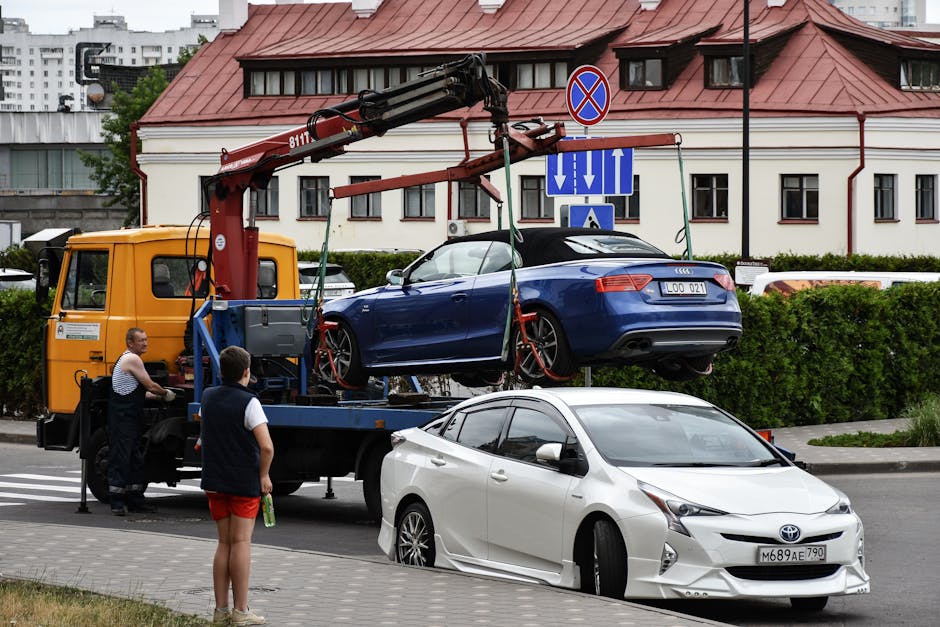
The diesel engine was already idling when the homeowner stepped onto the porch. A heavy-duty tow truck had backed its rear into the driveway, blocking the family sedan against the garage door. A man in a reflective vest was crouched near the rear wheel, threading a hook beneath the chassis with the calm efficiency of someone who had done this a hundred times before.
It was 6:42 AM on a weekday. The street was still quiet. The sprinklers hadn’t even kicked on yet.
What happened over the next twelve minutes would become a masterclass in the raw, uncomfortable space between private property rights and commercial enforcement — a standoff that played out in full view of a Ring camera, a pair of neighbors walking their dog, and a driver who clearly believed he had every right to be there.
The 6:42 AM Confrontation: A Quiet Morning Shattered at the Driveway Gate
The homeowner — we’ll call him Daniel, a software engineer who had lived on the property for nine years — walked down the steps in bare feet. His voice was steady at first. “Excuse me. What are you doing?”
The operator didn’t look up. “Vehicle’s been flagged for removal. You can take it up with dispatch.”
That was the first lie. Or, at minimum, the first half-truth. There was no municipal notice on the windshield. No sticker. No warning of any kind. The sedan was registered, insured, and parked entirely on private asphalt — roughly fourteen feet from the public right-of-way.
Daniel asked for documentation. The operator produced a phone screen with a work order number and a generic company logo. When Daniel asked which authority had authorized the tow, the operator pointed vaguely toward the street and said, “Your HOA.”
Daniel didn’t have an HOA. He lived in an unincorporated pocket of the county where deed restrictions existed but no active association had operated in over a decade.
“You’re telling me an HOA that doesn’t exist ordered you to take my car from my driveway at six in the morning. I need you to hear how that sounds.”
The operator’s body language shifted. He stood up. He glanced at the cab of his truck, where a second worker sat behind the wheel, engine still running, watching the exchange through a side mirror.
Daniel pulled out his phone and started recording. The operator noticed immediately. “You can record all you want. I’m doing my job.”
The hook was still attached. The chains were still taut. The sedan hadn’t moved an inch — but it was one hydraulic pull away from being dragged onto the public street.
- Did the tow operator have any valid authorization to enter private property without a signed request from the owner?
- What do state and municipal regulations actually require before a vehicle can be towed from a residential driveway?
- Why did the operator insist on staying hooked up for nearly ten minutes after being told to leave?
Where Authority Ends: The Contested Line Between Private Property and Commercial Orders
This is where the story stops being about one driveway and starts being about every driveway.
Under most state vehicle codes, a tow operator cannot enter private property to remove a vehicle without one of three things: a signed authorization from the property owner, a valid lienholder repossession order, or a specific municipal or law enforcement directive tied to a public safety violation. A generic “work order” from a dispatch system is not, by itself, legal authorization to cross onto private asphalt.
The operator knew this. Or he should have. Every licensed tow driver in the country is required to understand the boundaries of legal entry — it’s part of the certification process in nearly every state that regulates the industry.
But here’s where it gets murky. Some tow companies operate on what’s called “blanket authorization” — a standing agreement with a property manager or commercial lot owner that allows them to patrol and remove vehicles at will. Those agreements are legal. But they apply to commercial parking lots, apartment complexes, and retail centers. They do not apply to a single-family home on a county road with no active association.
Daniel knew none of this in the moment. What he knew was simpler: a stranger was trying to take his car from his own driveway, and the explanation didn’t add up.
The Stand-Off’s Turning Point: Why the Chains Were Finally Released
By the eight-minute mark, a small crowd had gathered. Two neighbors stood on the sidewalk. One had already called the non-emergency police line. The second worker had stepped out of the cab and was now standing near the rear of the truck, arms crossed, saying nothing.
Daniel had stopped arguing. He had shifted tactics. He stood directly between the tow truck’s rear bumper and the sedan’s front fender — not blocking the hook, but making it visually and physically clear that any pull would be recorded, reported, and contested.
“I’m not moving,” he said. “And you’re not taking this car.”
The operator looked at his partner. The partner shrugged. The engine kept running.
What broke the standoff wasn’t a police siren or a legal threat. It was a phone call — from the tow company’s dispatch, apparently prompted by the neighbor’s call to the non-emergency line. The operator answered, listened for less than thirty seconds, and then knelt down to release the hook.
“Dispatch says we’re clear. Wrong address.”
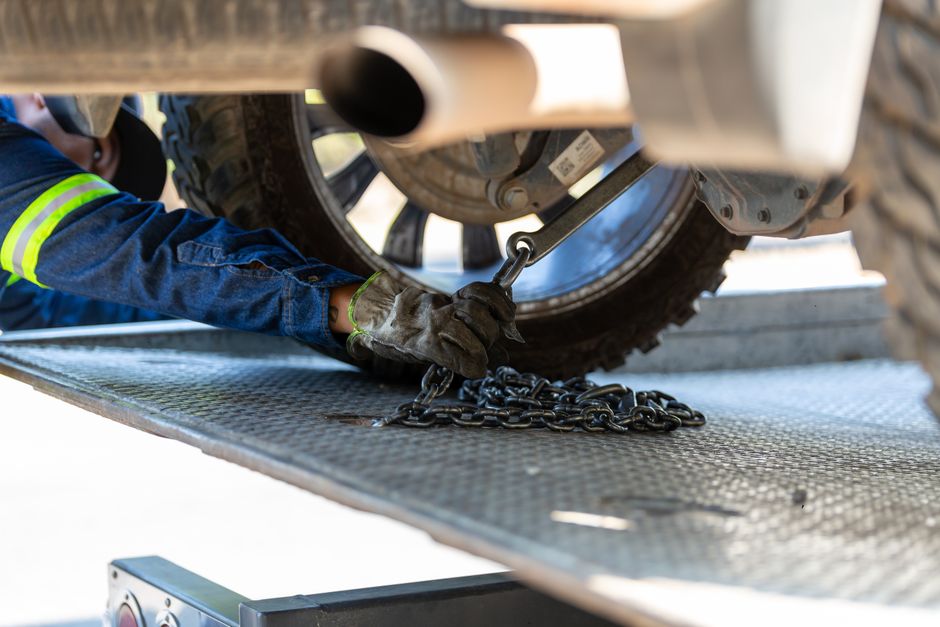
Wrong address. That was the entire explanation. No apology. No paperwork. The chains were coiled, the hook was stowed, and the truck pulled out of the driveway at 6:54 AM — twelve minutes after it had arrived.
| INCIDENT PARAMETER | RECORDED DETAILS / ON-SCENE OBSERVATION |
|---|---|
| Location & Setting | Private Residential Driveway, Unincorporated County Road |
| Primary Issue in Dispute | Authorization & Right of Entry onto Private Property |
| Available Evidence | Homeowner Cell Phone Video & Two Eyewitness Accounts |
| Regulatory Authority | State Vehicle Code & County Municipal Towing Regulations |
| Resolution | Chains Released, Vehicle Left in Place, Tow Truck Departed |
The sedan never moved. The family never received a bill. But the question lingered on that quiet street for days afterward: what if Daniel hadn’t walked outside when he did? What if he’d been in the shower? What if the truck had pulled away thirty seconds before he noticed?
Similar confrontations across the country are highlighting the fragile line between private property boundaries and commercial enforcement. Explore how related neighborhood disputes unfolded →
After the Engine Faded: What This Reveals About Defending Your Own Space
The tow company never issued a formal statement. When Daniel called the next day to file a complaint, he was told the driver had been “new” and the address had been “misread.” No disciplinary action was mentioned. No follow-up was promised.
He installed a motion-activated floodlight over the driveway the following weekend. He also printed a laminated sign that reads: “No tow authorization granted for this property. Violators will be prosecuted.” It’s zip-tied to the fence post near the street.
His neighbors followed suit. Three of them ordered the same sign. One installed a security camera aimed directly at the driveway apron.
That’s the quiet aftermath of a standoff that lasted less than fifteen minutes. It doesn’t end with a courtroom verdict or a dramatic arrest. It ends with ordinary people quietly reinforcing the boundaries they always assumed were absolute — and realizing, for the first time, that those boundaries are only as strong as the person willing to stand in the driveway at 6:42 AM and say no.
The truck is gone. The chains are coiled somewhere else. But the question remains parked on that quiet street like a sedan that refuses to move: who actually controls your driveway when someone else decides they have the right to take what’s on it?