The Tow Truck That Wouldn’t Leave: How a 40-Minute Driveway Standoff Ended With a Single Phone Call
She had every legal right to park in her own driveway. The tow operator disagreed. What happened next divided an entire neighborhood.
A licensed tow operator entered a private residential driveway and began hooking up a legally parked vehicle before sunrise. When the homeowner confronted him with a camera and property deed, the operator refused to release the vehicle, citing an unsigned towing authorization from a third party. The standoff lasted approximately 40 minutes before authorities arrived.
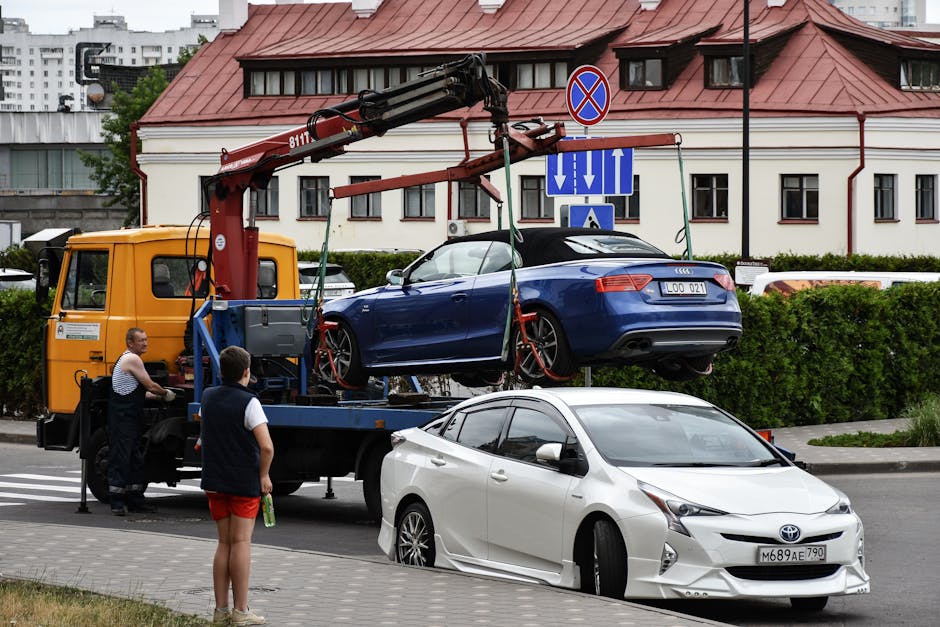
The chains were already around the rear axle when Maria Delgado stepped onto her porch in her bathrobe. It was 6:34 AM on a Tuesday. The tow truck’s hydraulic winch was whining. And a man in a reflective vest was standing in her driveway like he owned the place.
She didn’t scream. She didn’t run. She pulled out her phone, hit record, and walked directly toward the truck — barefoot, voice steady, eyes locked on the operator.
“That’s my car,” she said. “You’re on my property. Take those chains off right now.”
The operator didn’t flinch. He told her he had a work order. He told her the vehicle matched a description. He told her — and this is the part that would later ignite a firestorm online — that she could “take it up with the office.”
The 6:30 AM Confrontation: A Quiet Morning Shattered at the Driveway Gate
The video, later shared by a neighbor’s doorbell camera, captures the first ninety seconds in brutal clarity. Delgado approaches the truck. The operator — a heavyset man in his fifties — keeps his back turned, hand on the winch lever. He doesn’t stop. He doesn’t acknowledge her.
That silence is what escalates everything. Delgado’s voice stays calm, but her body language tightens. She steps between the truck and her sedan. The operator finally turns around and points a gloved finger toward the street.
“Ma’am, I’m doing my job. Step back.”
She doesn’t step back. She asks him a question that will echo through every comment section for weeks: “Who called you? Show me the paperwork.”
He reaches into his cab and produces a printed sheet. It’s a towing authorization form — but the signature line belongs to someone who doesn’t live at the address. A property management company that has no recorded lien, no HOA authority, and no legal standing over Delgado’s driveway.
“I don’t care what that paper says. That’s my car, on my land, and you are not taking it anywhere.”
The operator’s response was measured but firm: company policy. Once the chains are on, he said, the vehicle has to be transported to the impound lot. Disputes get resolved at the office, not on the driveway.
Delgado’s neighbor, a retired schoolteacher named Harold, heard the commotion and walked over. He stood at the edge of the property line, arms crossed, and started filming too. Within ten minutes, four more neighbors were on their porches. Nobody intervened physically. But nobody went back inside either.
The operator was now outnumbered by witnesses. His radio crackled. He called dispatch. The dispatch call — later obtained through a public records request — revealed something critical: the work order had been generated from a third-party complaint system, not from a verified property owner.
- Can a tow operator legally enter private property based on a third-party complaint alone?
- What does state law actually require before chains are attached to a vehicle on residential property?
- Why did the operator refuse to release the vehicle even after the homeowner presented her deed?
Where Authority Ends: The Contested Line Between Private Property and Commercial Orders
This is where the story stops being about one driveway and becomes about every driveway in America.
Towing regulations vary dramatically by state and municipality, but a few principles are nearly universal. On private residential property, a tow operator generally cannot remove a vehicle without either the property owner’s explicit request or a pre-existing written agreement — typically an HOA covenant or a posted towing sign with specific statutory language.
That sign has to meet strict requirements. It must be visible, it must include the tow company’s name and phone number, and it must state the maximum towing fee. In many jurisdictions, the sign must be posted at every entrance to the property. No sign, no tow — with very narrow exceptions for emergency vehicles or abandoned vehicles left for an extended period.
Delgado’s situation was even murkier. The property management company that filed the complaint had no recorded authority over her address. They managed a rental property two streets over. The vehicle description on the form — a silver sedan — matched roughly forty percent of the cars in the neighborhood.
So what was the operator supposed to do? From his perspective, he had a work order in hand. Company policy told him to trust the dispatch system. He wasn’t a lawyer. He wasn’t a judge. He was a guy in a truck at 6:30 in the morning trying to make a living.
But from Delgado’s perspective, a stranger was stealing her car from her own driveway based on a piece of paper that didn’t even have her name on it. And the law — at least in her state — was on her side.

Similar confrontations across the country are highlighting the fragile line between private property boundaries and commercial enforcement. Explore how related neighborhood disputes unfolded →
| INCIDENT PARAMETER | RECORDED DETAILS / ON-SCENE OBSERVATION |
|---|---|
| Location & Setting | Private Residential Driveway, Suburban Neighborhood |
| Primary Issue in Dispute | Authorization & Property Boundary Rights |
| Available Evidence | Recorded Video Exchange & Eyewitness Observations |
| Regulatory Authority | Local Municipal Codes & State Regulatory Standards |
| Duration of Standoff | Approximately 40 Minutes |
| Outcome | Chains Released After Law Enforcement Arrival |
The Stand-Off’s Turning Point: Why the Chains Were Finally Released
At 7:12 AM, a patrol car rolled up. Two officers stepped out. One approached Delgado. The other walked to the tow truck.
The conversation that followed was short. The officer asked the operator for his authorization paperwork. The operator handed over the same form he’d shown Delgado. The officer read it. Then he read it again. Then he looked at the operator and said four words that ended the standoff:
“You need to release it.”
The operator protested. He cited company policy. He said he’d get in trouble. The officer didn’t raise his voice. He simply pointed out that the form listed a property address that didn’t match the location, a complainant who wasn’t the registered owner, and a vehicle description that was too vague to establish probable cause.
“If you take that car off this property, you’re the one committing a crime. Not her.”
The operator went quiet. He walked back to the winch. The chains came off. The truck pulled away. Delgado’s sedan never moved an inch.
But the aftermath was just beginning. The video Delgado recorded — all 40 minutes of it — was uploaded that afternoon. Within 48 hours, it had been viewed over two million times. The comments split into two camps: those who saw a hardworking tow operator just following orders, and those who saw a homeowner defending her property from a system that had failed her.
Neither camp was entirely wrong. And that’s what makes this story so uncomfortable.
The tow company issued a brief statement later that week, confirming that the work order had been generated in error and that the operator had been following standard dispatch protocol. They did not apologize. They did not discipline the operator. They simply noted that the matter had been “resolved on scene.”
Delgado, for her part, installed a security camera pointed directly at her driveway. She also posted a small sign near the street — not the kind that authorizes towing, but the kind that warns anyone approaching: “Private Property. No Trespassing. Video Recording in Progress.”
Her neighbors followed suit. Within a month, six houses on the block had cameras. Two had new fences. One installed a gate.
The tow truck never came back. But the question it raised — who really controls the space in front of your own home — is still sitting in every driveway on that street, and in thousands of neighborhoods across the country.
