The Blood-Stained Fabric That Forced Times Square To Look Away No More
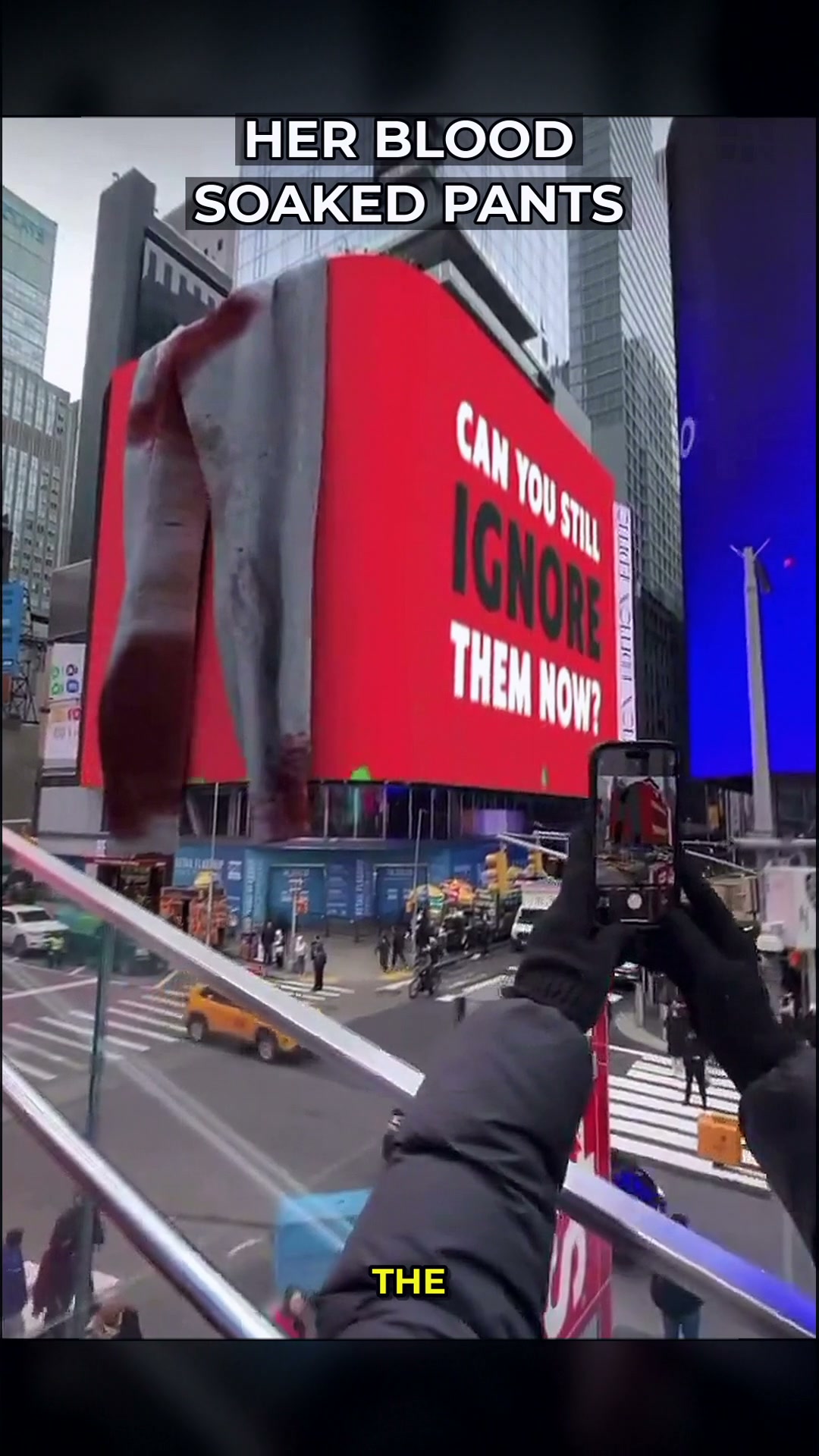
One pair of sweatpants on a glowing screen is shattering the silence around the darkest atrocities committed against women.
- The billboard uses a deeply personal artifact—Naama Levy’s clothing—to bypass political debate and confront viewers with physical evidence of gendered violence.
- The campaign responds to a perceived global indifference regarding the specific sexual atrocities committed against Israeli women on October 7th.
- Naama Levy remains a symbol of the ongoing hostage crisis, and her story is now inextricably linked to the demand for worldwide acknowledgment and accountability.
Imagine walking through the neon chaos of Times Square, dodging selfie sticks and superhero impersonators, when your gaze lands on a screen that stops you cold. It is not a movie trailer or a soda ad. It is a pair of grey sweatpants, stained deep brown with dried blood. They belonged to Naama Levy, a young woman ripped from her kibbutz and dragged into the hell of Gaza. The image is unflinching. It is raw. And it is forcing thousands of daily passersby to confront a reality that many have actively chosen to ignore.
This billboard is not just a photograph; it is a verdict. It is a public display of evidence that screams what diplomatic statements have failed to articulate: that on October 7th, the world witnessed a targeted campaign of sexual violence against women, and the response from the global community has been a deafening silence.

The Silent Epidemic of Denial
For months, the narrative surrounding the October 7th attacks has been dissected, debated, and in some circles, outright denied. But the blood on Naama’s pants is not a political opinion. It is a biological fact. The campaign organizers behind this Times Square display are using the most visceral evidence available to puncture the bubble of indifference that surrounds the victims of these specific sexual crimes.
There is a distinct discomfort when the conversation shifts from abstract conflict to the specific violation of a woman’s body. The billboard strips away the geopolitical jargon and leaves you with a single, horrifying truth: these women were hunted, degraded, and brutalized simply for being female. The lack of widespread outrage, the hesitancy to label these acts as what they were, is a betrayal that echoes louder than the initial explosions in the desert.
The choice to feature Naama Levy’s clothing is deliberate. It humanizes the statistic. She is not a number; she is a daughter, a soldier, a young woman with a life that was violently interrupted. Seeing her personal belonging, marred by her own blood, creates a connection that a text report never could. It forces the viewer to ask: “What if this was my sister? My friend?”
“The world saw the pictures of the devastation, but it refused to see the specific horror inflicted on the women. This display is about restoring the unedited truth to the center of the conversation.”

The Community That Refuses To Forget
Behind this visual protest is a community united by grief and fury. They are not just fighting for Naama’s return; they are fighting for the acknowledgment of what happened to her. In the realm of public relations, where narratives are spun and controlled, this billboard serves as a raw, unfiltered counter-narrative. It is a sign that the families of the victims have decided to take the story back from the pundits and the politicians.
This is about human resilience in the face of erasure. When the world tries to sanitize history, the families are using the most powerful tool they have: the visual truth. The sweatpants are a relic, a piece of evidence that cannot be talked away. They represent the physical suffering of a woman who is still not home, and they demand a level of accountability that has so far been absent.
The reaction to the billboard has been polarizing, which is precisely the point. It is designed to provoke a response, to force a conversation that many would rather avoid. The inconvenience of seeing such an image in a public square is nothing compared to the inconvenience of living through the reality it depicts.
The Unbearable Weight of Evidence
Why does a piece of clothing carry such potent power? Because it is proof of touch. It proves that violence was enacted upon a specific body. In legal terms, it is a piece of forensic evidence. In human terms, it is a relic of suffering. Placing it on a billboard in the most commercialized square in America is an act of defiance against the commodification of tragedy.
It forces a visceral reaction that bypasses the intellectual defenses of those who claim the events are too complex to judge. There is no complexity in a blood stain. There is only the aftermath of an action. And the action, in this case, was the brutalization of an innocent woman. The billboard asks a simple question: If you cannot condemn this, what can you condemn?
Naama Levy was seen in a video that day, her hands bound, her face bloodied, being shoved into a vehicle. She was wearing those same grey sweatpants. The image of her being paraded through the streets is etched into the memory of her nation. Now, the billboard brings that memory back to the forefront, refusing to let the world move on to the next news cycle while she remains in captivity.

The fabric of those sweatpants has become a banner for the voiceless. It represents every woman who was violated and whose story has been met with skepticism or silence. It stands for the mothers, the daughters, and the sisters who endured the unthinkable and are now denied even the justice of being believed.
As the lights of Times Square continue to flash, that one image holds steady. It is a scar on the landscape of the city, a reminder that some stains cannot be washed away by public relations campaigns or diplomatic pressure. The blood of Naama Levy is on those pants, and the burden of that truth is now on the shoulders of everyone who sees it.
She is still out there. The world is still watching. And a pair of sweatpants is screaming the truth that the world is too uncomfortable to say out loud.