Headline: Starbucks Faces Backlash Over Racial Quotas and Training Programs for Employees: What Does This Mean for Corporate Diversity and Hiring Practices?
Allegations of Racial Discrimination at Starbucks Spark National Debate
Coffee Giant Faces Accusations of Implementing Racial Quotas and Discriminatory Hiring Practices

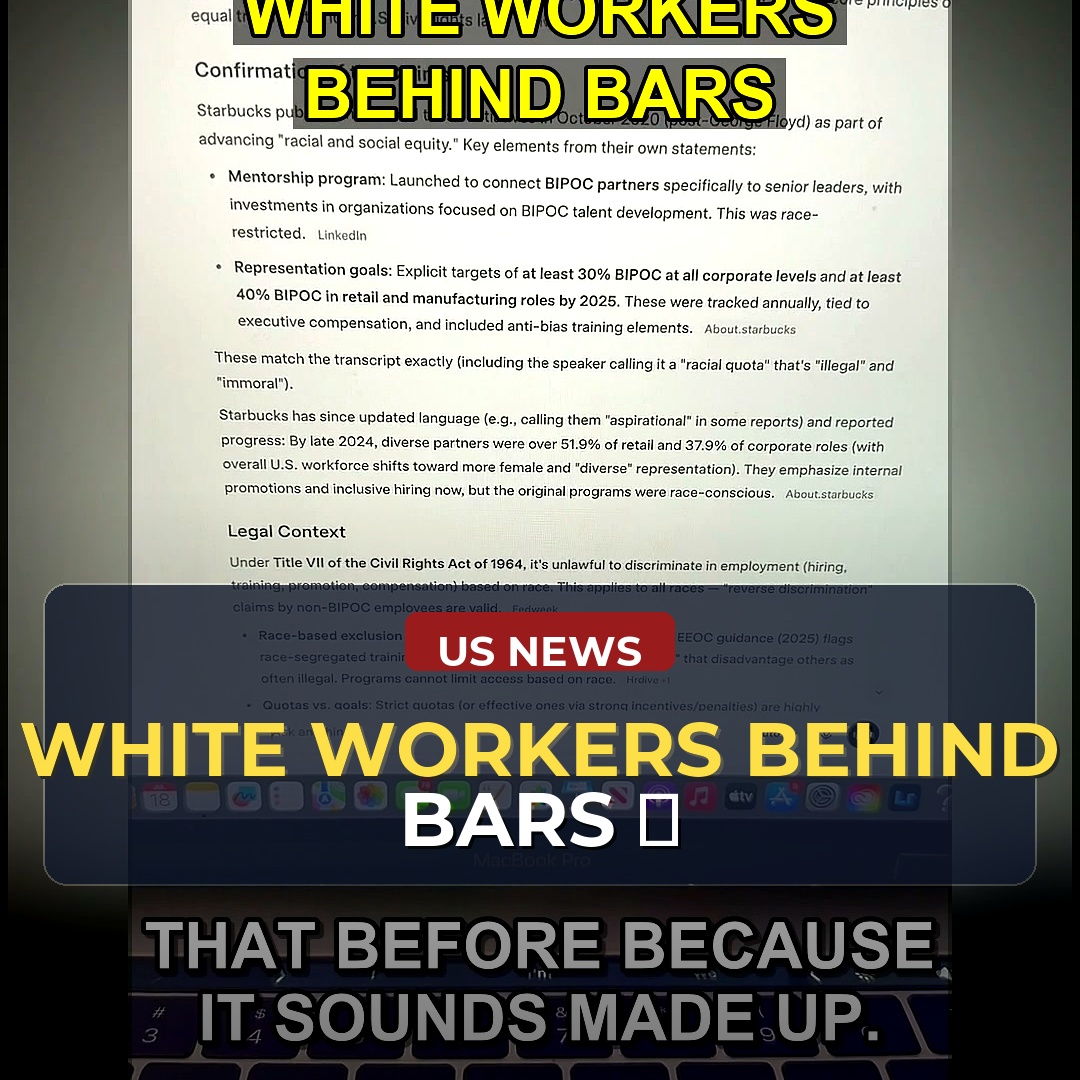
Recent allegations against Starbucks have sparked a national debate about racial discrimination and diversity in the workplace. According to reports, the company has been accused of implementing racial quotas and discriminatory hiring practices, allegedly aiming to eliminate White workers and replace them with minorities. These claims have raised concerns among Americans, with many questioning the fairness and legality of such policies.
The controversy began when it was reported that Starbucks had announced new anti-discrimination policies in October 2020, following the death of George Floyd. As part of these efforts, the company allegedly set a goal to increase diversity at its corporate levels, with a target of 30% of its workforce being people of color or Black. Additionally, the company reportedly aimed to have at least 40% of its entire workforce consist of people of color.
However, some have criticized these policies, arguing that they constitute reverse discrimination and are unfair to White employees. Others have accused the company of using a “quota system” to achieve its diversity goals, rather than considering the qualifications and merits of individual applicants. The debate has sparked a wider conversation about the role of diversity and inclusion in the workplace, with some arguing that such policies are necessary to address historical inequalities, while others see them as unfair and discriminatory.
At the heart of the controversy is the concept of “BIPOC,” which stands for Black, Indigenous, and People of Color. This term has been used by Starbucks and other companies to describe their diversity and inclusion initiatives. However, some have criticized the use of this term, arguing that it is divisive and exclusionary. Others have pointed out that the term is not widely recognized or understood, and that its use can be alienating to those who do not identify as BIPOC.
Starbucks has not publicly commented on the allegations, but the company has a history of promoting diversity and inclusion in the workplace. In recent years, the company has implemented various initiatives aimed at increasing diversity and promoting equity, including training programs and mentorship opportunities. However, the recent allegations have raised questions about the effectiveness and fairness of these initiatives, and whether they may be discriminatory towards certain groups of employees.
The controversy has also sparked a wider conversation about the role of diversity and inclusion in the workplace. Some have argued that companies like Starbucks have a responsibility to promote diversity and inclusion, and that such initiatives are necessary to address historical inequalities. Others have argued that such policies can be divisive and unfair, and that they may ultimately harm the very groups they are intended to help.

The allegations against Starbucks have also raised questions about the legal implications of such policies. Some have argued that the company’s alleged use of racial quotas and discriminatory hiring practices may be in violation of federal laws, such as the Civil Rights Act of 1964. Others have pointed out that the company’s policies may be subject to challenge under the Equal Employment Opportunity Commission (EEOC) guidelines, which prohibit employment discrimination based on race, color, national origin, sex, and religion.
As the debate continues, many Americans are left wondering about the implications of such policies for the country as a whole. Some have argued that the use of racial quotas and discriminatory hiring practices can have a divisive and damaging impact on society, while others see them as a necessary step towards achieving greater equality and fairness. Ultimately, the controversy surrounding Starbucks highlights the need for a nuanced and balanced approach to diversity and inclusion, one that promotes fairness and equality for all employees, regardless of their background or identity.
The controversy has also sparked a reaction from politicians and community leaders, with some calling for greater transparency and accountability in the company’s diversity and inclusion initiatives. Others have argued that the allegations against Starbucks are part of a broader pattern of discrimination and inequality in the workplace, and that more needs to be done to address these issues.
As the national debate continues, it remains to be seen how Starbucks will respond to the allegations and what steps the company will take to address the concerns of its employees and customers. One thing is certain, however: the controversy surrounding Starbucks has highlighted the need for a more nuanced and balanced approach to diversity and inclusion, one that promotes fairness and equality for all.

In conclusion, the allegations against Starbucks have sparked a national debate about racial discrimination and diversity in the workplace. While some have argued that the company’s policies are necessary to address historical inequalities, others have criticized them as divisive and unfair. As the controversy continues, it is clear that the issue of diversity and inclusion in the workplace is complex and multifaceted, and that more needs to be done to promote fairness and equality for all employees, regardless of their background or identity.
The debate surrounding Starbucks serves as a reminder that diversity and inclusion are not just moral imperatives, but also essential components of a fair and equitable society. As Americans, we must continue to strive for a workplace that is inclusive and fair, where all employees have an equal opportunity to succeed and thrive. By promoting diversity and inclusion, we can build a stronger, more equitable society, where everyone has the chance to reach their full potential.
Ultimately, the controversy surrounding Starbucks is a call to action, a reminder that we must continue to work towards a more just and equitable society. By engaging in open and honest dialogue, and by promoting fairness and equality in all aspects of our lives, we can build a brighter future for ourselves and for generations to come.